
In the world of language learning, we spend months mastering long-form essays and formal emails. But in 2026, the real business world moves at the speed of a thumb-tap.
Understanding SMS meaning (Short Message Service) isn’t just about knowing the technical definition; it’s about mastering the art of “Action-Oriented English.” Whether you are communicating with a client in Kuala Lumpur or a colleague in London, the ability to be brief is a high-level professional skill.
What is “Micro-English”?
Micro-English is the backbone of modern digital communication. It is where grammar takes a backseat to speed, clarity, and brevity. While textbooks teach you to say:
“I am writing to inform you that I have arrived at the location for our scheduled meeting.”
A pro using Micro-English simply texts:
“At lobby now. See you soon!”
The 3 Pillars of Professional SMS Style
To rank your communication skills as “Advanced,” you need to understand the three distinct styles of professional messaging.
1. The Transactional Style (Noun-Heavy)
Common in automated alerts (OTPs, banking, and shipping), this style uses precise nouns and eliminates unnecessary “fluff” like pronouns.
- The Structure: [Subject] + [Status] + [Time/Place].
- Example: “Your parcel is out for delivery. Expected ETA: 2-6 p.m..”
- Learner Tip: Pay attention to prepositions. In SMS, “at,” “on,” and “by” do the heavy lifting.
2. The Promotional Style (The Persuader)
Used in marketing to drive immediate action. It relies heavily on imperative verbs (command words).
- Key Words: Hurry, Claim, Shop, Verify, Update.
- Example: “Flash Sale! 50% off. Shop now at Read app.”
3. The Functional Style (The “Action” Update)
This is what you use with colleagues or service providers (like Grab drivers or delivery agents).
- The Structure: Dropping the “I” or “Am” to save space.
- Example: “Heading over now. 5 mins away.” (Instead of “I am heading over now.”)
SMS vs. Instant Messaging: Know the Difference
Even in a world dominated by WhatsApp and Telegram, the “SMS meaning” for business remains distinct. Use this table to decide which channel to use.
| Feature | SMS (Short Message Service) | IM (WhatsApp / Telegram) |
| Connectivity | No Internet required (Cellular) | Requires Data/Wi-Fi |
| Professionalism (Typical Perception) | SMS is often used for official alerts/OTPs | IM apps are common for ongoing conversations and team chats. (Expectations vary by company and country.) |
| Character Limit | Strict (160 characters, including spaces) | Virtually unlimited |
| Primary Use | High-priority, urgent alerts | Conversations and media sharing |
Note: If your text includes characters that require Unicode (UCS-2), often the case for Chinese characters, special symbols and many emoji, the per-segment limit usually drops from 160 to 70.
Why Every English Learner Should Practice “SMS English”
If you can communicate effectively in under 160 characters, you can communicate anywhere. Here’s why this format improves your fluency:
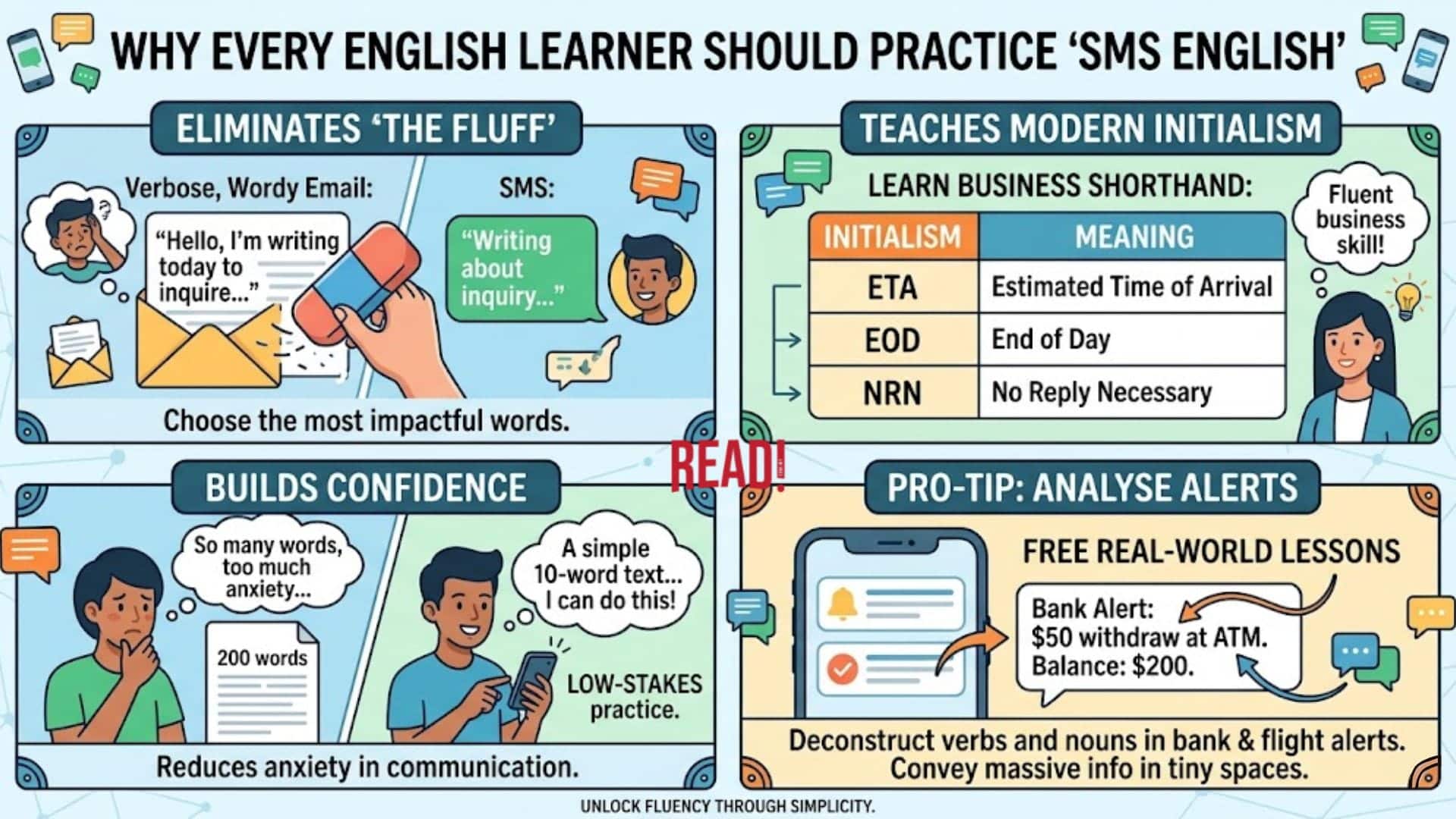
- Eliminates “The Fluff”: It forces you to choose the most impactful words.
- Teaches Modern Initialism: You’ll learn essential business shorthand like ETA (Estimated Time of Arrival), EOD (End of Day), and NRN (No Reply Necessary).
- Builds Confidence: Sending a 10-word text is a “low-stakes” way to practice active communication without the anxiety of a 200-word email.
Pro-Tip: Don’t delete your automated bank or flight alerts. These are free, real-world English lessons. Analyse how they use verbs and nouns to convey massive amounts of info in tiny spaces.
Localisation: SMS in Southeast Asia
In markets like Malaysia, the “SMS meaning” is often multilingual. Local providers (for example, SMS by Anchor and iSMS) offer bulk SMS tools that let businesses send campaigns in multiple languages, including English mixed with Malay or Chinese.
For a language learner, observing how these messages are “localised” (for example, using “Jom” in a promotional text) is a masterclass in how language adapts to culture.
Conclusion: Text Your Way to Fluency
Understanding the SMS meaning is about more than just knowing what the letters stand for; it is about mastering the art of concise, effective communication. In a world that moves faster than ever, being able to convey a clear message in just a few words is a vital skill for any English learner.
As you navigate real-world English, you’ll find that these “micro-conversations” happen everywhere from business alerts to catching up with friends. While textbooks give you the foundation, practicing with modern, everyday formats like SMS makes your fluency feel natural and up-to-date.
Exploring dedicated language learning resources can help you bridge that gap, turning simple text habits into professional-level communication skills. Start paying attention to the messages in your inbox, they are your daily invitation to practice.