

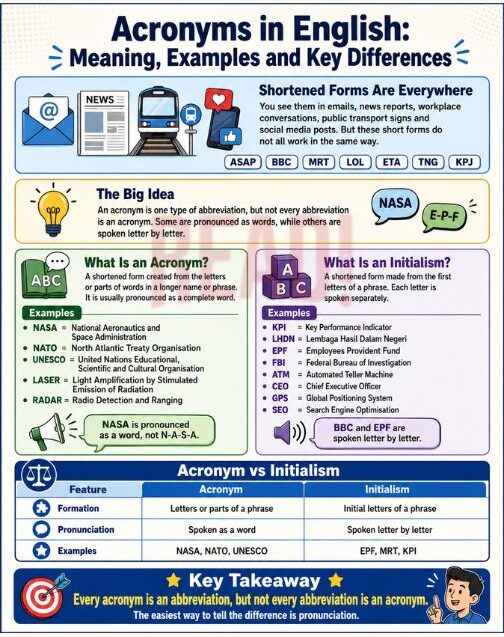
You see shortened forms everywhere in English. They appear in emails, news reports, workplace conversations, public transport signs and social media posts. However, these short forms do not all work in the same way.
ASAP, NASA, FAMA, LOL, FRIM, FELDA
But in English grammar, these short forms are not all the same.
An acronym is one type of abbreviation, but not every abbreviation is an acronym. Some are pronounced as words, while others are spoken letter by letter.
If you are still building the foundation, our guide on abbreviations in English explains how different shortened forms work before moving into specific types like acronyms.
This article focuses on how acronyms work, how they differ from initialisms, and how they are used in real-world English.
What is an Acronym?
An acronym is a shortened form created from the letters or parts of words in a longer name or phrase. It is usually pronounced as a complete word.
Common examples of acronyms include:
- NASA: National Aeronautics and Space Administration
- NATO: North Atlantic Treaty Organisation
- UNESCO: United Nations Educational, Scientific and Cultural Organisation
- LASER: Light Amplification by Stimulated Emission of Radiation
- RADAR: Radio Detection and Ranging
- FELDA: Federal Land Development Authority
- FRIM: Forest Research Institute of Malaysia
These are spoken as words rather than pronounced one letter at a time.
For example, NASA is pronounced “nasa,” not “N-A-S-A.”
Why Do People Confuse Acronyms with Initialisms?
An initialism is also formed from the first letters of a phrase. The difference is in pronunciation: each letter is spoken separately.
Common examples of initialisms:
- KPI (Key Performance Indicator)
- LHDN (Lembaga Hasil Dalam Negeri)
- EPF (Employees Provident Fund)
- FBI: Federal Bureau of Investigation
- ATM: Automated Teller Machine
- CEO: Chief Executive Officer
- GPS: Global Positioning System
- SEO: Search Engine Optimisation
CEO is pronounced “C-E-O, rather than “C-oh” or “Seh-o”.
This difference in pronunciation is the easiest way to distinguish an acronym from an initialism.
Acronym vs Abbreviation: What’s the Difference?
If you’ve already read our guide to abbreviations, think of an acronym as one specific type of abbreviation. The key difference isn’t how it’s written, it’s how it’s pronounced.
Feature | Acronym | Initialism |
Formation | Letters or parts of a phrase | Initial letters of a phrase |
Pronunciation | Spoken as a word | Spoken letter by letter |
Examples | NASA, NATO, UNESCO | EPF, MRT, KPI |
Simple examples in context
- NASA is an acronym because it is pronounced as a single word.
- EPF is an initialism because each letter is spoken separately.
The broad relationship is simple:
Every acronym is an abbreviation, but not every abbreviation is an acronym.
Can Pronunciation Change the Classification?
In some cases, the classification depends on how a person pronounces the shortened form.
Take ASAP as an example.
Some people pronounce it letter by letter:
A-S-A-P
Others pronounce it as a word:
“Ay-sap”
When it is spoken letter by letter, it behaves like an initialism. When it is spoken as a single unit, it functions more like an acronym.
A similar variation can be seen with LOL. Some people say each letter, while others pronounce it as a single word or simply interpret it as “laughing out loud” in context.
Because pronunciation can differ, some shortened forms do not fit neatly into only one category.
How Are Acronyms Formed?
Acronyms are often created from the first letters of important words in a name or phrase.
For example: North Atlantic Treaty Organisation → NATO
In many cases, smaller connecting words such as “of,” “and,” or “the” are left out.
For example: Malaysian Electronic Payment Systems → MEPS
The goal is usually to create a shorter, more practical form that is easier to say and remember in everyday communication.
Some acronyms may also take more than one letter from a word or adjust spelling slightly to make pronunciation smoother.
Why Are Acronyms Used in English?
Acronyms make long names and repeated phrases easier to use, make communication faster and more efficient.
Instead of repeating long names such as: Association of Southeast Asian Nations
people commonly use: ASEAN
In the same way, everyday communication in Malaysia often relies on shortened forms such as:
- MIDA (Malaysian Industrial Development Authority)
- MITI (Ministry of International Trade and Industry)
- PETRONAS (Petroliam Nasional Berhad)
- PIKOM (Persatuan Industri Komputer Malaysia/ Computer Industry Association of Malaysia)
- SIRIM (Standards and Industrial Research Institute of Malaysia)
Acronyms help by:
- reducing repetition
- saving time in speech and writing
- making long names easier to recognise
- improving readability in reports, signs, and digital systems
However, acronyms do not always improve clarity. If the reader is unfamiliar with what an acronym means, it can make a sentence more difficult to understand.
In formal writing, it is usually best to write the full term the first time it appears, followed by the acronym in brackets.
Where Are Acronyms and Initialisms Used?
Acronyms and initialisms appear across many areas of daily life in Malaysia and global English usage.
Context | Examples |
Government and public services |
|
Science and technology |
|
Business and work |
|
Transport and travel |
|
Education |
|
Quiz: Can you identify which terms in the table are acronyms and which are initialisms?
What Acronym Short Forms Are Common in Gen Z Communication?
Digital communication has made short forms more visible in informal English.
Many expressions associated with Gen Z communication existed before Gen Z, but they remain widely used on social media, messaging apps and online platforms.
Common examples include:
- LOL: Laughing Out Loud
- YOLO: You Only Live Once
- SCUBA: Self-Contained Underwater Breathing Apparatus
- AIDS: Acquired Immunodeficiency Syndrome
- FOMO: Fear of Missing Out
- GIF: Graphics Interchange Format
These forms are useful for speed and tone but are generally more suitable for informal communication than academic or professional writing.
Should Acronyms Be Written in Capital Letters?
Most acronyms are written in capital letters when they are still clearly recognised as shortened forms.
Examples include:
- NATO
- UNESCO
However, some acronyms eventually become ordinary words and are written in lowercase.
Examples include:
- laser
- radar
- scuba
These words began as acronyms but became common vocabulary over time.
5 Common Mistakes When Using Acronyms
1. Assuming everyone knows the acronym
Just because an acronym is familiar to you doesn’t mean your reader will recognise it.
For example, someone working in healthcare may instantly understand AIDS, while someone outside the industry may not.
2. Using too many acronyms in one sentence
Acronyms save space, but they can also slow readers down if there are too many.
“My FOMO kicked in when I saw their POV video, so I literally shouted LOL and decided to go to the concert after all.”
If your audience understands these terms, the sentence is efficient. If not, it becomes difficult to follow.
A good rule is to use only the acronyms your readers are likely to recognise.
3. Confusing local acronyms with international ones
Some acronyms are widely recognised around the world, while others are mainly understood in one country or industry.
For example:
- ASEAN (Association of Southeast Asian Nations) is instantly recognisable across Southeast Asia
- MARA (Majlis Amanah Rakyat) is well known institutional acronym in Malaysia but may be unfamiliar to overseas readers.
If you’re writing for an international audience, consider explaining local acronyms the first time they appear.
4. Using chat acronyms in professional writing
Social media has introduced hundreds of informal acronyms, but they don’t always belong in the workplace.
Examples include:
- FOMO
- YOLO
These work well in conversations or online posts but can make business writing feel too casual. Choose acronyms that match the purpose and audience of your writing.
5. Forgetting that some acronyms become ordinary words
Not every acronym stays in capital letters forever.
Words like laser, radar and scuba began as acronyms but are now treated as standard English words.
This is why you may not even realise you’re using an acronym.
Section Summary
Learners usually misunderstand acronyms and initialisms by relying on capital letters instead of pronunciation, overusing internal short forms, and ignoring audience context. In practice, clarity depends on how widely a term is understood and whether it suits the communication setting, not on whether it is technically an acronym or initialism.