

What is NLP? Neuro-Linguistic Programming Explained

Facebook
LinkedIn
Twitter
WhatsApp
Email
Table of Contents
Close up scene of headset demo used by a programmer to do testing on NLP

You may have heard NLP mentioned in coaching, communication courses, leadership training or personal development.

In this context, NLP stands for Neuro-Linguistic Programming. It is an approach that looks at connections between communication, patterns of thinking and behaviour.

Supporters and practitioners use different techniques to examine how people communicate and respond to situations. However, NLP should not be confused with neuroscience, academic psychology or medical therapy.

There is also another common meaning of NLP: Natural Language Processing, a field of artificial intelligence concerned with how computers work with human language. That is not the NLP discussed in this article.

Key Takeaways

  • NLP stands for Neuro-Linguistic Programming, an approach associated with communication, behaviour and personal development.
  • NLP training may include listening, questioning, rapport, framing and goal-setting exercises.
  • NLP is used in some workplace training, including leadership, sales, presentations, negotiation and coaching.
  • NLP is not an established neuroscience or a medical or psychological treatment.
  • Many broader claims associated with NLP are not strongly supported by scientific evidence.

What Does NLP Stand For?

Practitioners generally use these three words to describe three different parts of the approach. Tap each card below to see what it means in practice.

Neuro

Refers broadly to how people experience and process information.

Example: Two employees sit through the same meeting but remember completely different things, one focuses on what was said, the other on how people reacted.

Note: "Neuro" here doesn't mean NLP is scientifically validated neuroscience.

Linguistic

Refers to language and communication, the words we choose, the questions we ask, and how we describe situations.

Example: "This project is impossible" vs. "What would need to change to make this project possible?" Same project, very different direction.

Programming

Refers to patterns or habits in how people think and behave.

Example: Someone gets nervous every time they present to senior management. An NLP exercise might help them notice that pattern and practise responding differently.

Note: "Programming" is a metaphor, people aren't literally programmed like computers.

What is Neuro-Linguistic Programming

NLP is generally described as an approach to communication and personal development that looks at patterns in language, thought and behaviour. It was developed in the 1970s and is associated with Richard Bandler and John Grinder, and it’s since found its way into coaching, communication training and professional development, though the three aren’t quite the same thing, as we break down in NLP vs. coaching vs. communication training. Rather than focusing only on what someone says, NLP also looks at how they say it.

Here’s a common example: a manager tells an employee, “You need to communicate better.” That’s vague, so an NLP-style approach might turn it into sharper questions instead: What does “better communication” actually mean here?

  • Who needs more information?
  • When does communication break down?
  • What would success actually look like?

The aim is turning a vague problem into something specific and actionable, a good chunk of what all of NLP’s communication tools are really doing. Curious how this plays out in writing too? Our breakdown of common corporate email phrases and what they actually mean covers the same idea applied to inbox language.

Worth being upfront about: This doesn’t mean NLP as a whole has been scientifically validated. A systematic review published in the British Journal of General Practice found little evidence that NLP interventions improve health-related outcomes, and noted the available research was limited in both quantity and quality. So it’s more accurate to think of NLP as a communication and personal-development approach, not established psychological or neurological science.

How is NLP Used in Communication?

Communication is one of the main areas in which NLP techniques are taught.

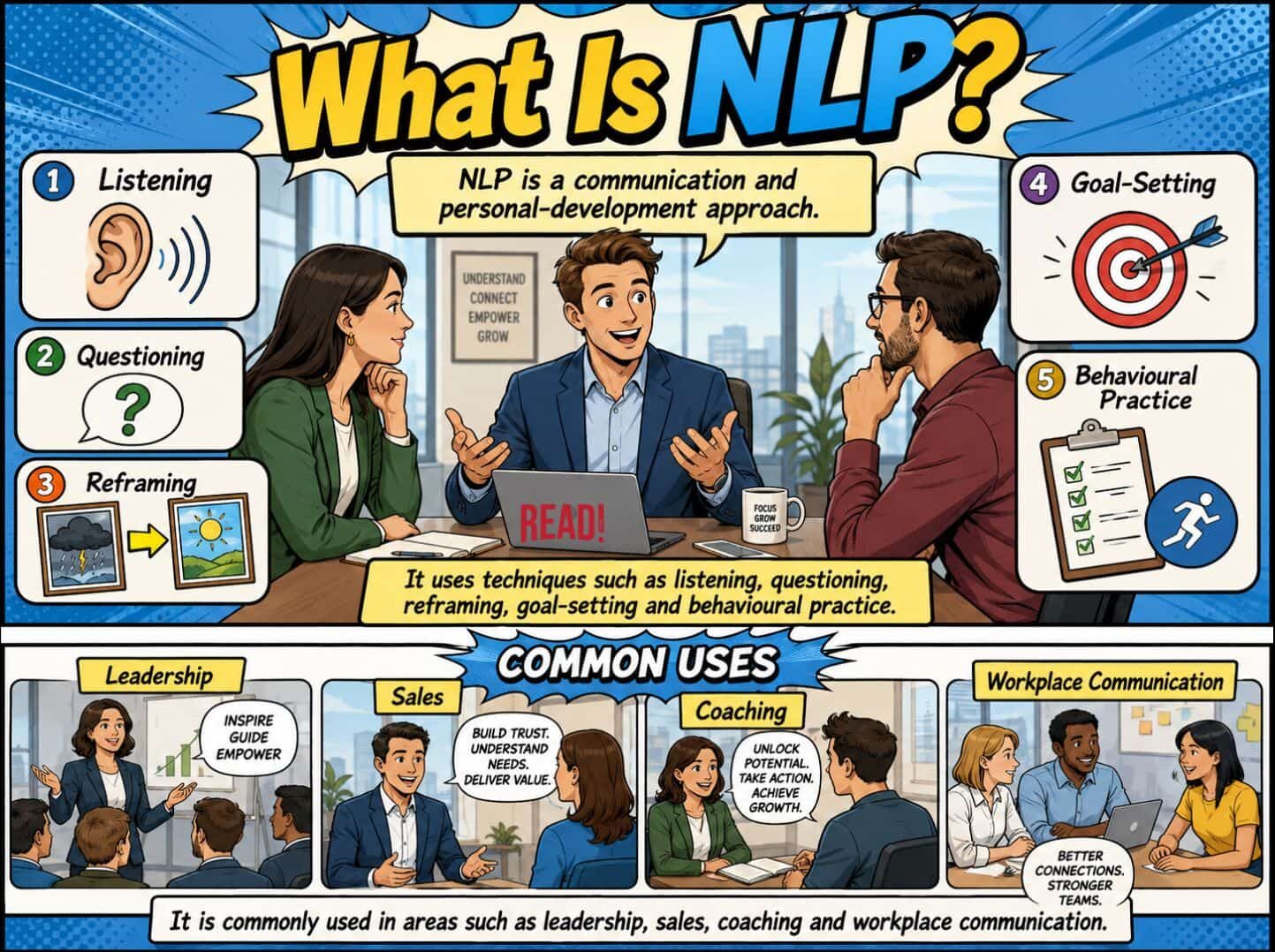
Listening

NLP training may encourage participants to listen more carefully instead of immediately preparing their own response.

If an employee says:

“I’m not sure what I’m supposed to prioritise.”

a manager could ask for clarification rather than making assumptions.

Questioning

Questions can help make unclear statements more specific.

For example: “Everyone hates this new system.”

could be followed with:

“Who specifically has given you negative feedback?”

The second question encourages a more precise discussion.

Rapport

Rapport means creating a comfortable and cooperative relationship with another person. NLP courses may encourage participants to pay attention to communication style, tone, pace and body language. The aim should not be to copy someone or assume their thoughts can be read from their behaviour. Instead, the practical focus is usually on becoming more aware of how your own communication affects the interaction.

Framing

Framing refers to the way a situation is presented.

For example: “We failed to reach the target.” could also be discussed as:

“We reached 85% of the target. What stopped us from reaching the remaining 15%?”

The facts are the same, but the second version directs attention towards problem-solving.Illustration image explaining what is NLP by read.com.my
What Can NLP Training Involve?

There is no single universal NLP course. Course structures and certification requirements can vary between trainers and organisations. Common activities may include:

Communication Exercises

Participants may practise conversations, questioning techniques and ways of explaining ideas more clearly.

Observation

Some exercises focus on word choice, tone, pauses, facial expressions or body language. These observations should not be treated as reliable methods for “reading” another person’s thoughts.

Language Patterns

Participants may explore how wording can influence a conversation.

For example: “Why can’t you finish this?”

compared with:

“What is preventing you from finishing this?”

The second version may encourage the person to identify a specific obstacle.

Goal Setting

Some NLP exercises encourage people to make goals more specific.

Instead of:

“I want to become a better presenter.”

a participant might say:

“I want to deliver a 10-minute presentation confidently without reading directly from my slides.”

Behavioural Practice

Participants may role-play workplace situations such as negotiations, presentations, sales conversations or difficult discussions.


Quick Recap

Neuro = how we process experience. Linguistic = the language we use. Programming = our behavioural habits. Put together, NLP looks at how these three connect.

How is NLP Used in the Workplace?

NLP training is offered in professional-development settings such as communication, leadership, sales and coaching.

Workplace AreaHow NLP-Style Training May Be Used
LeadershipPractising clearer communication and questioning
SalesExploring customer concerns and practising conversations
PresentationsPractising communication habits and audience engagement
Team CommunicationRecognising different communication preferences
NegotiationAsking questions and reframing discussions
CoachingHelping people clarify goals and possible actions

These examples describe how NLP-style training may be applied rather than scientifically proven outcomes. For example, practising clearer questions may help structure a performance discussion. That does not prove the improvement came from a scientifically validated NLP theory. If you deal with clients regularly, our Corporate Communication Guide for Malaysia’s Service Sector walks through the phrasing and tone expected at each stage of a client relationship, a good practical companion to the workplace scenarios above.

What is an NLP Practitioner?

An NLP Practitioner is generally someone who has completed a training programme covering a particular set of NLP concepts and techniques. You may also see titles such as:

  • NLP Practitioner
  • NLP Master Practitioner
  • NLP Coach
  • NLP Trainer

NLP Practitioner training is generally positioned as the first substantial level of certification within the NLP training industry. Master Practitioner training usually follows Practitioner-level training and explores NLP concepts and techniques in greater depth. However, an NLP certification should not automatically be treated as equivalent to a regulated healthcare, psychology or other professionally licensed qualification. Course standards, assessment methods and certification requirements vary between organisations.

What Should You Check Before Taking NLP Training?

If you are considering NLP training, look beyond the course name, look into: Certification body: which organisation issues or recognises it, and what the certificate actually represents

  • Trainer background: real experience and qualifications, not just a list of titles
  • Course duration: how much time actually goes to live instruction, exercises, and assessment
  • Practical training: demonstrations, role-play, and feedback, not just lectures
  • Support after training: follow-up sessions, practice groups, or ongoing materials
  • Corporate vs. individual focus: some courses are built for personal development, others for managers, sales teams, or coaches. The best option depends on what you actually want to learn.

Using Neuro-Linguistic Programming for Self-Development

Neuro-Linguistic Programming, or NLP, is an approach commonly associated with communication, behaviour and personal development. NLP training may involve listening, questioning, language patterns, goal setting, observation and behavioural practice. It is also offered in areas such as leadership, sales, coaching and workplace communication. At the same time, NLP should not be treated as established neuroscience, psychological science or a replacement for professional healthcare. Scientific evidence supporting many of its broader claims remains limited. If you’re considering formal NLP training, understanding what the programme actually involves is an important first step. Curious how it actually differs from coaching or communication training? See the comparison here. Or if you’re ready to compare real providers, check out our roundup of licensed NLP training programs in Malaysia.

Quiz: Spotting the Reframe

One of NLP's most practical tools is reframing, saying the same thing in a way that opens up a conversation instead of shutting it down. Here are a few real examples. Try guessing the reframe before you tap to reveal it.

"Everyone hates this new system."
"Who specifically has given you negative feedback?", swaps a sweeping generalisation for something you can actually act on.
"We failed to reach the target."
"We reached 85% of the target, what stopped us from reaching the remaining 15%?" Same facts, but attention shifts toward solving the gap instead of dwelling on it.
"Why can't you finish this?"
"What is preventing you from finishing this?", less accusatory, and more likely to actually surface the real obstacle.

Quick Recap

Reframing keeps the same facts but changes the direction of the conversation, usually from blame or vagueness toward something specific you can act on.

Conclusion

NLP isn’t a magic trick, and it isn’t neuroscience either, it’s a set of communication habits built around noticing patterns, asking sharper questions, and reframing how things are said. Some of that is genuinely useful, some of it is oversold, and the honest answer is usually somewhere in between.

If nothing else, the reframing exercises above are worth trying the next time you catch yourself using a vague or negative phrase at work. Small shifts in how you ask a question often do more for a conversation than any framework label attached to it.

Communication skills like these tie closely into how we pick up language in general, and if you’re working on your own English alongside this, our online learning resources cover the same kind of practical, everyday techniques.

FAQs About Neuro-Linguistic Programming

What is NLP used for?

NLP training is offered in communication, coaching and personal-development settings. Workplace programmes may also apply NLP-style exercises to leadership, sales, negotiation and presentations.

Is NLP a form of psychology?

NLP draws on ideas about communication and behaviour, but it is not the same as academic psychology or established psychological science.

Is NLP the same as natural language processing?

No. Neuro-Linguistic Programming and Natural Language Processing share the abbreviation NLP, but they are completely different. Natural Language Processing is a field of artificial intelligence and computer science concerned with how computers process and work with human language.

What does an NLP practitioner do?

An NLP Practitioner is generally someone who has completed training in NLP concepts and techniques. They may use them in coaching, communication training or personal development.

Is NLP training worth taking?

It depends on your goals and the quality of the programme. Before enrolling, check the trainer, course structure, practical components, certification body and whether the programme matches what you want to learn.

Related Post