
What is Communication Training?
Communication training teaches practical skills for communicating more effectively with other people.
It is commonly used in workplaces because communication affects almost every part of professional life, from meetings and presentations to customer conversations and team discussions. For professionals who want to communicate more confidently in English at work, Business English training can be a useful part of this development.
A communication course might cover:
- Speaking: Expressing ideas clearly and confidently.
- Listening: Paying attention, clarifying information and understanding another person’s perspective.
- Workplace interaction: Communicating with colleagues, managers, customers and stakeholders.
- Presentations: Structuring information and delivering it effectively to an audience.
- Feedback: Giving and receiving constructive feedback professionally.
Some programmes may also include negotiation, conflict management, business writing or interpersonal communication.
The important point is that communication training usually focuses on skills you can apply directly in specific situations.
For example, someone who regularly struggles to explain ideas during meetings may benefit more from practical communication training than from a broader personal-development programme.
What is Coaching?
Coaching is a goal-oriented development process that helps a person think through challenges, identify goals and decide on actions.
Rather than simply teaching someone what to do, a coach will often use questions and structured conversations to encourage reflection.
A typical coaching process may involve:
- Defining a goal.
- Understanding the current situation.
- Identifying obstacles.
- Exploring possible approaches.
- Agreeing on actions.
- Reviewing progress over time.
Accountability may also form part of the process, with the coach helping the participant review commitments and evaluate what is or isn’t working.
Coaching can take place individually or in groups. In a professional setting, you may encounter terms such as executive coaching, leadership coaching, career coaching or performance coaching.
The specific methods used depend heavily on the coach and the coaching framework.
What is NLP Training?
NLP (Neuro-Linguistic Programming) is a personal-development methodology that explores communication, language patterns and behaviour. If you’re looking for a more detailed explanation, see our guide on what NLP is and how it works.
NLP training typically focuses on practical techniques such as:
- Communication and language patterns.
- Behavioural modelling.
- Rapport building.
- Goal-setting and reframing.
- Questioning techniques
- Observation of verbal and non-verbal behaviour.
Many NLP courses are presented as practical and may include individual, paired or group exercises, although formats vary between providers.
It’s important to note that NLP is a personal-development methodology rather than an established branch of psychology or neuroscience. Research has found limited support for some NLP-specific claims and techniques, so it should not be presented as an evidence-based psychological or neuroscientific framework.
Training content and certification standards can also vary between providers, so it’s worth reviewing the specific programme before enrolling.
NLP vs Coaching vs Communication Training: What’s the Difference?
The easiest way to compare the three is to look at their main objectives.
The examples below are broad rather than universal, as course formats, audiences and methods vary between providers.
NLP Training | Coaching | Communication Training | |
Main Focus | NLP communication and behavioural techniques | Goals and development | Communication skills |
Typical Format | Workshops and practical exercises, depending on provider | Individual or group sessions | Classes and workshops |
Common Audience | Varies by programme; may include professionals, coaches and trainers | Leaders, professionals and other coaching clients | Employees and professionals |
Typical Activities | May include language exercises, modelling, observation and reframing | Questions, reflection, action planning and progress review | Speaking, listening, presentations and workplace exercises |
Certification | Provider-specific | Depends on the credential or professional body | Depends on provider |
There can still be considerable overlap.
For instance, a coach might use communication techniques while working with clients. A leadership communication course might incorporate coaching exercises. Some NLP practitioners may also work professionally as coaches or trainers.
The label alone therefore doesn’t tell you everything about a programme. The syllabus, trainer, evidence base and learning outcomes matter more.
Which Type of Training Might Suit You?
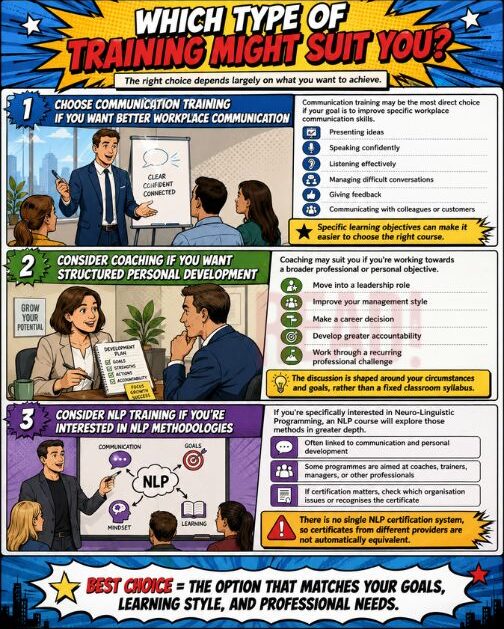
The right choice depends largely on what you want to achieve.
Choose Communication Training If You Want Better Workplace Communication
Communication training may be the most direct choice if your main goal is to improve skills such as:
- Presenting ideas.
- Speaking confidently.
- Listening effectively.
- Managing difficult conversations.
- Giving feedback.
- Communicating with colleagues or customers.
Because the learning objectives are usually quite specific, it can also be easier to identify whether a course addresses the skill you need.
Consider Coaching If You Want Structured Personal Development
Coaching may suit you if you’re working towards a broader professional or personal objective.
For example, you might want to:
- Move into a leadership role.
- Improve your management style.
- Make a career decision.
- Develop greater accountability.
- Work through a recurring professional challenge.
Instead of following a fixed classroom syllabus, the discussion may be shaped around your circumstances and goals.
Consider NLP Training If You’re Interested in NLP Methodologies
If you’re specifically interested in Neuro-Linguistic Programming, then an NLP course will naturally explore those methods in greater depth.
NLP courses are commonly marketed around communication and personal development, and some programmes are aimed at coaches, trainers, managers or other professionals.
If certification matters to you, check exactly which organisation issues or recognises the certificate.
There is no single NLP certification system that automatically makes certificates from different providers equivalent.
What Questions Should You Ask Before Paying for a Course?
Training courses can require a significant investment of both time and money, so it’s worth looking beyond the course title.
Ask the provider:
Who Certifies the Programme?
Find out whether certification is issued directly by the training company or through another professional or accreditation organisation.
Different types of certification can have very different meanings. A provider’s certificate of completion, a professional-body credential and a formally accredited educational qualification are not necessarily equivalent.
If you need the qualification for employment or professional purposes, check whether the relevant employer, professional body or organisation recognises it.
In Malaysia, formal accredited qualifications can also be checked through the Malaysian Qualifications Register where applicable.
Who is the Trainer?
Look at the trainer’s actual experience, qualifications and professional background.
A long list of course titles is less useful than understanding what experience the trainer has applying the subject in real situations.
How Much Practical Work is Included?
Communication and coaching-related skills usually require practice.
Ask whether the programme includes exercises, demonstrations, role-playing, feedback or supervised practice rather than relying mainly on lectures.
How Long is the Programme?
A short introductory workshop and a multi-day certification programme serve very different purposes.
Make sure the duration matches the depth of knowledge you’re expecting.
Is the Certification Recognised by the Relevant Organisation?
“Certified” doesn’t automatically mean universally recognised.
Check who issues the certificate, what standards participants must meet and whether the organisation that matters for your career or professional development accepts it.
For coaching, for example, professional bodies such as the International Coaching Federation operate their own accreditation and credential requirements. Other training programmes may use entirely different systems.
Is It Suitable for Corporate Use?
If you’re choosing training for employees, consider whether the programme connects clearly with workplace situations.
Ask whether the trainer can adapt examples, exercises and learning outcomes to areas such as leadership, customer service, management or team communication.
Understanding The Differences
NLP, coaching and communication training all sit within the wider landscape of personal and professional development, but they approach that development differently.
Communication training focuses mainly on practical communication skills. Coaching focuses on helping people work towards goals through reflection, action planning and progress review. NLP training explores a particular set of communication, language and behavioural techniques associated with Neuro-Linguistic Programming.
None of these labels alone guarantees that a programme will suit you. Look closely at what is actually taught, how much practice is included, who delivers the course, what evidence supports the methods used and whether the training supports the outcome you want.
If NLP is the approach you’re interested in, the next step is to compare the training providers, certification structures and course formats available in Malaysia.