
What is a Semiconductor? A Simple Guide to Chips, Manufacturing and Malaysia

Facebook
LinkedIn
Twitter
WhatsApp
Email
Table of Contents
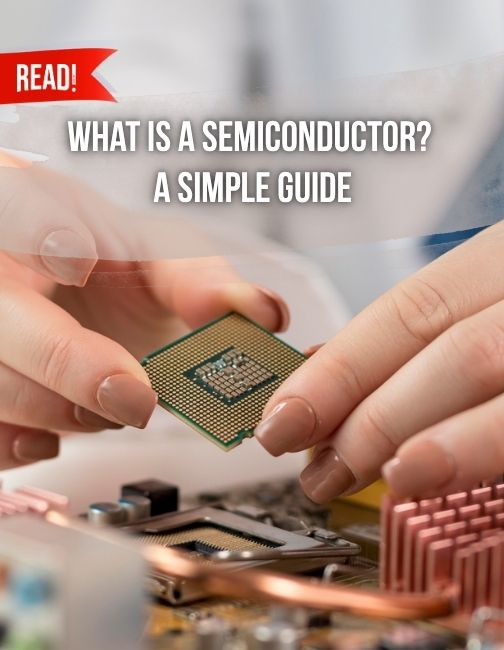
A close up to hands holding chips made by semiconductor

A

semiconductor is a material that can control the flow of electricity, making it the foundation of the microchips used in smartphones, cars, computers, industrial machinery and countless other electronic products.

Tiny as they are, semiconductors sit at the centre of some of the world’s largest industries. Semiconductors are used in many products we rely on every day, from smartphones and computers to cars, medical equipment and industrial machines. When chip supplies tighten, the impact can quickly spread from electronics factories to automotive production lines and other downstream industries.

For Malaysia, the semiconductor industry is also an important part of the country’s electrical and electronics (E&E) sector. Malaysia has built a long-standing manufacturing base in areas such as assembly, packaging and testing, while government policy is now placing more attention on activities such as IC design, advanced packaging and semiconductor manufacturing equipment.

Key Takeaways

  • Semiconductor is a material with electrical properties that can be controlled.
  • Chips and integrated circuits are electronic devices made using semiconductor technology.
  • Semiconductor production involves many stages, including design, fabrication, packaging and testing.
  • The industry is capital-intensive and depends on a highly specialised global supply chain.
  • Understanding semiconductor vocabulary can be useful for anyone working in business, manufacturing, technology or investment.

What Exactly is a Semiconductor?

A semiconductor is a material that has electrical conductivity between that of a conductor and an insulator.

Copper is a good conductor because electricity can flow through it easily. Rubber is an insulator because it resists the flow of electricity.

Materials such as silicon can be engineered to control how electricity moves. This property makes them useful for creating electronic switches called transistors.

Billions of transistors can be placed on a small piece of semiconductor material. Together, they can perform calculations and process information.

Semiconductor vs. Chip: What’s the Difference?

These two terms are often used as if they mean the same thing, but they are not exactly the same.

A semiconductor is a material or class of materials with useful electrical properties.

A chip, or integrated circuit (IC), is an electronic device manufactured using semiconductor materials.

So, a simple way to remember it is:

Semiconductor = the material and technology
Chip = the electronic device made using that technology

Chips are now used in many areas, including:

  • Smartphones and computers
  • Cars and electric vehicles
  • Data centres
  • Artificial intelligence systems
  • Medical equipment
  • Telecommunications
  • Industrial automation
  • Consumer electronics

This is why semiconductor technology is now closely connected to many parts of the modern economy.

How Does Semiconductor Manufacturing Work?

The semiconductor industry is a global supply chain rather than a single manufacturing process.

A simple way to understand it is to divide the process into three broad stages:

  1. Design
  2. Fabrication
  3. Assembly, packaging and testing

The real industry is more complex, but these three stages provide a useful starting point.
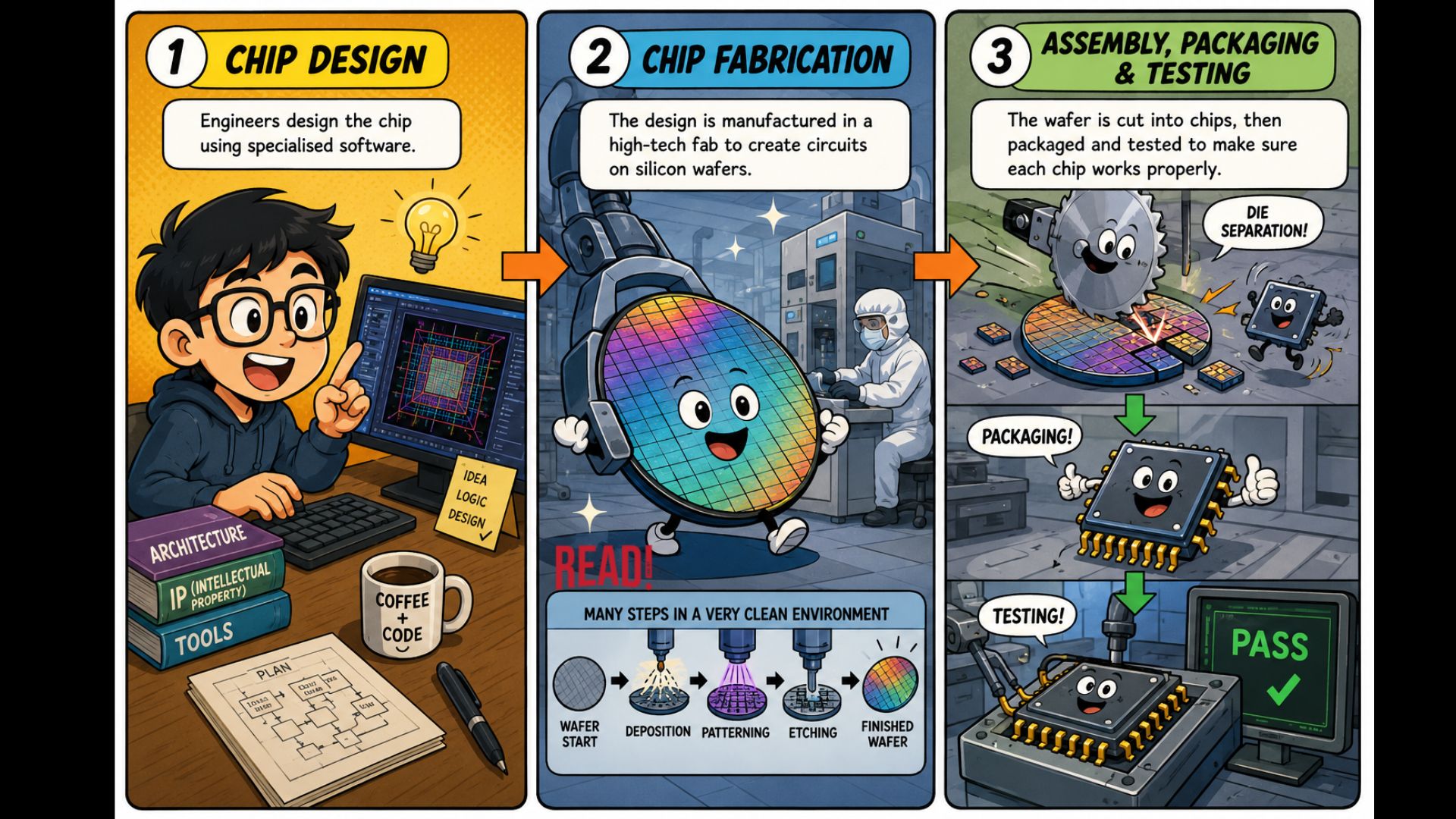
Manufacturing stages for semiconductor illustration image prepared by read.com.my

1. Chip Design

The process begins with chip design.

Engineers decide what a chip needs to do and how its circuits should be arranged. This requires specialised knowledge, software, research and development, and intellectual property (IP).

Some companies design chips but do not manufacture them themselves. These are known as fabless semiconductor companies.

The word fabless means that the company does not operate its own fabrication plant. Instead, it may work with a foundry, a company that manufactures chips for other companies.

Useful Business Term: Intellectual Property (IP)

Intellectual property, often shortened to IP, refers to creations and knowledge that a company can own or protect.

In the semiconductor industry, IP can include chip designs, technologies and other specialised knowledge.

Example:

“The company invests heavily in semiconductor IP and chip design.”

2. Chip Fabrication

After a chip has been designed, it must be physically manufactured.

This happens in a semiconductor fabrication facility, commonly called a fab.

One of the main materials used is silicon. The silicon is processed into thin discs called wafers.

A wafer can contain many individual chip areas, known as dies. Semiconductor manufacturing involves many highly controlled steps to create tiny electronic circuits on the wafer.

The manufacturing environment also needs to be extremely clean. Even very small particles can affect the production process.

Why is Semiconductor Manufacturing Expensive?

Building and operating a semiconductor fab requires expensive equipment, specialised facilities and highly trained workers.

This is why semiconductor manufacturing is described as capital-intensive.

Capital-intensive means that a business requires a large amount of investment in equipment, buildings or other physical assets.

Example:

“Semiconductor manufacturing is a highly capital-intensive business.”

In business discussions, these large investments are often referred to as capital expenditure, or CapEx.

3. Assembly, Packaging and Testing

After fabrication, the wafer contains many individual chip diesIndividual pieces of a semiconductor wafer, with each piece containing the circuits that will become a single chip..

The dies are separated and then go through processes such as assembly, packaging and testing.

Packaging protects the chip and provides the connections needed for it to work in an electronic product. Testing checks whether the chip performs as expected.

These activities are important parts of the semiconductor supply chain, and Malaysia has developed significant capabilities in assembly, packaging and testing. Industry sources describe Malaysia’s semiconductor ecosystem as covering activities from design and fabrication to assembly, packaging and testing.

Why is the Semiconductor Industry Important to Malaysia?

Now that we have looked at how semiconductors are designed, manufactured, packaged and tested, it is useful to look at how this industry connects to Malaysia.

Malaysia has developed its electrical and electronics industry over several decades. Penang is one of the country’s best-known electronics and semiconductor centres, while Kulim in Kedah has also become an important location for semiconductor-related manufacturing.

The semiconductor industry also involves many businesses beyond chip manufacturers. Depending on the type of operation, companies may require:

  • Engineering services
  • Precision equipment
  • Materials and chemicals
  • Automation systems
  • Testing services
  • Logistics
  • Maintenance
  • Cleanroom services
  • Technical support

This means that semiconductor activity can create opportunities across a wider industrial ecosystem.


A Malaysia Semiconductor Fact

(Flip for more details)

According to the Malaysian Investment Development Authority (MIDA), electronic components and semiconductor-related activities accounted for approximately 59% of Malaysia’s approved E&E investments in 2025. This represented RM16.9 billion out of RM28.5 billion in total approved E&E investments.

Foreign investment accounted for RM14.6 billion, or 86.3%, of the approved investment in the electronic components and semiconductor sub-sector.

One example of this investment is a RM3.51 billion advanced semiconductor facility being developed at Kulim High Tech Industrial Park in Kedah. MIDA states that the facility is expected to produce system-in-package (SiP) systems or modules, microelectromechanical systems (MEMS), and sensors.

These examples show that Malaysia’s semiconductor industry is not limited to producing chips. It also includes activities such as advanced packaging, sensors, engineering, equipment and other supporting services.

Useful Business Term: Ecosystem

An ecosystem is a group of businesses, organisations and activities that are connected and support one another.

For example, a semiconductor ecosystem can include chip designers, manufacturers, equipment suppliers, testing companies, logistics providers and other supporting businesses.

Example:

“Malaysia has developed a semiconductor ecosystem that includes manufacturing and supporting industries.”

How is Malaysia Moving Up the Semiconductor Value Chain?

Malaysia already has established capabilities in semiconductor manufacturing and related activities.

The next question is how the country can develop more activities that involve higher levels of technology, engineering and intellectual property.

Malaysia’s National Semiconductor Strategy (NSS) sets targets for areas including:

  • Integrated circuit (IC) design
  • Advanced packaging
  • Wafer fabrication
  • Semiconductor manufacturing equipment
  • Research and development
  • Talent development

The NSS targets at least RM500 billion in combined domestic and foreign investment and aims to train and upskill 60,000 Malaysian engineers. MITI also states that at least RM25 billion is to be allocated, initially, to implement the strategy.

The broader goal is not simply to produce more semiconductor products. It is also to develop capabilities in more parts of the semiconductor value chain.

Useful Business Term: Value chain

A value chain refers to the different activities involved in creating and delivering a product or service.

For example, a semiconductor value chain can include:

Design → Fabrication → Packaging → Testing → Electronics Manufacturing

When a company or country moves into more stages of this chain, it may be able to develop additional technical capabilities and business opportunities.

Example:

“Malaysia is looking to move further up the semiconductor value chain.”

Why Are Semiconductors Sometimes Called the “New Oil”?

You may have heard semiconductors described as the “new oil”.

The comparison is not exact. Oil is a natural resource and an important source of energy, while semiconductors are highly engineered products.

However, the phrase is used because semiconductor technology is important to many industries. Cars, computers, telecommunications equipment, data centres and industrial systems all depend on electronic components.

For countries, access to semiconductor technology and reliable supply chains can therefore have economic and strategic importance.

For Malaysia, the semiconductor industry is one part of a wider E&E ecosystem that connects manufacturing, investment, technology, engineering and international trade.

Rather than asking whether semiconductors will literally replace oil, it may be more useful to understand the comparison this way:

Oil has been central to the industrial economy. Semiconductors are central to the digital economy.

Useful Semiconductor Vocabulary for Business English

If you work in manufacturing, technology, investment or supply chain management, these are useful terms to know.

TermSimple meaningExample
SemiconductorA material with controllable electrical properties“Semiconductors are used in many electronic devices.”
Chip / ICAn electronic device containing electronic circuits“The company designs chips for automotive applications.”
FabA semiconductor fabrication facility“The company is investing in a new fab.”
WaferA thin disc of semiconductor material used to make chips“The chips are manufactured on silicon wafers.”
PackagingThe process of protecting and connecting a chip“The company specialises in advanced packaging.”
Capital-intensiveRequiring a large amount of investment“Chip manufacturing is highly capital-intensive.”
CapExCapital expenditure; money spent on long-term assets“The expansion will require significant CapEx.”
Supply chainThe network involved in producing and delivering a product“The semiconductor supply chain is global.”
BottleneckA problem that slows down a process“A shortage of components created a supply chain bottleneck.”
DownstreamBusinesses or industries that use a product“Automotive companies are important downstream customers.”
Value chainThe activities involved in creating and delivering a product“The company wants to move higher up the value chain.”
FDIForeign direct investment“The semiconductor industry continues to attract FDI.”

Conclusion

Semiconductors are a technical subject, but understanding the basics can help you follow important developments in technology, manufacturing and Malaysia’s economy. At the same time, terms such as supply chain, CapEx, downstream and value chain are useful business English beyond the semiconductor industry.

Learning through real-world topics is one practical way to build both knowledge and English skills. With online learning, you can study at your own pace, explore topics that interest you and gradually become more confident using English in work and everyday situations.

Keep learning, keep reading, and keep building your English.

Related Post