

You know your grammar. Your vocabulary is decent. You can write an email without checking Google Translate every two sentences.
So why did your colleague completely misunderstand what you meant?
This happens more often than people realise.
Having good English does not automatically make someone a good communicator. English gives you the words, but communication is about what happens after those words leave your mouth, appear on a screen, or land in someone’s inbox.
Did the other person understand your intention? Did your tone match what you were trying to say? Did they know what action you expected from them?
At work, these small differences matter.
You can speak perfectly correct English and still sound impatient, vague, uncertain, overly aggressive, or even uninterested without meaning to.
The good news? Communication is a skill, and like English itself, it can be improved.
English is the Tool, Communication is the Outcome
Think of English as the vehicle carrying your message.
You need the vehicle, of course. If your grammar, vocabulary or pronunciation makes your sentence difficult to understand, communication becomes harder.
But having a fancy car does not mean you automatically know where you are going.
Good workplace communication usually combines several things:
- Grammar helps you form understandable sentences.
- Vocabulary gives you the right words for your message.
- Fluency helps you speak without constantly stopping to search for words.
- Clarity helps other people quickly understand your point.
- Intent determines what you actually want the other person to understand, feel or do.
That last part is easy to overlook.
Imagine someone saying:
“The report isn’t finished yet.”
The grammar is perfectly fine.
But what does the person mean?
Are they simply giving you an update? Are they apologising? Are they asking for more time? Are they warning you that today’s deadline will be missed?
Without context, tone or a clear next step, the sentence leaves plenty of room for interpretation.
This is why Business English in Malaysia is not just about memorising impressive words. Professional English works best when it helps people understand you quickly and accurately.
Why Do People Misunderstand Each Other at Work?
Two people can understand every word in a conversation and still walk away with completely different ideas about what was agreed. Here are some common reasons.
Different Assumptions
You say:
“Can you send the document later?”
To you, “later” means before lunch.
To your colleague, “later” means sometime before going home.
Nobody used incorrect English. The problem was that both people filled in the missing information differently.
Tone
Compare:
“Send me the numbers.”
with:
“Could you send me the numbers when you have a moment?”
Both communicate a similar request, but they do not feel the same.
Tone becomes especially important in emails and chat messages because the reader cannot see your facial expression or hear your voice.
That is why seemingly harmless corporate email phrases can sometimes carry more urgency or pressure than the literal words suggest.
Indirect Language
Workplaces often use polite or indirect phrases.
Your manager may say:
“Perhaps we should have another look at this.”
They might not literally mean, “Maybe, if everyone feels like it.”
They may actually mean, “Please revise this.“
Learning to recognise the message behind the wording can be just as important as understanding the words themselves.
Poor Listening
Sometimes we are not really listening. We are simply waiting for our turn to speak.
You may hear the first half of someone’s explanation, assume you know where it is going, and mentally prepare your answer.
Then you miss the important part.
Workplace Hierarchy
A sentence can also feel different depending on who says it.
“Please do this today” from your teammate may sound like a request.
The same sentence from your department head probably does not feel optional.
Position and workplace relationships affect how language is interpreted.
Cultural Differences
Malaysia’s workplaces can include people from different cultural, linguistic and professional backgrounds.
Some people communicate very directly. Others prefer softer language to avoid sounding confrontational.
Even within Malaysia, someone who speaks mostly formal English at work may communicate differently from someone comfortable switching between English, Malay, Mandarin, Tamil or Manglish.
Neither approach is automatically better.
The challenge is knowing what works for the situation and the person you are speaking to.
Speaking Clearly is Not the Same as Being Understood
Consider these three sentences:
“Can you do this?”
“Would you be able to help with this?”
“I need this today.”
Simple English. No complicated vocabulary.
Yet each creates a different impression.
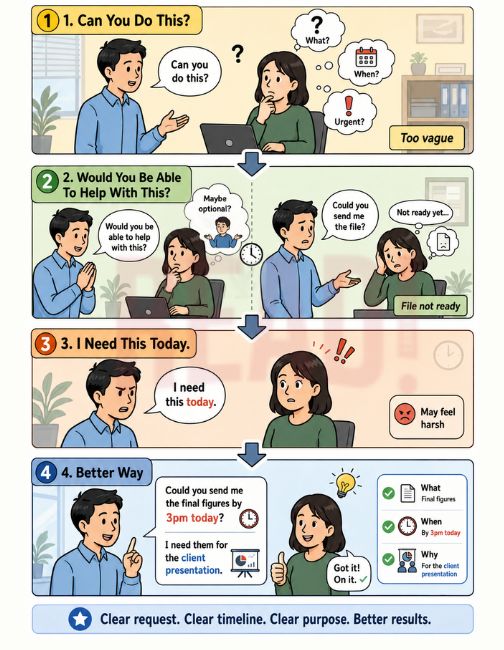
“Can You Do This?”
This sounds relatively neutral, but it can also be vague.
Can they do what exactly? When? Is it urgent?
Are you asking whether they have the ability, or are you assigning them the task?
“Would You Be Able to Help With This?”
This sounds softer and more collaborative.
It can work well when you genuinely want to ask for help.
But if the task is actually compulsory and urgent, being too indirect may create another problem. The other person may think they can say no or complete it whenever they have time.
“I Need This Today.”
Now the deadline is clear.
But depending on your tone and relationship with the recipient, it could sound firm, urgent or demanding.
A clearer version might be:
“Could you send me the final figures by 3pm today? I need them for the client presentation.”
Now the person knows what, when and why.
That is effective communication.
It is not necessarily more sophisticated English. It simply removes unnecessary guessing.
The same principle applies to writing. Templates can help with structure, but good email writing still requires you to think about the reader and what they need from your message.
Listening is Part of Communication Too
We tend to associate communication skills with speaking confidently. But good communication is not a one-person performance.
Listening matters just as much.
More specifically, you need to listen for meaning, not only words.
Suppose a colleague says:
“I can probably finish it today, but I’m still waiting for the sales figures.”
If you only hear “finish it today”, you may assume everything is settled.
The important part is actually the second half. Their ability to finish depends on something they do not control.
A good response might be:
“So if the figures don’t arrive today, you’ll need more time?”
That simple question checks whether your understanding is correct.
Clarifying questions are especially useful when discussing:
- Deadlines
- Responsibilities
- Client requests
- Changes to a project
- Important decisions
- Anything you are not 100% sure about
There is no prize for pretending you understood everything.
A quick “Just to confirm, you mean…” can prevent a long chain of mistakes later.
Communication Also Involves Behaviour
This is where communication becomes more interesting.
Two people can know the same vocabulary and still communicate very differently because of their habits and reactions.
- Maybe you automatically become defensive when someone gives you feedback.
- Maybe you speak very quickly when you are nervous.
- Maybe you avoid asking questions because you worry about looking inexperienced.
- Or perhaps you always agree immediately, then realise later that you misunderstood the request.
These are communication patterns.
Over time, we develop habits around how we:
- React to disagreement.
- Handle
- Give
- Ask for help.
- Build rapport with colleagues.
- Interpret other people’s behaviour.
- Express our own needs.
Becoming aware of these patterns can help you communicate more deliberately instead of reacting automatically.
For example, if you know that you tend to say “yes” too quickly during meetings, you can train yourself to ask one or two questions before agreeing to a task.
If you know that your messages often sound too direct, you can learn to pause and check your tone before pressing Send.
Small changes can make workplace communication much smoother.
Can Communication Skills Be Improved?
Definitely.
You do not have to be naturally outgoing, charismatic or “good with people” to become a better communicator.
Like any workplace skill, it improves through practice.
Practise Your English
Improving your language vocabulary, grammar, pronunciation and confidence still matters.
The easier it becomes to express yourself in English, the more attention you can give to the message instead of worrying about every sentence.
Use Role-Play
Practising realistic situations can be surprisingly useful.
Try role-playing scenarios such as:
- Asking your manager for clarification.
- Explaining a delay to a client.
- Disagreeing politely in a meeting.
- Giving feedback to a colleague.
- Handling an unhappy customer.
It may feel slightly awkward at first, but that is much better than practising for the first time during an actual difficult conversation.
Ask for Feedback
You may not always notice how you come across.
A trusted colleague, manager, trainer or coach may notice that you speak too quickly, provide too much background before reaching your point, or sound less confident than you actually feel.
Useful feedback gives you something specific to improve.
Review Misunderstandings
When communication goes wrong, do not only think:
“They misunderstood me.”
Ask why.
- Was your instruction vague?
- Did you assume the other person knew something they did not?
- Did your tone create the wrong impression?
- Could you have asked a question before ending the conversation?
Looking back at real situations is one of the easiest ways to spot recurring communication habits.
Consider Professional Communication Training
Some people benefit from structured training, particularly if communication is an important part of their role.
Professional development may cover presentation skills, interpersonal communication, leadership communication, negotiation, conflict management or behavioural awareness.
The goal is not to teach everyone to speak in exactly the same way.
It is to help you become more conscious of how you communicate and how other people respond.
Good English Helps, but Good Communication Goes Further
Strong English gives you an important foundation at work. It helps you explain ideas, write professional emails, participate in meetings and communicate with people from different backgrounds. But getting every tense correct will not automatically stop misunderstandings.
Good communication also depends on clarity, listening, tone, context, assumptions, behaviour and awareness of the person on the other side of the conversation. So the next time someone misunderstands you, do not immediately assume your English was the problem.
Sometimes the words were correct. The communication around them just needed a little more work. And that is something you can practise.
Some professionals eventually go beyond language practice and explore structured approaches to communication and behavioural development. One approach you may come across is Neuro-Linguistic Programming, or NLP.
Next, we will look at What Is NLP? A Simple Guide to Neuro-Linguistic Programming and explain what the term actually means without making it sound more complicated than it needs to be.