Business Proposal Guide: Free Templates for Every Industry

Facebook
LinkedIn
Twitter
WhatsApp
Email
Table of Contents
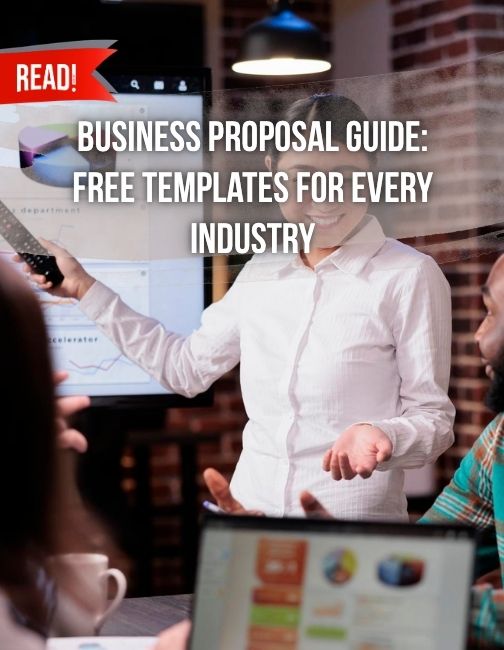
A business woman presenting her business proposal during meeting with clients

What is a business proposal? A business proposal is a formal document created by a B2B company to persuade a prospective client to buy a specific product or service. Unlike an internal business plan, it acts as a targeted sales pitch designed to demonstrate an understanding of the client’s needs and outline the strategy, timeline, and costs required to address their problem.

The 3-Sentence Takeaway for Success:

A successful business proposal aligns directly with the client’s explicit requirements and pain points. By establishing clarity around deliverables and presenting a value proposition focused on return on investment (ROI), you present a highly compelling case. Ultimate success lies in minimising friction so the prospect can easily approve the project and say “yes.”

Understanding Business Proposals: Types, Purpose, and Key Differences

To write an effective proposal, you must understand its exact purpose. Misjudging the intent of this document is a common reason sales pitches fail to secure contracts.

Solicited vs. Unsolicited Proposals

The approach you take depends entirely on whether the client asked for your pitch:

  • Solicited Proposals: The client knows they have a problem and has actively requested a proposal (often via a Request for Proposal, or RFP). Because they are evaluating multiple vendors, your focus should be on clear differentiation, precise compliance with their requirements, and proving your capabilities.
  • Unsolicited Proposals: These function similarly to a warm sales call. The prospect did not request the document, meaning you must first demonstrate that an issue exists before you can sell them or present your solution. These require deep research and a highly compelling hook to capture interest.

Proposal vs. Business Plan vs. Estimate

These three documents serve entirely different stages of business growth and sales funnels. Here is how they compare:

Document

PurposeTarget Audience

Key Focus

Business Proposal

To sell a specific service or projectPotential Clients / BuyersProblem-solving & Value
Business PlanTo map out overall business growthInvestors / Banks

Financials & Strategy

Price Estimate

To give a rough cost projectionCurious Leads

Budget & Scope

How to Write a Business Proposal That Stands Out

Every structured business proposal follows a logical framework that guides your reader from identifying their problem to visualising a successful partnership.

Title Page & Introduction

First impressions matter. Your title page should be clean, professionally branded, and clearly state the project name, client name, your company name, and the date. Follow this with a brief, warm introduction introducing your team and expressing excitement about your interest in the partnership.

Executive Summary (The Hook)

The executive summary is the most critical part of your entire document, often read first by decision-makers. Rather than summarising your company history, it should provide a high-level overview of the client’s current situation, the core challenges they face, and a teaser of the transformative results your solution will deliver.

Problem Statement (Proving You Understand Their Pain)

Before presenting a solution, you must demonstrate that you understand the client’s current situation. Use this section to outline their specific pain points and the business impact of their current operational inefficiencies, utilising data gathered from your discovery calls. If you can define their problem better than they can, they will automatically assume you have the best solution.

Proposed Solution (Your Strategy)

This section details your strategy. Outline a clear, step-by-step strategy to address the challenges raised in the problem statement. Focus on project outcomes, using a scope of work (SOW) breakdown, implementation phases, and clear milestones so the client can understand exactly how the project will unfold from day one.

Qualifications & Social Proof (Why Trust You?)

Now that they like your solution, to build trust, use this section to establish your company’s capability to execute the project. Include brief bios of key team members, relevant industry certifications, awards, and most importantly, case studies and testimonials from past clients who faced similar challenges.

Pricing and Options (Clear, Transparent ROI)

Avoid complex, hidden fees that trigger buyer’s remorse. Present your pricing in a structured, transparent, and easy-to-read format to avoid confusion. Tie the financial investment directly back to the value and ROI the client will receive, using options where appropriate to accommodate different budget levels.

Terms, Conditions, and Next Steps (Call to Action)

Conclude with legal clarity and a straightforward path forward. Outline the terms of the agreement, payment schedules, and a clear call to action detailing exactly what steps the client needs to take to initiate the project.
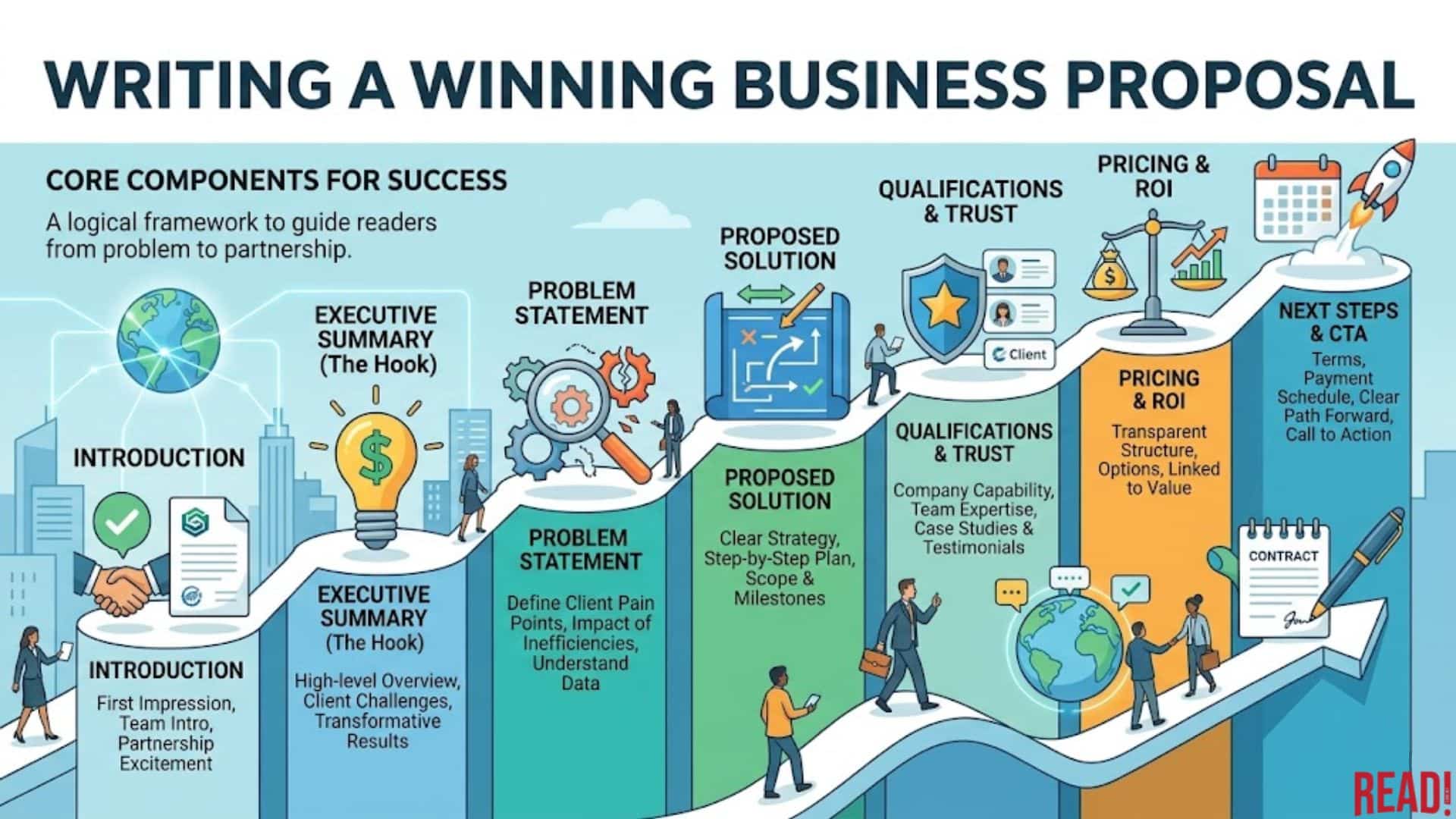
Steps and tips on writing a winning business proposal

The One-Size-Fits-All Universal Business Proposal Template

How to use this template: Copy and paste the text below into your word processor or proposal software. Replace the bracketed information [like this] with your specific details.

📋 Click anywhere inside to highlight (Pastes as clean text)

Business Proposal

[Your Company Logo]

Prepared For: [Client Name or Client Company]
Project Name: [Name of the Project/Service]
Date: [Current Date]
Valid Until: [Expiration Date - usually 30-60 days out]

Prepared By:
[Your Name / Title]
[Your Company Name]
[Your Email Address]
[Your Phone Number]

1. Executive Summary

[Client Company Name] is currently facing a critical opportunity to [mention the main goal, e.g., scale online sales / streamline operations / upgrade infrastructure]. However, achieving this is hindered by [mention their biggest pain point, e.g., an outdated legacy system / a lack of qualified leads].

Our team at [Your Company Name] has developed a tailored strategy designed specifically to address this challenge. By implementing our [Name of your service/product], we aim to help you achieve [mention the primary benefit, e.g., a 25% increase in efficiency / a 2x return on ad spend] within [Timeframe].

2. Problem Statement & Objectives

Based on our recent discussions, we understand that your current situation involves:

  • Challenge 1: [Describe the first issue they are facing]
  • Challenge 2: [Describe the second issue, or the negative impact of the first issue]

Our Project Objectives:

  1. [Objective 1 - e.g., Optimise the existing workflow to save 10 hours per week]
  2. [Objective 2 - e.g., Launch the new platform by Q3 with zero downtime]
  3. [Additional objective if applicable]

3. Proposed Solution & Scope of Work

To achieve these objectives, [Your Company Name] will execute the following phases:

  • Phase 1: Research & Discovery
    We will analyse your current [system / market / assets] and deliver a comprehensive roadmap.
  • Phase 2: Implementation & Execution
    Our team will build, design, or execute the core solution, including [specific deliverable A] and [specific deliverable B].
  • Phase 3: Testing & Launch
    We will test the solution and handle the official deployment.
  • Phase 4: Optimisation & Support
    Provide [X days/months] of post-launch monitoring and team training.

4. Timeline & Milestones

We estimate this project will take approximately [Total Weeks/Months] to complete, broken down as follows:

Milestone / Phase Key Deliverables Estimated Completion
Phase 1: Discovery Initial audit report & strategy brief Week 1–2
Phase 2: Execution First draft/prototype delivery Week 3–5
Phase 3: Final Delivery Fully deployed solution & training Week 6

5. Investment & Pricing

We offer straightforward pricing tailored to the scope of this project.

  • Option A: Flat Project Fee
    Total Investment: [Amount]
    Payment Schedule: 50% upfront deposit, 50% upon project completion.
  • Option B: Monthly Retainer (If Applicable)
    Monthly Fee: [Amount] / month (Minimum [X]-month commitment)

6. Why Choose [Your Company Name]?

  • Proven Track Record: We have helped over [Number] businesses in similar positions achieve [specific result].
  • Our Core Expertise: [Mention a specific certification, unique methodology, or proprietary tool you use].
“Insert a powerful 1–2 sentence quote or testimonial from a past client that highlights your reliability and results.” — [Client Name], [Client Title]

7. Next Steps & Acceptance

To accept this proposal and initiate the project, please follow these steps:

  1. Review the proposal details.
  2. Sign and date below.

Once received, we will send over the initial invoice and schedule our project kickoff meeting.

By signing below, the parties agree to the terms and scope outlined in this document.

For [Client Company Name]


_______________________________________
Name:
Title:
Date:

For [Your Company Name]


_______________________________________
Name:
Title:
Date:

Free Business Proposal Templates by Industry

To streamline your process, we have developed specialised proposal templates tailored to specific industries.

1. E-Commerce Business Proposal Template

Designed for digital agencies, supply chain experts, and marketing consultants looking to pitch retail brands. This framework focuses on conversion rate optimisation (CRO), platform migrations (e.g., Shopify, Magento), and data-backed digital marketing strategies.

2. Services Business Proposal Template

Suitable for creative agencies, IT consultants, freelancers, and B2B service providers. It features an structured Scope of Work (SOW) builder and milestone tracking to ensure clear boundaries and minimise scope creep.

  • Services Proposal Template

3. Wholesale & Retail Business Proposal Template

Tailored for brands looking to secure physical retail distribution deals. This template guides you through presenting vendor agreements, optimising shelf-space pitches, detailing bulk pricing tiers, and outlining logistics partnerships.

  • Wholesale & Retail Proposal Template

4. Agriculture & Mining Business Proposal Template

Built specifically for industrial B2B operations navigating long-term corporate partnerships. Focus areas include equipment leasing, land utilisation planning, supply contract bidding, and environmental and safety compliance protocols.

  • Agribusiness & Mining Proposal Template

5. Manufacturing Business Proposal Template

Designed for scaling production capabilities, closing Original Equipment Manufacturer (OEM) partnerships, and establishing quality control standards. This template highlights prototyping timelines, supply chain scaling, and unit-cost efficiency.

  • Manufacturing Proposal Template

Tips to Improve: Make Your Business Proposal Stand Out

Use Visual Elements Effectively

Dense text can reduce readability. Break up dense paragraphs with clean typography, branded headers, and intuitive data visualisations like charts, timelines, and infographics. A beautifully designed proposal subtly signals that your business operates with high attention to detail.

Consider Tiered Pricing

Offering a single price point creates a binary decision for the prospect. Providing three options structured as a “Good, Better, Best” model allows them to choose a level that best fits their budget, which can help improve conversion rates.

Follow Up Etiquette

Send a polite follow-up 48 hours after delivery to confirm receipt and answer any initial questions. If you use digital tracking tools and notice they are actively viewing the document, reaching out can be highly effective. Space subsequent follow-ups 3 to 5 days apart, ensuring each interaction offers clear value.

Conclusion

Writing an effective business proposal requires shifting your perspective from a generic sales pitch to a collaborative, value-driven strategy. When you demonstrate that you clearly understand the client’s business goals and challenges, closing deals becomes a natural result. Use our framework, select the template that matches your niche, and approach your next pitch with confidence.

Ready to improve your team’s communication skills and secure more global clients? Explore more on an online language learning site to master corporate communication today!

FAQs About Business Proposal

How long should a business proposal be?

There is no hard rule, but standard B2B project proposals usually land between 5 and 15 pages. For massive enterprise accounts or government contracts, they can easily span dozens of pages. The golden rule is simple: make it as short as possible to convey the complete value, but long enough to answer every potential objection.

What is the most important part of a proposal?

The Executive Summary and the Problem Statement are tied for first place. If you fail to hook the reader in the first two pages or fail to prove that you intimately understand their unique business bottlenecks, they will never bother reading your brilliant strategy or your pricing options.

Can I use a PDF, or should it be web-based?

While PDFs are traditional, web-based proposal software is rapidly becoming the gold standard. Web proposals allow you to embed interactive pricing tables, video introductions, and electronic signatures. Best of all, they give you built-in analytics so you can see exactly which sections the client spent the most time reading.

What is the difference between a business proposal and a business pitch deck?

While both documents aim to secure new business, they are delivered in different formats and stages of the sales process.

A pitch deck is a highly visual, slide-based presentation used during live meetings to capture initial interest.

A business proposal is a formal, text-based document that provides the granular details such as explicit scopes of work, legal terms, and exact pricing needed for final corporate approval.

How do I handle a prospect who asks for a proposal but goes silent?

If a prospect stops responding after receiving your proposal, follow up after 48 hours to confirm receipt. If they remain silent, send another follow-up 3 to 5 days later, shifting the focus away from the contract and toward giving value (e.g., sharing a relevant industry insight or a tool related to their problem). If there is no response after three attempts, send a final, professional “closing the file” email to politely prompt a definitive yes or no.

Should I include a contract within the business proposal itself?

For standard B2B services or smaller projects, including a “Next Steps” or sign-off section directly in the proposal streamlines the onboarding process and reduces friction.

However, for enterprise accounts, complex legal projects, or government contracts, it is best to keep the proposal focused on strategy and value, and deliver the formal Master Services Agreement (MSA) or Statement of Work (SOW) separately once the initial terms are accepted.

Related Post