
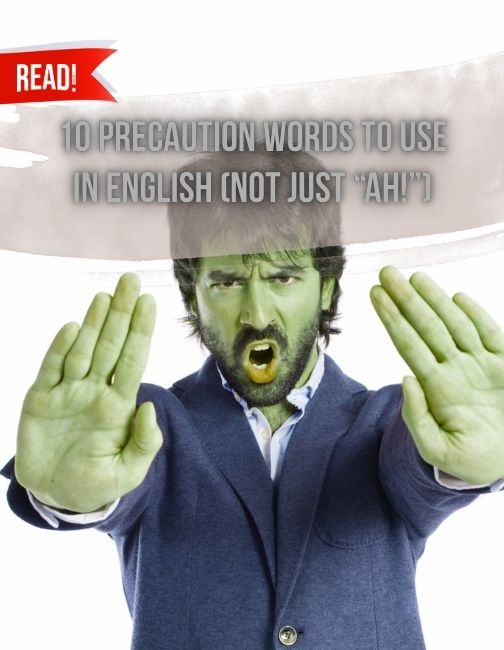
In emergencies, knowing English grammar doesn’t help if all you can do is shout “Ah!”. Precaution words help you react fast and protect others.
In real-life situations, native speakers use short, clear precaution words to warn people quickly. These words are simple, loud, easy to understand and they can actually prevent accidents.
In this guide, you’ll learn 10 common precaution words in English, what they mean, and how to use them naturally in emergencies and everyday situations.
What Are Precaution Words in English?
Precaution words in English are short warning words or phrases used to warn, advise care, or prevent danger, mistakes, or harm. They signal that someone should be careful before taking an action.
They are usually:
- One or two words
- Said loudly
- Used instinctively, without thinking
These are not “advanced” English, they are real, practical spoken English in daily speech.

When Do Native Speakers Use Precaution Words?
Precaution words are commonly used when:
- Someone is about to get hurt
- Something is falling or moving fast
- There’s traffic or danger nearby
- A situation feels unsafe or urgent
Common situations include:
- Crossing the road
- Crowded places
- Slippery floors
- Construction areas
- Sudden accidents
10 Common Precaution Words You Should Know
Below are 10 essential precaution words used in daily spoken English. Learn them as reactions, not vocabulary lists.
1. Careful!
Meaning: Be cautious / pay attention
When to use: General warning, not urgent
Example: Careful! The floor is wet.
2. Watch out!
Meaning: Danger is coming
When to use: Something is about to happen
Example: Watch out! There’s a car coming.
3. Duck!
Meaning: Move your head down quickly
When to use: Something is flying or falling
Example: Duck! That ball is coming straight at you.

4. Look out!
Meaning: Similar to “watch out”
When to use: Immediate danger
Example: Look out! Behind you!
5. Heads up!
Meaning: Pay attention / warning
When to use: Friendly or casual warning
Example: Heads up! There’s a step here.
6. Stop!
Meaning: Do not move or continue
When to use: Urgent or serious situations
Example: Stop! Don’t cross yet.
7. Slow down!
Meaning: Reduce speed
When to use: Driving, walking, or rushing
Example: Slow down! It’s dangerous.
8. Move!
Meaning: Change position immediately
When to use: Emergency situations
Example: Move! Get out of the way!
9. Don’t touch that!
Meaning: Warning against danger
When to use: Hot, sharp, or unsafe objects
Example: Don’t touch that! It’s hot.
10. Get back!
Meaning: Step away
When to use: Unsafe distance
Example: Get back! Stay behind the line.
Tone Matters: Warning vs Emergency
Not all precaution words are said the same way and tone can change everything.
In real life, we don’t always shout. Sometimes we warn. Sometimes we panic. Sometimes we only have half a second to react.
Gentle warnings are used when there’s no immediate danger yet:
- Careful!
- Heads up!
- Watch out!
These are common in daily life, walking past someone carrying hot coffee, stepping onto a wet floor, or noticing something slightly off.
Emergency shouts, on the other hand, are short, sharp, and loud:
- Duck!
- Move!
- Stop!
There’s no time for grammar. No time for politeness. Your brain switches to survival mode and English needs to do the same.
Knowing the difference helps you sound natural, clear, and human, not rude, robotic, or frozen.
Common Mistakes English Learners Make in Emergencies
When danger appears, many English learners don’t lack vocabulary, they lose confidence.
Here are some very real mistakes:
🚫 Freezing and saying nothing
You see the danger. Your brain knows it. But the words don’t come out.
🚫 Screaming without words
“AHHH!” gets attention, but it doesn’t give direction.
🚫 Using long sentences
“Please be careful because something dangerous is falling from above.”
By the time you finish, it’s already too late.
🚫 Translating directly from your first language
Your brain searches for the “correct” English instead of the useful English.
In emergencies, short is better.
How to Practice Precaution English
This is about building instinct.
Try these simple but powerful habits:
- Say the words out loud
- Imagine real-life situations
- Notice how movies and TV shows use them
- Practice reacting quickly, not thinking slowly
The goal is instinct, not perfection.
Conclusion
In real-life situations, you don’t have time to think about grammar or sentence structure. Knowing precaution words helps you react fast, warn others clearly, and stay safe.
English isn’t just for exams or emails, it’s for real moments, real reactions, and real life.
If you enjoy learning practical English like this, READ is your language learning hub for everyday vocabulary, spoken English, and expressions people actually use.