

Many people think English spelling is impossible to learn.
“Words don’t sound the way they look. “
“Spelling rules have too many exceptions.”
“Spellcheck fixes mistakes, but I still don’t understand why they happen.”
The truth is this:
English spelling is not random.
It follows a small number of core rules and patterns. Most learners struggle because they are taught to memorise words instead of learning how to make spelling decisions.
This guide will teach you how spelling actually works, using clear rules you can apply, not memorise.
If you are a student, ESL learner, adult learner, or teacher, this article will finally make spelling click.
What Are Spelling Rules?
A spelling rule is a decision rule.
It helps you answer questions like:
- Should I double a letter?
- Should I drop the “e”?
- Which spelling system should I use?
- Why does this word keep a silent letter?
Good spellers don’t guess. They ask the right questions.
If you want a deeper overview of how spelling works as a system (especially for Malaysian learners), you can also read our complete guide to English spelling guide.
Rule 1: Short Vowel + One Consonant → Double the Consonant
This is one of the most important spelling rules in English.
The Rule
When a word has:
- One short vowel (a, e, i, o, u)
- Followed by one consonant
- And you add -ing, -ed, -er
Double the final consonant
Examples
- run → running
- stop → stopped
- plan → planned
- big → bigger
Wrong vs Right
❌ runing → ✅ running
❌ planed → ✅ planned
Why This Rule Exists
English spelling prioritises pronunciation.
In English, changing a vowel from short to long often changes the word itself (for example, hop vs hope, plan vs plane). When a suffix like -ing or -ed is added, the spelling system must protect the original vowel sound.
Doubling the final consonant acts like a vowel guard. It stops the vowel from becoming long and ensures the word keeps the same pronunciation and meaning.
Without doubling:
runing would be read as ru-ning
planed would be read as plane
The rule exists to preserve meaning by preserving sound.
Rule 2: Silent “E” Makes the Vowel Long
The silent E changes pronunciation.
The Rule
A final E:
- Is not pronounced
- Makes the vowel before it say its name
Examples
- hop → hope
- cap → cape
- kit → kite
When adding -ing or -ed, drop the E:
- make → making
- hope → hoping
Wrong vs Right
❌ hopeing → ✅ hoping
❌ makeing → ✅ making
Rule 3: Two Vowels Together → Do NOT Double
This rule prevents over-spelling.
The Rule
If a word already has two vowels together, do not double the consonant.
Examples
- clean → cleaning
- rain → raining
- read → reading
Why?
Two vowels usually mean a long vowel sound, so no protection is needed.
Rule 4: Words Are Spelled by Meaning, Not Just Sound
This rule explains many silent letters.
English spelling often protects word families, not pronunciation.
Example: “sign”
- sign
- signal
- signature
The G is silent in sign, but pronounced in signal. The spelling stays the same to show they are related.
More examples
- heal → health
- magic → magician
- nation → national
Silent letters often exist to show meaning and connection, not sound.
Rule 5: Prefixes Do Not Change Spelling
Prefixes are added to words to change meaning, not spelling. In most cases, the base word keeps its original spelling.
Common Prefixes
- un- (meaning not)
- re- (meaning again)
- dis- (meaning not or opposite of)
- pre- (meaning before)
- in- (meaning not)
Application Examples
- happy → unhappy
- appear → reappear
- connect → disconnect
- view → preview
- correct → incorrect
If the base word is clear and recognisable, keep its spelling.
Extra Depth: Why illegal Uses il-
Some prefixes change form for pronunciation, not spelling logic.
The prefix in- adjusts its shape depending on the first letter of the base word:
| Base word starts with | Prefix form | Example |
| l | il- | legal → illegal |
| r | ir- | regular → irregular |
| m / p / b | im- | possible → impossible |
This change:
- makes the word easier to pronounce
- does not change the base spelling
- still follows the same meaning rule (in- = not)
So in illegal, the spelling of legal stays intact, only the prefix adapts.
At this point, you might be curious about why English uses in- instead of un-, the reason is that they come from different histories.
- un- comes from Old English and was used with native English words.
- in- comes from Latin and was used with words borrowed from Latin or French.
So, English doesn’t choose between un- and in- freely, the origin of the base word usually determines the prefix.
Rule 6: Suffixes Follow Predictable Patterns
Suffixes are added to the end of words to change their meaning or how they’re used. They can sometimes make spelling tricky, but there are patterns that can help.
Common Suffixes and What They Mean
| Suffix | What It Does / Meaning |
| -tion | Turns a verb into a noun; shows the act or process |
| -sion | Turns certain verbs into nouns; shows the act or result |
| -ment | Forms a noun; shows the result or object of an action |
| -able / -ible | Forms an adjective; means can be / worthy of |
Examples in Practice
| Base Word | With Suffix | What it Means |
| educate | education | the act of educating |
| compress | compression | the act of compressing |
| decide | decision | the result of deciding |
| manage | management | the result of managing |
| enjoy | enjoyment | the act or state of enjoying |
| comfort | comfortable | can be comforted |
| possible | possible | can happen |
Tip: Think of suffixes as meaning markers: they tell you what type of word it is (noun, adjective) and help you connect words in the same family.
Rule 7: “I Before E”
The traditional rhyme goes:
“I before E, except after C.”
Many learners memorise this, but it’s incomplete.
The Real Rule
I before E, except after C, or when it sounds like “ay” (as in neighbour, weigh)
The rule reflects sound and word history, not just spelling patterns.
Correct Examples
- believe
- field
- receive
- ceiling
Exceptions (Sound-Based)
- weird
- height
- science
How It Works
Listen to the vowel sound, don’t just rely on the letters.
The key is to treat this rule as a pronunciation guide, not a strict spelling law.
RULE 8: British vs American Spelling is a System Choice
This matters for exams and formal writing. In Malaysia, British spelling is usually expected
Common Differences
- colour (UK) / color (US)
- centre (UK) / center (US)
- travelling (UK) / traveling (US)
The Rule
Choose one system and never mix. Mixing systems = spelling error.
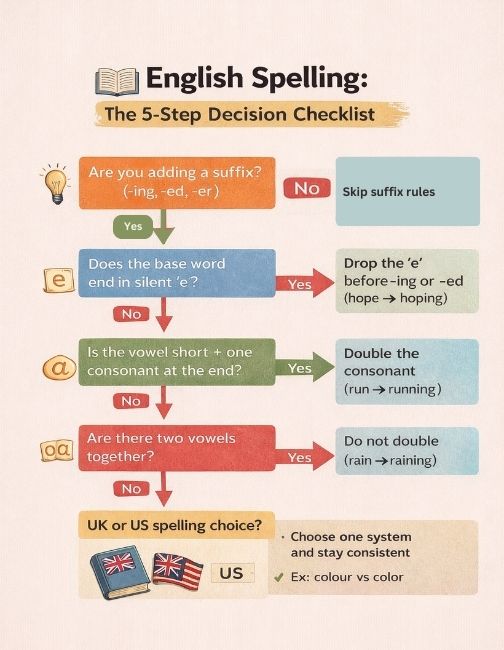
How to Apply Spelling Rules Step by Step
Instead of guessing, ask these questions:
- Is the vowel short or long?
- Am I adding a suffix?
- Does this word belong to a family?
- Is there a silent “e”?
- Am I using British or American spelling?
Spelling becomes logical when you follow decisions, not memory.
Why Spellcheck Alone is Not Enough
Spellcheck:
- Fixes obvious errors
- Misses real-word mistakes (their/there)
Spelling rules:
- Help you prevent errors
- Improve exam writing
- Build long-term accuracy
Spellcheck is a tool. Rules are understanding.
Conclusion
English spelling may seem tricky at first, but it follows clear rules and patterns. By understanding prefixes, suffixes, vowel sounds, and the logic behind spelling decisions, you can write more accurately and confidently.
The key is to observe patterns and meanings rather than memorising words randomly. For more tips, explanations, and helpful articles, visit our online learning website, a resource designed to help students, ESL learners, and teachers make sense of English, one rule at a time.
Spelling becomes much easier when you approach it logically and connect words to their families and meanings.