

Summary
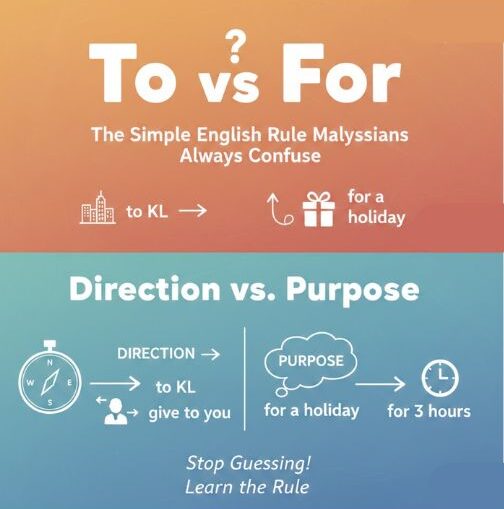
- Movement vs. Motive: Use “to” for the destination (to KL) and “for” for the motive (for a holiday).
- The “Verb” Test: If you follow the preposition with a verb, it is usually “to + verb” (to meet) rather than “for + verb.”
- Gift Logic: Use “for” to identify the intended owner (for you) and “to” to identify the act of giving (give to you).
- Time Tracking: Use “for” specifically when mentioning a total duration of time (for 3 hours).
- Professionalism: Using the correct preposition in emails, such as “reply to” or “apply for,” significantly boosts your perceived English proficiency.
Many Malaysians confuse these because, in Bahasa Malaysia, the word untuk or ke is often used interchangeably. To simplify your English, follow this:
| Preposition | Focus | Malaysian Example |
| TO | Movement / Receiver | “Pass the file to the boss.” |
| FOR | Purpose / Benefit | “I bought coffee for the boss.” |
However, in a professional context, using the wrong preposition can change the meaning of your sentence. To communicate clearly and confidently, you only need to understand one simple “Direction vs. Purpose” rule.
Before we dive in, if you want a solid foundation on general rules, check out our English grammar complete guide.
1. When to Use “TO” (The Receiver)
Use to when there is a sense of movement toward a destination or a specific person receiving an action.
Movement & Destination
- I am driving toJohor Bahru tomorrow.
- We are traveling toPenang next week.
The Receiver (Giving or Telling)
Use to when you give, send, or explain something to a specific person.
- Please send the email tothe customer.
- I gave the documents tomy manager.
Tip: Use “to” after verbs like give, send, tell, speak. (e.g. I will reply to you soon, She talked to the manager)
2. When to Use “FOR” (The Reason)
Use for to express the reason behind an action, the person who benefits from it, or the length of time involved.
Purpose & Reason
- I went to KL fora meeting.
- This laptop is forwork purposes.
Benefit
- I bought this gift formy mother. (It is for her benefit/enjoyment).
- I made dinner formy family.
Duration (Length of Time)
- I lived in Kuala Lumpur forfive years.
- I have been waiting for20 minutes.
Comparison Summary Table
| Prepositions | Main meaning | Example |
| to | direction / receiver | go to KL, send to boss |
| for | purpose / benefit / duration | for you, for work, worked for 2 years |
Common Mistakes
Mistake 1: explain for me
Incorrect: Can you explain for me?
Correct: Can you explain it to me?
Because “explain” needs a receiver.
Mistake 2: I buy for my mother (when giving)
This one depends on meaning. If you mean you bought it as a gift:
✅ I bought it for my mother.
If you mean you purchased something and handed it to her:
✅ I bought it and gave it to my mother.
Mistake 3: I go to KL to meeting
Incorrect: I go to KL to meeting.
Correct: I go to KL for a meeting.
Because “meeting” is the purpose.
Mini Quiz of “To” and “For”
Fill in the blanks with to or for.

1. I’m going ___ Penang tomorrow.
💡 Hint: Used to show movement to a place.
2. This cake is ___ you.
💡 Hint: Used to show who receives something.
3. Please send the file ___ my email.
💡 Hint: Used when sending something toward a destination.
4. I went there ___ a meeting.
💡 Hint: Used to show purpose.
5. She waited ___ 30 minutes.
💡 Hint: Used to show duration of time.
6. I gave the documents ___ my boss.
💡 Hint: Used to show who receives something.
7. I’m studying English ___ my career.
💡 Hint: Used to show benefit or purpose.
8. I went to KL ___ buy a new phone.
💡 Hint: Used before a verb to show purpose.
Conclusion: Elevating Your Communication
Mastering “to” versus “for” is a simple yet effective way to refine your professional English. By distinguishing between the destination of your actions and the purpose behind them, you eliminate the ambiguity that often arises from direct translation.
As you continue to improve your writing, remember that prepositions are the “glue” of the English language. If you found this guide helpful, explore our in vs on vs at for place or our in vs on vs at for time tutorials. For a complete bird’s-eye view of how these words function, visit our complete guide to English prepositions.
Start applying the “Direction vs. Purpose” rule in your next conversation or email, you will notice the difference in clarity immediately.
FAQs About To vs For
Is it "talk to" or "talk for"?
In most cases, it is “talk to.” You talk to someone to exchange information. You would only “talk for” someone if you were speaking on their behalf (as their representative).
Is it "wait to" or "wait for"?
Use “wait for” when followed by a noun (e.g., “wait for the bus”). Use “wait to” when followed by a verb (e.g., “I am waiting to see the doctor”).
Do I "apply to" or "apply for"?
Both are correct but used differently. You apply for a position or a thing (apply for a job, apply for a permit). You apply to a place or an entity (apply to Maybank, apply to the University).
Is it "responsible to" or "responsible for"?
You are responsible for a task or a person (e.g., “I am responsible for the budget”). You are responsible to a person in authority (e.g., “I am responsible to the Director”).
Should I say "thanks to you" or "thanks for you"?
“Thanks to you” means “because of you” (e.g., “Thanks to you, we finished early”). “Thanks for…” is used to express gratitude for a specific thing (e.g., “Thanks for the gift”).
Is it "go to" or "go for"?
Use “go to” for a place (go to the park). Use “go for” for an activity (go for a walk, go for a swim).