

Prepositions are some of the shortest words in English. But they cause some of the longest-lasting confusion.
You can speak fluent English, write emails daily, and still hesitate over:
Should it be in Friday or on Friday?
Is it good in English or good at English?
Do I send the email to someone or for someone?
Is it submit by Friday or until Friday?
The frustrating part is this:
- You usually know the vocabulary.
- The grammar feels 90 percent correct.
- But that last 10 percent sounds slightly off.
That 10 percent is often a preposition.
This guide will walk you step by step, from basic understanding to advanced usage. By the end, you will not just memorise rules. You will understand the logic behind them.
What is a Preposition?
A preposition shows the relationship between a noun or pronoun and another word in a sentence. For instance:
- The meeting starts at 9am (showing time)
- She lives in Johor Bahru (showing place)
These words connect the action with time, place, or purpose, making sentences more precise.
What is a Prepositional Phrase?
Now let’s go one level deeper. A prepositional phrase consists of:
Preposition + object (noun or pronoun)
Examples:
in the morning
after the meeting
between two buildings
under the chair
before 5pm
These phrases function as adjectives or adverbs. They add detail about time, place, or condition.
Compare:
- The meeting starts.
- The meeting starts at 3pm.
The second sentence is clearer because of the prepositional phrase.
Why Prepositions Are Difficult for Malaysians
In Malaysia, prepositions are often tricky because of how they’re used differently in languages like Malay or Chinese dialects.
Direct translation can lead to mistakes such as ‘I wait you here’ instead of ‘I’m waiting for you here’ or ‘In Tuesday’ instead of ‘On Tuesday.’
But don’t worry, by learning the correct patterns, you’ll soon sound more natural and confident in English.
How English Conceptualises Prepositions (The Shape Model)
Before we go into specific rules, there is one idea that will make almost every preposition easier to understand.
English does not choose prepositions randomly. It visualises relationships using shapes.
Think of it like this:
AT = a point
ON = a surface
IN = a container
This idea works for both time and place.
Once you understand this mental model, many confusing rules suddenly become logical instead of arbitrary.
Let’s apply it step by step.
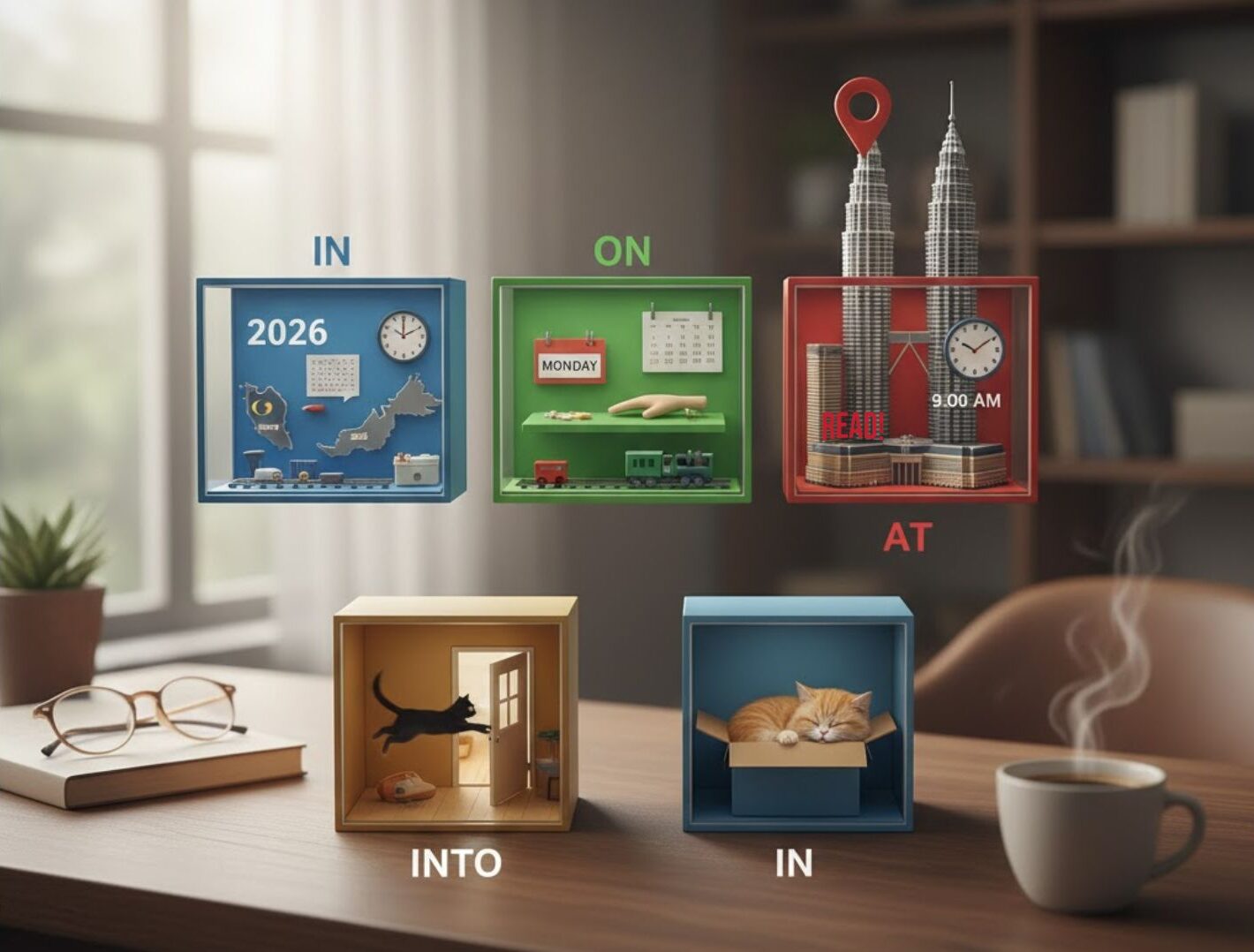
Prepositions of Time
Time is abstract, but English treats it as if it were physical space. We imagine time as something we can point to, place on a calendar, or step inside.
That is why at, on, and in behave differently.
In vs On vs At (Time)
If you have ever hesitated between in Monday and on Monday, you are not alone. The confusion usually comes from translation, not from misunderstanding.
Using the shape model makes this much clearer.
| Preposition | When to Use | Example |
| At | For specific times or moments | at 9 am, at midnight |
| On | For specific days or dates | on Monday, on 12th July |
| In | For larger periods or periods | in 2020, in the morning |
These three rules handle most everyday situations. For more detailed breakdowns of tricky cases such as “at night” versus “in the night,” or when time expressions do not follow the pattern exactly, the discussion in our guide on in vs on vs at prepositions for time explores those subtleties more closely.
Deadlines vs. Duration: By vs. Until
- By (Deadline): No later than a specific time.
Example: “Submit the report by Friday.” (Friday is the latest acceptable time). - Until (Continuation): An action continues up to a certain time, then stops.
Example: “The office is closed until Monday.” (In this case, the waiting continues and ends on Monday.).
Starting Points vs. Duration: Since vs. For
- Since (Starting Point): Refers to when an action began.
Example: “I have lived here since 2018.” - For (Duration): Refers to the length of time an action has lasted.
Example: “I have worked here for five years.”
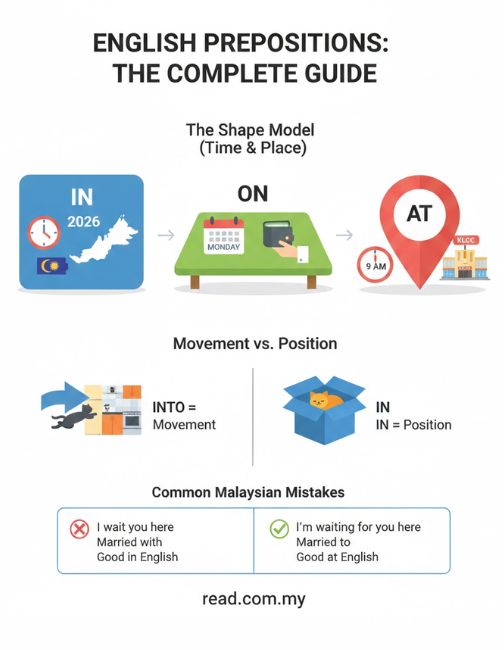
Prepositions of Place
Now let’s return to the same shape model, but apply it to location instead of time.
Preposition | Usage | Examples |
At | Precise points or spots | at the entrance, at Pavilion KL |
On | Surfaces or public transport | on the desk, on the LRT, on the floor |
In | Inside defined boundaries or areas | in Cyberjaya, in the room, in the box |
If you are unsure about borderline cases such as “at the mall” versus “in the mall,” or why we say “on the bus” but “in the car,” those comparisons are examined more thoroughly in the article on in vs on vs at for place, where the container and surface logic is expanded further.
Direction vs. Purpose: To vs. For
- To (Direction/Receiver): Indicates movement toward a place or person.
Example: “I sent the invoice to the client.” - For (Purpose/Benefit): Indicates the purpose of an action or who benefits.
Example: “I am studying for the exam.”
The difference between direction and intended benefit becomes clearer when comparing the examples in the discussion on to vs for, where the receiver-versus-purpose distinction is broken down more carefully.
Movement vs Position: In vs Into
This is a subtle but powerful distinction. Many learners stop at in and never upgrade to into. The key question is: Is something already there, or is it moving?
- In (Position): Something is already inside a space.
Example: “The documents are in the drawer.” - Into (Movement): Indicates movement from outside to inside.
Example: “He ran into the office.”
Common Malaysian Preposition Mistakes
These mistakes are extremely common in daily conversation.
| Mistake | Correct Version |
| I wait you here | I’m waiting for you here |
| Married with | Married to |
| Good in English | Good at English |
| Arrived to the airport | Arrived at the airport |
| Return back the form | Return the form |
| Discuss about the issue | Discuss the issue |
These corrections may look small, but they significantly improve your professional tone.
Prepositions in Workplace English
In professional settings, using the correct preposition can make all the difference. Here are some examples of how prepositions shape formal communication:
- Please submit the final draft by Thursday afternoon.
- The meeting will be held at our KL Sentral office.
- Kindly send the invoice to the finance department.
- The payment was received on 12 January.
- We will discuss the budget during the meeting.
- The issue arose because of a system error.
Using the right prepositions helps avoid awkward phrasing and ensures your message is clear and professional.
Quick Reference Table
| Situation | Preposition | Example |
| Exact time | at | at 9am |
| Specific day | on | on Tuesday |
| Month/year | in | in 2026 |
| City/country | in | in Malaysia |
| Specific location | at | at KLCC |
| Surface | on | on the desk |
| Direction | to | go to Penang |
| Purpose | for | for marketing use |
| Deadline | by | submit by Friday |
| Continuous action | until | open until midnight |
| Starting point | since | since 2020 |
| Duration | for | for five years |
| Movement inside | into | walk into the room |
Mini Quiz
Fill in the correct preposition.