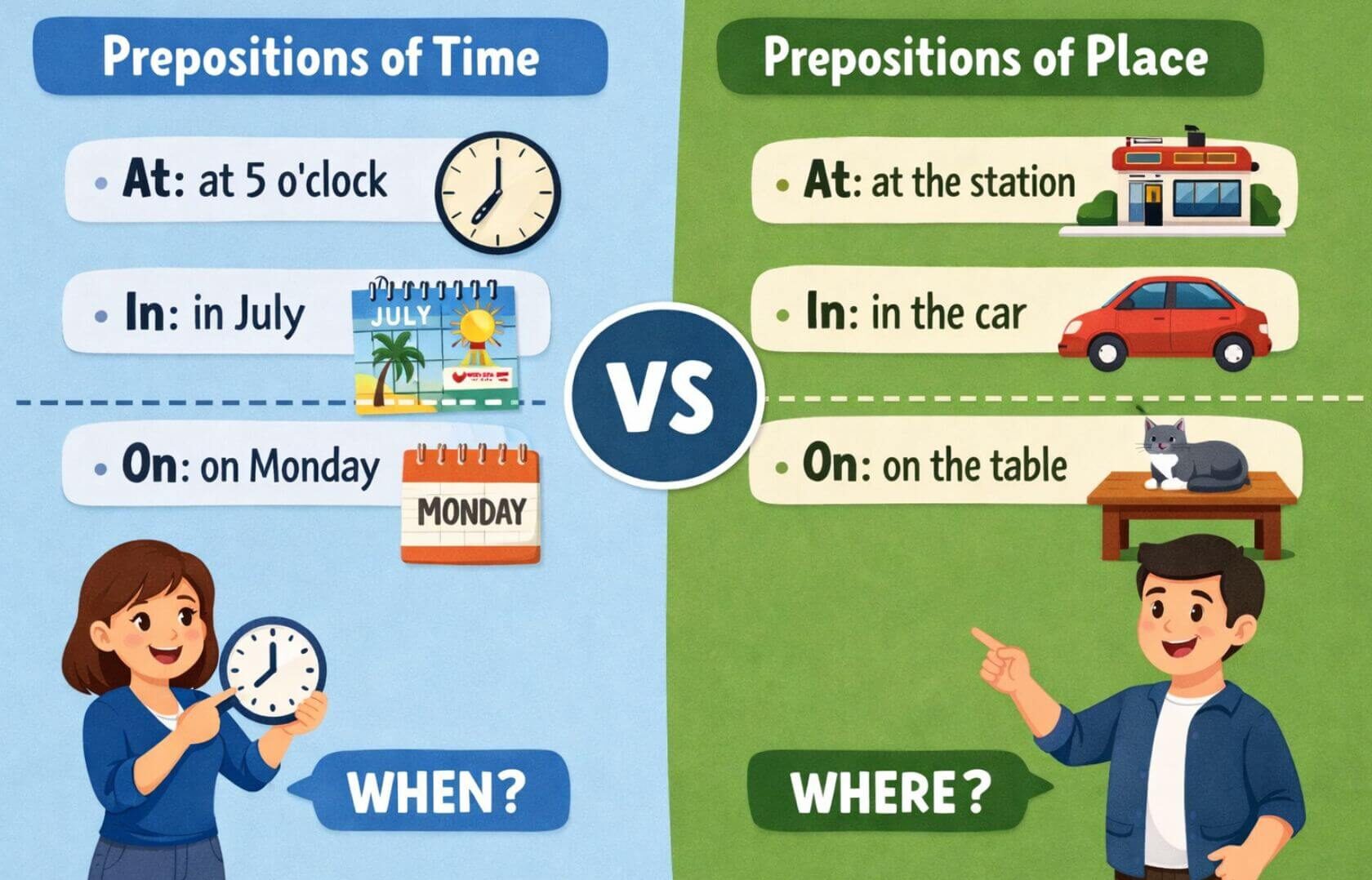

In, on, and at for time follow a simple “pyramid” pattern: in for long periods, on for days and dates, and at for exact moments.
If you’ve ever said:
I will see you on 8pm.
My birthday is at October.
We are meeting in Monday.
You are not alone! Malaysians often mix these up because Manglish tends to reuse one preposition for everything, especially “on” (e.g., “I reach on 8 o’clock”).
This guide makes it easy with a zoom-level rule, local examples (Merdeka Day, Chinese New Year, work meetings), and a quick cheat sheet you can remember instantly.
The “Zoom Level” for Time
Think of time like a calendar or funnel. We start broad and get more specific as we go down.
- IN = Long Periods (Months, Years, Centuries)
- ON = Days and Dates (Specific 24-hour periods)
- AT = Precise Moments (Clock times, Mealtimes)
1. How to Use IN for Time
Use in for “large” containers of time where you don’t need to be exact, for anything that is a “period” of time longer than a day.
- Months: In January, in August.
- Years & Decades: In 2026, in the 90s.
- Seasons: In (the) spring, in monsoon season.
- Long Periods: In the past, in the 21st century, in the future.
- Parts of the Day: In the morning, in the evening.
Common Mistake: We say “in the morning,” but we say “at night.” English is weird like that!
“In” vs “Within” (Duration)
“In” doesn’t just mean “inside”; it can mean “after a period of time.”
- “I will be ready in 5 minutes.” (Meaning 5 minutes from now).
- “I will finish within 5 minutes.” (Meaning it might take 2, 3, or 4 minutes).
2. How to Use ON for Time
Use on for specific days or any date that has a “day” (24-hour block) in it.
- Days of the Week: On Monday, on Friday, on weekends
- Full Dates: On 31st August, on October 19th.
- Special Days: On my birthday, on New Year’s Day.
- Day + Part of Day: On Tuesday morning, on Friday night.
3. How to Use AT for Time
Use at for the “pinpoint” on the clock(Precise Moments). It’s for the most specific times.
- Clock Times: At 8:00 AM, at 5:30 PM, at midnight.
- Mealtimes: At lunchtime, at break time, at breakfast.
- Specific Expressions: At the moment, at sunset, at night.
Note: Always use at night (unless talking about a specific moment in the night).
Quick Comparison Table (Cheat Sheet)
| Preposition | Use it for… | Examples |
| IN | Long periods / General | In 2026, in June, in the morning |
| ON | Days / Dates | On Monday, on 1st May, on my birthday |
| AT | Precise clock times | At 9pm, at lunchtime, at midnight |
The “Golden Rule”: No Preposition Needed!
Malaysians often add “in/on/at” when they shouldn’t. You do not need a preposition if you use these words:
- Next (e.g., See you next Monday, NOT “on next Monday”)
- Last (e.g., I went last month, NOT “in last month”)
- This (e.g., I’m free this evening, NOT “in this evening”)
- Every (e.g., I gym every day, NOT “on every day”)