
E
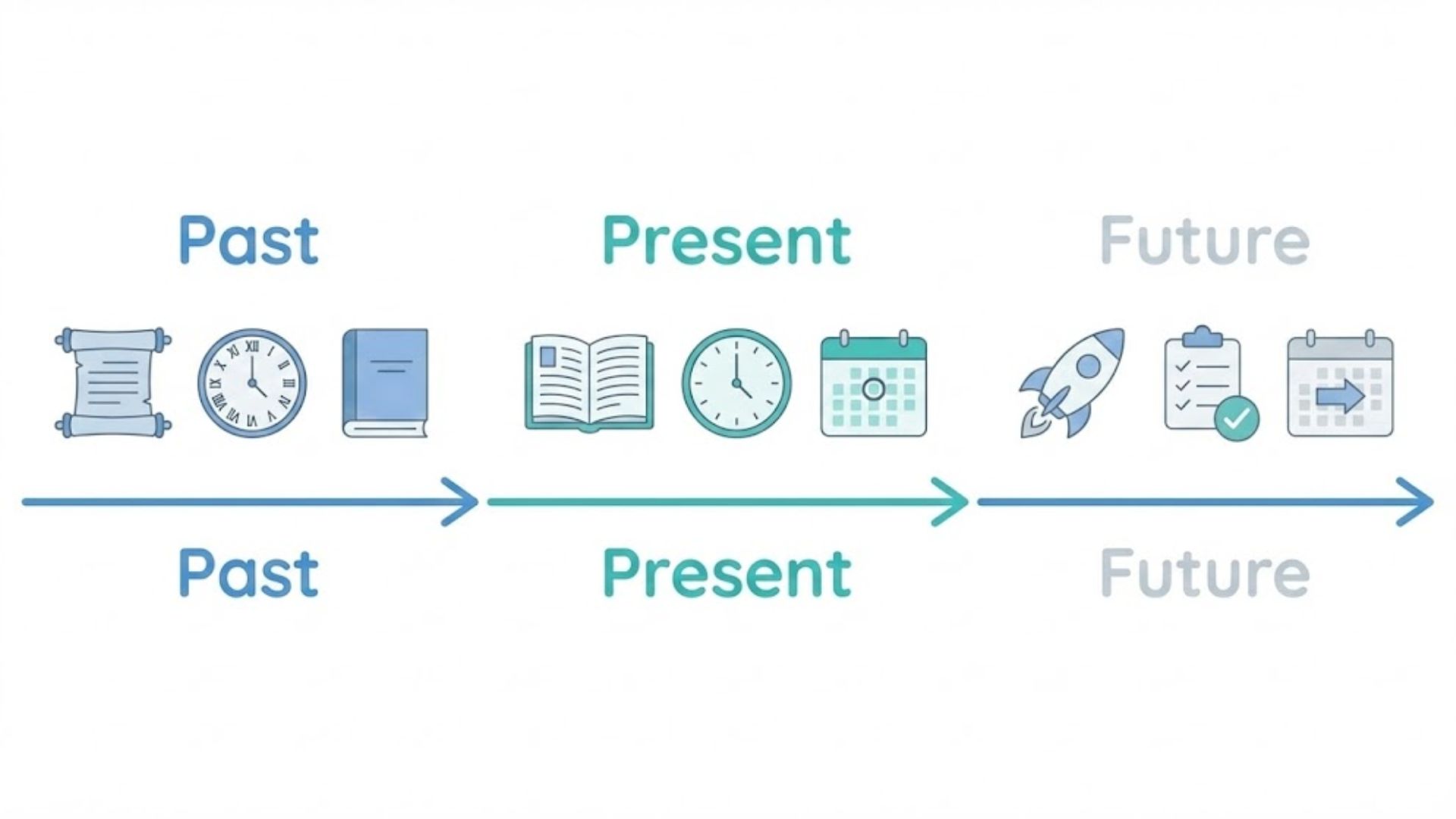
nglish tenses tell us when an action happens, in the past, present, or future. They also show whether an action is finished, ongoing, or repeated.
English tenses are important because they help you:
- Speak clearly and naturally
- Write accurately in school or at work
- Score better in exams
- Avoid misunderstandings in daily communication
Many learners feel English tenses are difficult. The good news is: English tenses follow clear patterns. Once you understand the logic, they become much easier to use.
What is a Tense in English?
A tense shows:
- Time – when the action happens
- Aspect – how the action happens
Simple Definition
A tense tells us when something happens and what stage the action is in.
Examples
- I eat rice every day. (habit – present)
- I am eating rice now. (action happening now)
The verb form changes to give us this information.
Types of Tenses in English (Overview Table)
English has 12 main tenses.
Time | Simple | Continuous | Perfect | Perfect Continuous |
Present | Simple Present | Present Continuous | Present Perfect | Present Perfect Continuous |
| Past | Simple Past | Past Continuous | Past Perfect | Past Perfect Continuous |
Future | Simple Future | Future Continuous | Future Perfect | Future Perfect Continuous |
How This System Works
- English has 3 main time frames: present, past, future
- Each time frame has 4 forms
- Once you learn the pattern, all tenses become predictable
Present Tenses in English (With Examples)
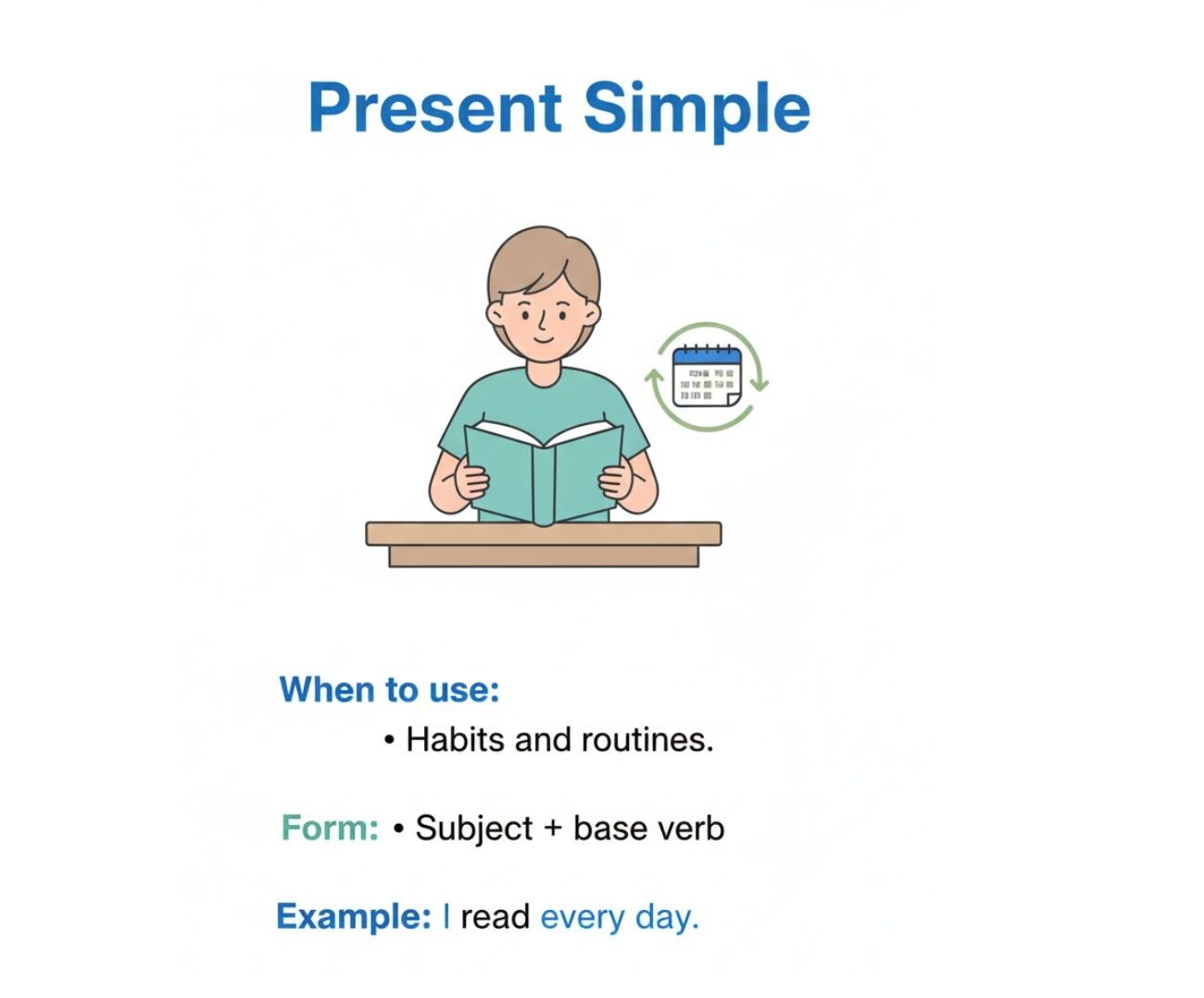
Simple Present Tense
Used for:
- Habits and routines
- General facts
- Permanent situations
Structure: Subject + base verb (+s/es for he/she/it)
Examples:
- I wake up early.
- She works in an office.
Present Continuous Tense
Used for:
- Actions happening now
- Temporary situations
Structure: Subject + am / is / are + verb-ing
Examples:
- I am studying English.
- They are watching TV
The present continuous focuses on actions in progress, temporary situations, and planned arrangements.
If you want a clear, example-based explanation of how the present continuous actually works (and why learners often confuse it with the simple present), read our present continuous tense guide.
Present Perfect Tense
Used for:
- Past actions with present results
- Life experiences
Structure: Subject + has / have + past participle
Examples:
- I have finished my homework.
- She has visited Japan.
Present Perfect Continuous Tense
Used for:
- Actions that started in the past and continue now
- Emphasis on duration
Structure: Subject + has / have been + verb-ing
Example:
- I have been studying for two hours.
Past Tenses in English (With Examples)
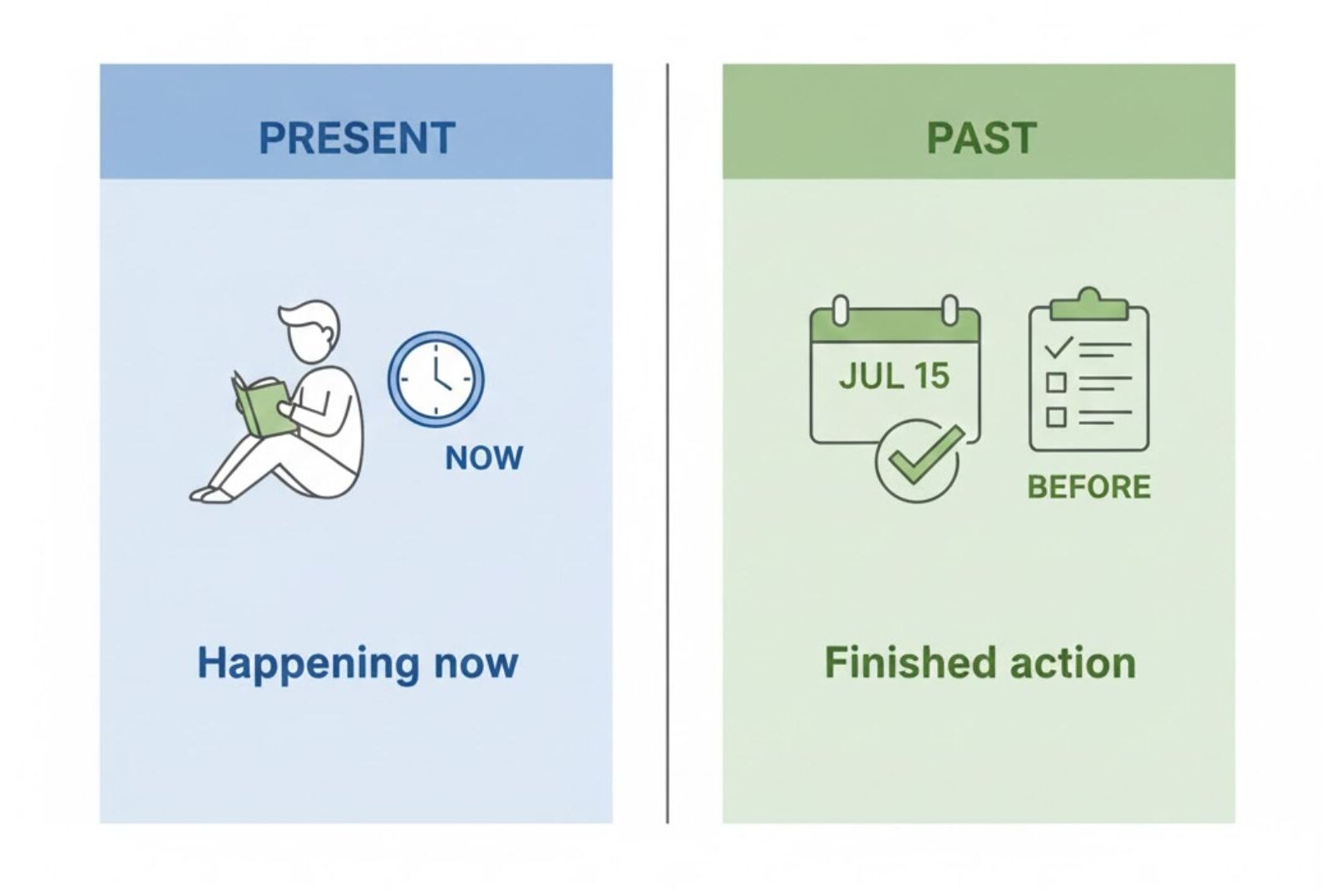
Simple Past Tense
Used for:
- Completed actions in the past
Structure: Subject + verb-ed / irregular verb
Examples:
- I watched a movie last night.
- She went to school yesterday.
Past Continuous Tense
Used for:
- Actions in progress at a specific time in the past
Structure: was / were + verb-ing
Example:
- I was reading when you called.
Past Perfect Tense
Used for:
- An action completed before another past action
Structure: had + past participle
Example:
- She had left before I arrived.
Past Perfect Continuous Tense
Used for:
- Duration of an action before another past action
Structure: had been + verb-ing
Example:
- They had been waiting for an hour.
Future Tenses in English (With Examples)
Simple Future Tense
Used for:
- Decisions made at the moment
- Predictions
Structure: will + base verb
Example:
- I will call you later.
Future Continuous Tense
Used for:
- Actions in progress at a future time
Structure: will be + verb-ing
Example:
- I will be studying at 8 PM.
Future Perfect Tense
Used for:
- Actions completed before a future time
Structure: will have + past participle
Example:
- I will have finished the project by Friday.
Future Perfect Continuous Tense
Used for:
- Duration of an action up to a future point
Structure: will have been + verb-ing
Example:
- She will have been working here for five years.
Common Mistakes Learners Make With Tenses
Many learners struggle with the same issues:
- Mixing present perfect and past simple
- Forgetting has / have
- Using the wrong verb form
- Overusing future tense with will
- Ignoring time expressions
- Translating directly from their native language
Tips to Learn English Tenses Easily
- Learn tenses using timelines
- Focus on when to use, not just structure
- Practice with real-life sentences
- Learn one tense at a time
- Review often, even simple tenses
Consistency matters more than speed.
English Tenses Practice (Quick Exercise)
Fill in the blanks:
- She ___ (work) here since 2020.
- I ___ (watch) TV when he arrived.
- They ___ (finish) the task already.
- We ___ (meet) tomorrow morning.
- He ___ (study) English for two years.
Highlight the Part Below to Reveal the Answers
- has worked
- was watching
- have finished
- will meet
- has been studying
Summary: English Tenses Made Simple
English tenses may seem complex, but they follow a clear system:
- 12 tenses
- 3 time frames
- 4 forms per time frame
Once you understand this structure, learning tenses becomes much easier. With regular practice and correct usage, English tenses start to feel natural and intuitive rather than confusing.
If you want a clear breakdown, examples, and practical exercises to master everything in English step by step, see our English Grammar Complete Guide. Start building confidence in your grammar today and make tense usage effortless in your everyday English.