
Business documents are something most people deal with regularly, yet many find them confusing, even stressful. Payslips, HR letters, internal emails, invoices, and official notices are often filled with unfamiliar terms, abbreviations, and formal language that assume readers already understand what everything means.
This guide helps you understand common terms used in business documents, especially in the Malaysian context. Instead of focusing on systems, rules, or calculations, this article focuses on language and meaning, what these terms mean, where you’ll see them, and how to read documents with confidence.
If you’ve ever looked at a payslip or HR email and thought “I don’t really understand this, but I guess it’s normal”, this guide is for you.
What Are Business Documents?
Business documents are written records used in professional and commercial settings. They communicate information related to employment, payment, operations, and communication.
Why Business Documents Are Hard to Understand
Business documents are not written for learning, they are written for efficiency and consistency. As a result, they share several characteristics that make them difficult to understand:
- Formal tone
Even simple messages sound serious or indirect. - Heavy use of abbreviations
Short forms like PCB, EPF, PO, or EOD save space but reduce clarity. - Assumed background knowledge
Documents often assume readers already know company or system terms. - Mixed language usage
In Malaysia, documents frequently combine English with Malay terms.
Because of this, many people struggle not with English itself, but with workplace-specific vocabulary.
The good news is that most workplace documents reuse the same terms repeatedly. Once you understand these common terms, documents become much easier to read.
Common Types of Business Documents
Business documents appear at different stages of working life. Below are the most common types you’ll encounter and what they are mainly used for.
Here are some documents that regularly appear in working life:
- Employment & HR Documents: These documents often contain formal terms related to salary, benefits, deductions, and obligations. (e.g. Offer letter, confirmation letter)
- Salary & Compensation Documents: These documents explain how you are paid and what is deducted. (e.g. Payslip, Salary adjustment letter)
- Payment & Transaction Documents: These documents record buying, selling, and payments. (e.g. Invoice, Quotation)
- Business Communication Documents: These documents are used for daily workplace communication. (e.g. Business emails, Memos)
- Agreements & Legal Documents: These documents set rules, responsibilities, and expectations. (e.g. Contracts, Agreements)
- Business & Financial Reports: These documents summarise a company’s performance, finances, and activities over a specific period. (e.g. Annual report, Financial statements, Management reports)
Each of these documents uses a predictable set of terms. Let’s break them down.
Quick Reference: Common Business Document Terms
| Term | Document Type | Simple Meaning |
| Payslip | Salary | Monthly salary breakdown |
| PCB | Payslip | Monthly tax deduction |
| EPF | Payslip | Retirement savings |
| SOCSO | Payslip | Social protection |
| EIS | Payslip | Job loss insurance |
| Annual Report | Business Report | Yearly company performance summary |
| Invoice | Payment | Request for payment |
| Receipt | Payment | Proof of payment |
| Offer Letter | HR | Job offer details |
| Probation | HR | Trial employment period |
| CC | Copy recipient | |
| EOD | End of working day |
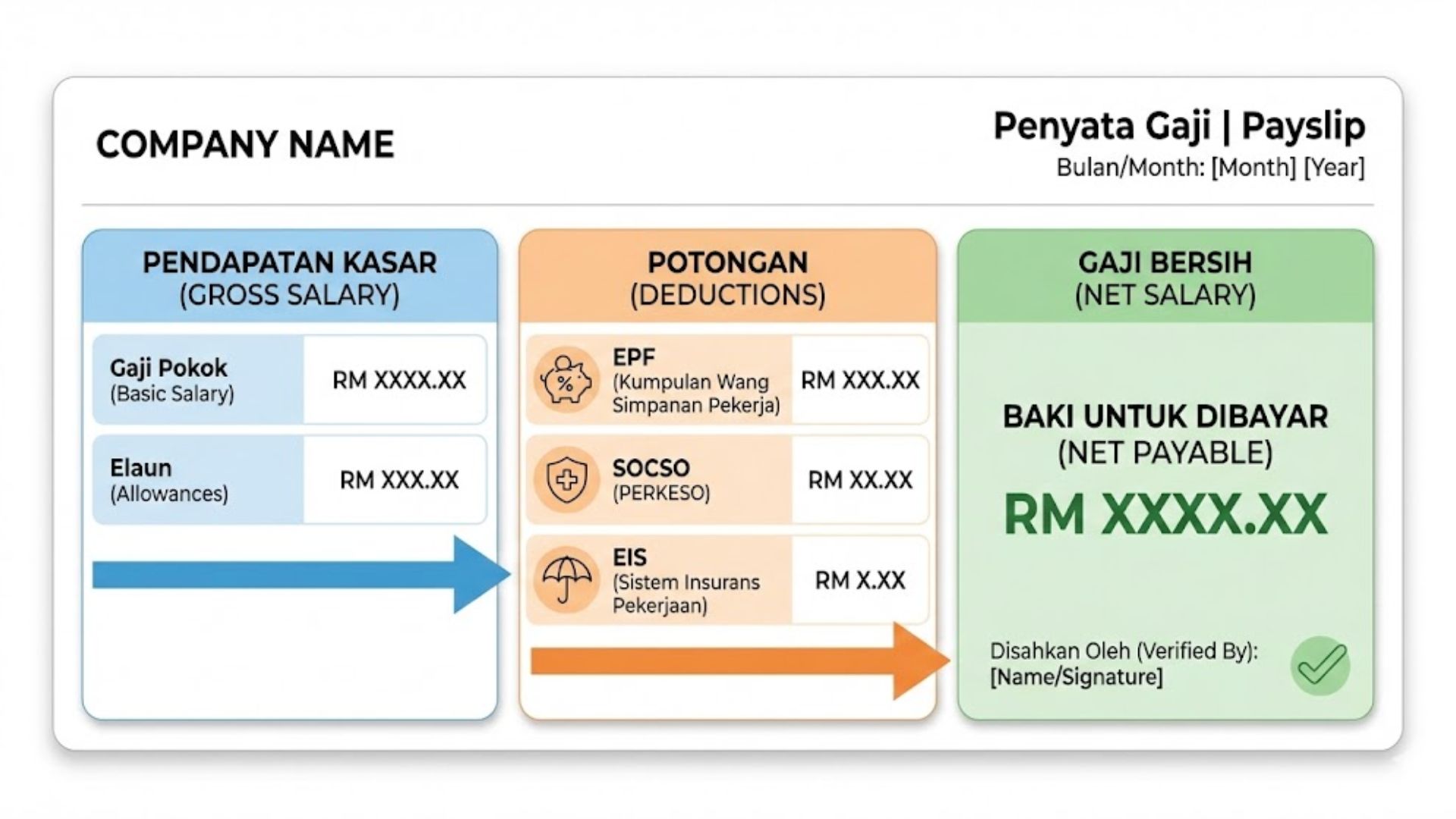
Common Malaysia Payslip Terms Explained
Payslips are one of the most confusing documents for many employees because they contain many abbreviations.
Some common terms you may see include:
- Gross Salary
Your total salary before any deductions. - Net Salary
The amount you actually receive after deductions. - Deduction
Money taken out of your salary (for example, tax or contributions). - Allowance
Extra payment added to your salary, such as transport or phone allowance.
You may also see abbreviations like PCB, EPF, SOCSO, and EIS. These are extremely common in Malaysia and often cause confusion for first-time employees. Understanding these terms is often the first step to understanding business documents as a whole.
Common HR & Office Terms
HR documents often sound serious because they use formal and indirect language, even when the meaning is simple.
Employment Status Terms
- Probation Period
A trial period at the start of a job. - Confirmation
Official approval after passing probation. - Notice Period
Required time before leaving a job.
Policy & Administration Terms
- Policy
A formal rule or guideline set by the company. - Entitlement
Benefits you are eligible to receive. - Discretionary
Given based on management’s decision, not guaranteed.
Understanding these words helps you interpret HR messages accurately instead of assuming the worst.
Common Workplace Email Terms & Phrases
Emails are often short, but the meaning behind the words can be indirect.
Frequently Used Email Terms
- CC (Carbon Copy)
Adds someone to the email for visibility. - BCC (Blind Carbon Copy)
Adds someone without others seeing it. - FYI
For your information (no action needed). - EOD
End of day.
Indirect Workplace Phrases
| Phrase | What It Usually Means |
| “Please take note” | This is important |
| “Kindly advise” | Please reply |
| “Noted” | I’ve read this |
| “As discussed” | Referring to earlier conversation |
These phrases are common in workplace English and often sound more serious than they are.
Business & Payment Document Vocabulary
Business documents focus on transactions and records. The vocabulary is formal but consistent.
Common Terms Explained
- Invoice
A document requesting payment. - Receipt
A document confirming payment. - Purchase Order (PO)
Official request to buy goods or services. - Due Date
Deadline for payment or action.
Understanding these terms prevents confusion when dealing with suppliers, clients, or finance teams.
How to Read Business Documents with Confidence
You don’t need perfect English to understand business documents. Here are a few practical tips:
1. Look for keywords first
Ignore long sentences first. Look for familiar terms like salary, deduction, date, amount.
2. Identify abbreviations
Many documents reuse the same short forms. Once you learn them, they keep repeating.
3. Check headings and tables
Tables and headings often explain meaning visually.
4. Separate tone from meaning
Formal language doesn’t always mean bad news.
5. Don’t assume you’re the only one confused
Many workplace terms are unclear, even to experienced employees.
6. Look for repeated terms
If a word appears multiple times, it is usually important.
Understanding the language removes much of the anxiety around documents. This approach also applies to longer documents like annual reports, where the same terms are often repeated across sections.
Start With Understanding, Then Build Confidence
Business documents are part of everyday professional life. When you understand the language used in them, you feel more confident, informed, and in control.
This pillar is your starting point. As part of our language learning hub, it helps you build real-world understanding of business and workplace language.. From here, you can explore individual guides that explain specific terms in more detail, one document, one word, one explanation at a time.
Disclaimer: This guide explains what business document terms mean in plain English. It does not provide legal, tax, or financial advice. The goal is to help readers understand workplace terminology, read business documents with confidence, and communicate more clearly in professional settings.