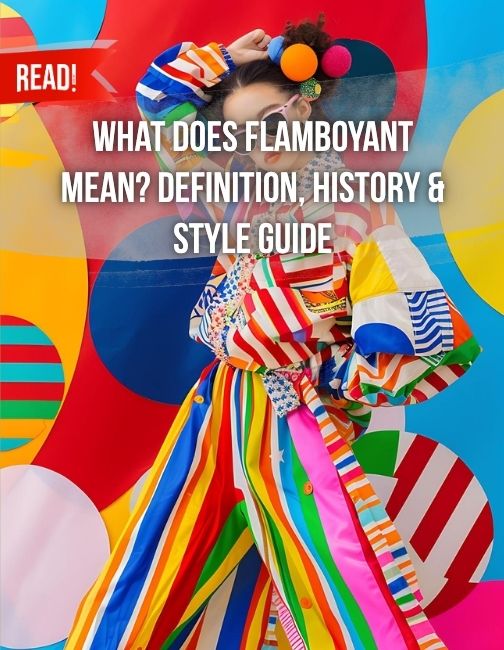
Flamboyant means bold, colourful, extravagant or theatrical in a way that attracts attention. It describes people, clothing, personalities, artwork and interior designs that stand out through expressive details and a strong sense of style. The word is often positive, suggesting confidence, creativity and individuality rather than simply showing off.
For example, a person wearing a brightly coloured suit with intricate embroidery might be described as flamboyant. A restaurant with dramatic lighting, ornate decorations and rich colours could also have a flamboyant interior.
In everyday life, flamboyant is a useful word for describing something that is more expressive and theatrical than ordinary. It is not necessarily expensive, and it does not always mean excessive or tasteless.
The key idea is bold self-expression that makes an impression.
Understanding Flamboyant Through Everyday Examples
Flamboyant style is easier to recognise when you look at how it appears in everyday situations.
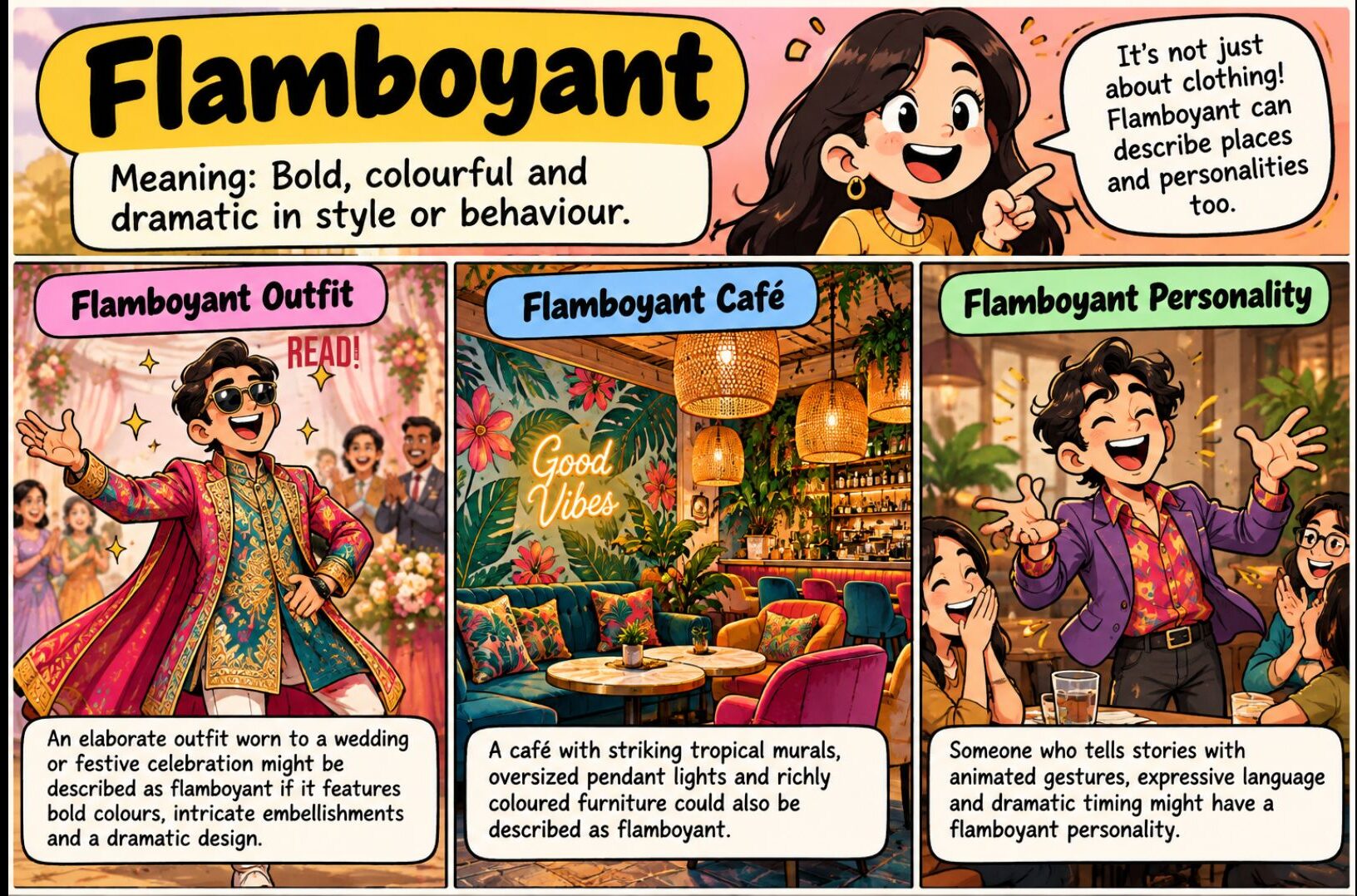
In Malaysia, an elaborate outfit worn to a wedding or festive celebration might be described as flamboyant if it features bold colours, intricate embellishments and a dramatic design. The same word could describe a café with striking tropical murals, oversized pendant lights and richly coloured furniture.
Flamboyance is not limited to appearance, either. Someone who tells stories with animated gestures, expressive language and dramatic timing might have a flamboyant personality.
These examples share one quality: they make an impression through boldness and expressive character.
Here are three common ways to use the word:
- Fashion: “She wore a flamboyant outfit with vibrant colours and intricate embroidery.”
- Interior design: “The restaurant has a flamboyant interior, with ornate mirrors and dramatic lighting.”
- Personality: “He has a flamboyant personality and loves entertaining people with his stories.”
In each example, flamboyant describes something distinctive and expressive, rather than simply something bright or expensive.
Where Does the Word Flamboyant Come From?
The word flamboyant comes from French and is associated with the idea of flames. Its history is closely linked to Flamboyant Gothic, a late phase of Gothic architecture that developed in France during the late Middle Ages.
Architects of this period created elaborate stone tracery in church windows, using flowing, curved patterns that resembled flickering flames. This flame-like appearance gave the architectural style its name.
Over time, flamboyant developed a broader meaning. It came to describe people, objects and artistic expressions that share a similar sense of visual drama and boldness.
The connection remains easy to remember. Just as flame-like stone patterns made Gothic windows distinctive, flamboyant clothing, artwork or interiors stand out through expressive details.
Today, the word is commonly used in fashion, design, entertainment and everyday descriptions of personality.
What Are the Main Characteristics of Flamboyant Style?
Flamboyant style generally has three defining characteristics: visual impact, expressive individuality and a sense of drama.
1. Bold Visual Impact
Flamboyant things attract attention through striking colours, unusual shapes, elaborate decorations or dramatic presentation.
A flamboyant outfit might feature a vibrant colour combination, a distinctive silhouette or eye-catching accessories. A flamboyant interior might use patterned wallpaper, sculptural furniture and ornate lighting to create a memorable atmosphere.
However, bright colours alone do not automatically make something flamboyant. The overall effect needs to feel notably bold or expressive.
2. Individuality and Self-Expression
Flamboyant style often communicates a strong sense of personality or creative vision.
For example, someone who enjoys combining unusual patterns, statement accessories and dramatic clothing may have a flamboyant fashion sense. An artist who uses vivid colours and exaggerated forms may also be described as flamboyant.
This does not mean every flamboyant choice must be perfectly coordinated. The important point is that the style creates a distinctive impression.
3. Theatricality and Energy
Flamboyant things often feel dramatic, lively or larger than life.
A singer wearing an elaborate stage costume, a performer using expressive gestures or a hotel lobby decorated with oversized floral installations could all be described as flamboyant.
The word is particularly useful when ordinary descriptions such as colourful or beautiful do not fully capture the scale, drama or personality of something.
Flamboyant in Movies: How the Word is Used in Real Dialogue
Sometimes, the easiest way to understand a word is to hear how people use it in everyday conversation. The word flamboyant also appears in films, where its meaning becomes clearer through the situation and the speaker’s tone.
Here are two examples from the big screen.
1. Find Me Guilty (2006)
“You will hear a lot about my client’s flamboyant lifestyle.”
In this line, flamboyant describes someone’s lifestyle as extravagant, conspicuous or larger than life. It suggests a way of living that attracts attention, whether through appearance, behaviour or personal choices.
Notice that the word does not automatically mean the lifestyle is good or bad. The surrounding conversation determines whether it sounds admiring, critical or simply descriptive.
2. The Suicide Squad (2021)
“I’m sorry it’s so flamboyant.”
Here, flamboyant refers to something noticeably bold, dramatic or over the top. Depending on the scene, the line can sound apologetic, playful or self-aware, as though the speaker recognises that their choice is more attention-grabbing than usual.
This is a useful reminder that flamboyant does not always describe a person’s personality. It can also describe an outfit, an object, a design or anything with a particularly theatrical appearance.
What These Lines Tell Us
Both examples show that flamboyant is a flexible word. It can describe an extravagant lifestyle or something visually dramatic, and it can be used in either a neutral or a playful context.
The next time you encounter something bold, expressive or unmistakably theatrical, you might find that flamboyant is a more precise choice than simply calling it flashy or colourful.
A Simple Tip for Using Flamboyant Correctly
If you only mean that something has many colours, colourful may be more accurate. If you mean that something is expensive or elaborate, extravagant may fit better. If you want to suggest that something is excessively decorated in an unattractive way, gaudy is often more suitable.
Choosing the right word helps you describe not just what something looks like, but also the impression it creates.
Flamboyant vs Flashy vs Gaudy vs Kitsch vs Camp
Flamboyant is often confused with words such as flashy, gaudy, kitsch and camp because they can all describe things that attract attention. However, each word emphasises a different quality.
Word | Meaning | Example |
Flamboyant | Bold, expressive and theatrical | A performer wearing a dramatic, colourful costume |
Flashy | Designed to attract attention, sometimes through an obvious display of wealth | A luxury car with conspicuous styling |
Gaudy | Excessively bright or decorated, often in a way considered unattractive | A room overwhelmed by clashing colours and glitter |
Kitsch | Art or decoration associated with sentimental, quirky or exaggerated popular taste | A novelty clock shaped like a giant cat |
Camp | Deliberately exaggerated theatricality, often involving humour, irony or playful excess | An over-the-top performance with extravagant costumes and exaggerated gestures |
Flamboyant vs Flashy
Something flashy catches your eye, but the word can suggest a display intended to impress others, sometimes through wealth or status.
For example:
“He arrived at the event in a flashy sports car.”
This sentence may suggest that the car is intended to make an impression.
Now consider:
“The singer is known for her flamboyant stage costumes.”
Here, the focus is on theatrical expression and artistic style rather than simply showing off.
The distinction is not absolute. A flashy outfit can also be flamboyant, and a flamboyant person can enjoy luxury. The words simply emphasise different aspects of the same thing.
Flamboyant vs Gaudy
Gaudy is generally more negative than flamboyant.
It describes something excessively bright, colourful or decorated in a way that seems unattractive or lacking in restraint.
For example:
“The decorations were so gaudy that they overwhelmed the small room.”
Compare this with:
“The ballroom was decorated in a flamboyant style, with dramatic chandeliers, rich colours and elaborate floral displays.”
Both descriptions suggest visual excess, but the second is more appreciative of the design’s theatrical effect.
This is an important distinction to remember if you want to compliment someone’s appearance or creative choices without accidentally sounding rude.
Flamboyant vs Camp
Camp is a little more nuanced.
It often involves exaggerated theatricality, artificiality or deliberate excess that audiences enjoy because it is humorous, playful or knowingly over the top.
Think of a performance featuring enormous wigs, exaggerated gestures, extravagant costumes and dramatic poses that seem to wink at the audience.
That could be camp.
If the costumes are also bold, colourful and attention-grabbing, they might be flamboyant too.
The difference is that flamboyant emphasises boldness and expressive style, while camp often adds a sense of theatrical exaggeration, irony or playful self-awareness.
In short, something can be flamboyant without being camp, and something can be both.
Is Flamboyant a Compliment?
Generally, yes. In many modern contexts, describing someone or something as flamboyant suggests admiration for its boldness, creativity or theatrical appeal.
Calling an outfit flamboyant can be a compliment. Describing an artist as flamboyant may suggest that their work is expressive and memorable. A flamboyant interior can be praised for its distinctive character.
However, context matters.
Imagine someone saying:
“Her flamboyant dress was the most memorable outfit at the event.”
That sounds appreciative.
Now consider:
“He has a rather flamboyant way of behaving.”
Depending on the speaker’s tone, this could sound admiring, amused or mildly critical.
The word itself does not guarantee a positive or negative judgement. The surrounding sentence and the speaker’s intention help determine how it comes across.
If you want to compliment someone, you can make your meaning clearer by adding words such as beautiful, creative, confident or striking.
For example:
“I love your flamboyant style. It is so expressive and full of personality.”
That makes your appreciation unmistakable.
Can a Quiet Person Be Flamboyant?
Yes. Flamboyant describes a person’s style or manner of expression, not necessarily how outgoing they are.
A quiet person may have a flamboyant fashion sense, enjoy dramatic interior design or create artwork with bold colours and elaborate details. They may prefer expressing themselves visually rather than through conversation.
Similarly, a writer can have a flamboyant writing style through vivid descriptions, expressive language and dramatic imagery without being particularly outgoing in everyday life.
There is no contradiction.
Being flamboyant does not mean demanding attention from everyone. It means embracing an expressive style that stands out.
Nor does it mean that everyone needs to be flamboyant. Understated design, simple clothing and quieter personalities can be just as appealing.
The word simply gives us a way to describe one particular kind of expression.
How Can You Add Flamboyant Style to Everyday Life?
You do not need an expensive wardrobe or a dramatically decorated home to appreciate flamboyant style.
A single statement piece can introduce a bold element to an otherwise simple look. For example, a colourful handbag, an unusual pair of shoes or a patterned jacket can make a neutral outfit more expressive.
The same principle applies to interior design. A striking artwork, a sculptural lamp or a richly coloured accent chair can add personality to a room without overwhelming the entire space.
If you enjoy creative activities, you can also explore flamboyance through photography, painting, writing or presentation design. Experimenting with bold colours, expressive details and dramatic compositions can help you develop a more distinctive style.
The aim is not to make everything extravagant. It is to make deliberate choices that reflect your taste and personality.
For some people, flamboyant style means vibrant colours and elaborate details. For others, it might mean one dramatic feature against a relatively simple background.
There is no single formula. What matters is the overall impression.
Final Thoughts: Flamboyant is About More Than Being Seen
Flamboyant is more than just being colourful or flashy. It can describe fashion, interiors, personalities and performances that leave a lasting impression.
Although it shares similarities with words like gaudy, flashy, kitsch and camp, each has its own meaning and nuance.
Understanding these differences helps you use the word more naturally and accurately.
After all, the most interesting things are not always the ones that simply catch our attention, but the ones that leave us with something to remember.
Understanding words like flamboyant is a simple way to build a richer vocabulary and express yourself more precisely. If you enjoy learning how English words are used in real life, explore READ, an online English learning platform for practical vocabulary guides, grammar tips and everyday English explanations designed with Malaysian learners in mind.