
Key Takeaways
- It’s a Manglish slang phrase used when someone feels left out.
- “Bo” means no / didn’t, while “jio” means invite.
- Most people say it jokingly among friends.
- It can apply to many situations.
- Words like “lah” make the expression sound more natural.
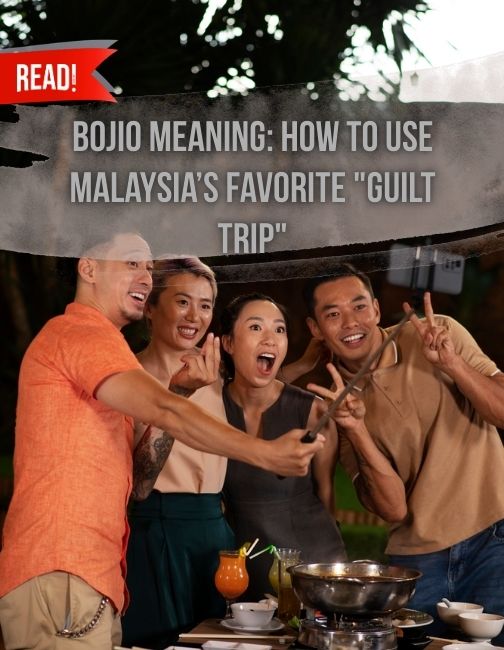
On a cozy weekend, you’re lying on the couch scrolling through Instagram when you see your makan gang (buddies) at that new viral hotpot place in SS15, steam rising, wagyu on the table, everyone smiling in the photo but you aren’t in the photo.
Your thumb twitches. You type five letters that carry the weight of a thousand betrayals: “BOJIO!”
In Malaysia, Bojio isn’t just a word; it’s a lifestyle. It’s the official anthem of FOMO (Fear Of Missing Out). But if you’re using it literally, you’re missing the soul of the slang. Let’s break down the bojio meaning, its Hokkien roots, and how to use it without sounding like a textbook.
5-Second Summary: What is Bojio?
- The Literal Meaning: “No invite” or “Didn’t invite.”
- The Origin: Derived from the Hokkien dialect (Bo = No; Jio = Invite).
- The Usage: A playful, sarcastic, or mildly offended way to tell someone they should have included you in their plans.
The Origin: Why “Bo” and “Jio”?
Like most Manglish expressions, Bojio is a linguistic rojak.
It comes from the Hokkien dialect, where “Bo” means “without” or “did not have,” and “Jio” means to “invite” or “call.” In the early 2000s, this phrase exploded across Malaysian social media, becoming the go-to comment for every group photo posted online.
Today, it’s used by Malaysians of all races. Whether you’re at a Mamak in Penang or a cafe in Bangsar, the “Bojio” sentiment is universal.
The 3 Levels of “Bojio”
Don’t just throw the word around. You need to match the “Bojio” to the level of betrayal.
Level 1: The Casual Tease
Your friend posts a photo of a bubble tea they just bought.
- You: “Wah, Starbucks ah? Bojio!”
- Translation: “That looks good. I’m jealous, but I’m just making conversation.”
Level 2: The Social Media “Attack”
You see a group photo of your colleagues at a karaoke session on a Friday night.
- You: “Wah, big group ah… everyone there except me. Bojio me!”
- Translation: “I am actually a little hurt that I wasn’t asked, but I’m going to hide it behind this slang so I don’t look sensitive.”
Level 3: The True Betrayal
Your best friends go on a weekend trip to Melaka without telling you.
- You: “Siao ah? Melaka also bojio? Cut friend lah like this.”
- Translation: “You have committed a social crime. You owe me a very expensive dinner to make up for this.”
How to Respond When You Get “Bojio-ed”
Being on the receiving end of a “Bojio” can be leceh (troublesome). Here is how to defend yourself like a local:
- The “Next Time” Promise: “Relax lah, next round I jio you confirm!”
- The “You Were Busy” Defense: “I thought you were working! Don’t be like that.”
- The “Abuden” (The Aggressive Counter): “Abuden! You didn’t reply to the group chat for three days!”
Common Phrases Used With Bojio
Manglish is all about the “flavour” words. To sound natural, pair Bojio with these:
- “Bojio lah!” – Adds a touch of playful frustration.
- “Why always bojio me?” – A classic “poor me” statement.
- “Don’t FFK and then say people bojio.” – A reality check for friends who cancel plans last minute (FFK).
Stop Being a “Bojio” Friend
Understanding the bojio meaning is your ticket to better Malaysian friendships. It shows you understand the culture of inclusion and the “guilt-trip” humor that keeps us all connected.
Conclusion
The bojio meaning is simple but culturally rich. At its core, it means “you didn’t invite me,” but Malaysians usually say it in a playful, friendly way.
Because Manglish blends multiple languages and cultures, expressions like bojio help capture everyday Malaysian humor and social life. Once you start recognising these phrases, conversations become much easier to understand.
Tired of being the one left out? Check out our guide ‘Lah’ so you can blend in better, help you sound more natural when interacting with Malaysians.
At READ – Language Learning Hub, we aim to make language learning practical, fun, and connected to real-life communication. Feel free to explore more guides and discover the fascinating world of Manglish.
FAQs About Bojio Meaning
Is "Bojio" rude?
Almost never. In 99% of cases, it’s a joke between friends. However, don’t say it to your CEO if they post a photo of a high-level board meeting. That’s just awkward.
Can I use it in formal writing?
Absolutely not. Keep it for WhatsApp, Instagram comments, and Mamak sessions.
Is it only used in Malaysia?
You’ll hear it in Singapore (Singlish) too, as they also have a strong Hokkien influence.
What is the opposite of Bojio?
There isn’t a direct one-word opposite, but you could say “Jio” (e.g., “He jio me to the movies”).
Where does the word bojio come from?
The word comes from Hokkien dialect. “Bo” means “don’t have” or “didn’t,” and “jio” means “invite.”
How do you respond if someone says bojio?
You can respond casually, such as:
- “Next time I invite you.”
- “You were busy!”
- “Okay next round you join.”
It’s usually part of a friendly conversation rather than a serious complaint.