Have you ever noticed that English speakers often leave sentences “unfinished,” yet you still understand them perfectly?
- Friend A: “Are you coming to the party?”
- Friend B: “I might [ ]” (Instead of “I might come to the party”).
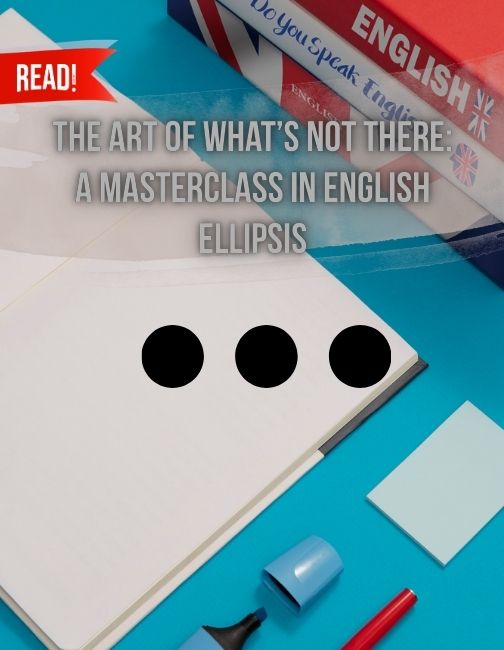
This “missing” piece isn’t a mistake, it’s a sophisticated linguistic tool called Ellipsis. Whether you are looking for the three dots (…) or the omission of words, this guide covers everything you need to ace your exams and sound like a native.
Read to the end to discover the “Hidden Trap” that most students fall into during writing exams!
What is Ellipsis?
In English grammar, ellipsis refers to the intentional omission of one or more words from a sentence that is already understood from the context (like the “Ghost” in the Sentence). It’s the “dark matter” of language, invisible, yet it holds the whole structure together. You hear it in the most famous movie lines without even realising that half the sentence is missing.
1. Grammatical Ellipsis (The “Invisible” Words)
This occurs when we skip words because they are redundant.
- Full: “I went to the mall and my sister went to the mall too.”
- Elliptical: “I went to the mall and my sister did“
2. Punctuation Ellipsis (The Three Dots)
This refers to the mark “…” used to show a pause, an unfinished thought, or a deleted section of a quote.
Types of Grammatical Ellipsis
To outrank, you must understand the three technical types of ellipsis often tested in IELTS, TOEFL, and Cambridge exams.
| Type | Description | Example |
| Textual Ellipsis | Removing words already mentioned in the text. | “He likes tea; she [likes] coffee.” |
| Situational Ellipsis | Removing words understood from the physical environment. | “[Do you] Want a drink?” |
| Structural Ellipsis | Removing “function” words (common in headlines or titles). | “Man [who was] found on moon.” |
Tip: Using situational ellipsis in speaking tests boosts your fluency. However, overusing it in writing can lead to a Linguistic Shift where your professional prose starts to look like a movie script.
How to Use the Ellipsis Punctuation (…) Correctly
Here is the definitive standard for your writing:
1. In Quotations
If you are quoting a long passage but only need the beginning and the end, use an ellipsis to bridge the gap.
“The report stated that the economy is growing… despite the recent challenges.”
2. To Create Suspense or Hesitation
In creative writing, it signals a trailing off or a realisation.
“I thought I saw someone in the hallway… but nobody was there.”
3. The “Four-Dot” Rule
If an ellipsis comes at the end of a full sentence, you use a period followed by the ellipsis.
“I’m not sure what to say…. Let’s talk tomorrow.”

Ellipsis in Daily Conversations vs. Exams
Casual Use (Highly Recommended)
In texting and speaking, ellipsis makes you sound natural.
- “Been there, done that.” (Omits “I have”)
- “See you later.” (Omits “I will”)
Academic/Exam Use (Handle with Care)
In formal writing, you should never use the “…” punctuation to show hesitation. However, you should use grammatical ellipsis to improve your “Cohesion and Coherence” score.
- Bad (Repetitive): “Some people prefer city life, and some people prefer country life.”
- Good (Elliptical): “Some people prefer city life; others, the country.”
Common Pitfalls: Don’t Lose Marks Here!
Ambiguity: If the omitted word isn’t obvious, don’t remove it.
- Confusing: “John likes Mary more than Paul.” (Does John like Mary more than Paul likes her? Or does John like Mary more than he likes Paul?)
Verb Agreement: Ensure the auxiliary verb matches the new subject.
- Correct: “I have finished, and she has” (Not “she have”).
The “Space” Debate: Most style guides (like Oxford) suggest a space before and after the dots (word … word), but always check your specific style guide!
Conclusion: Mastering the Invisible
Ellipsis isn’t just about what you leave out; it’s about the efficiency and rhythm of your communication. By mastering the “invisible” words in grammar, you transition from a student who follows rigid rules to a communicator who understands the natural flow of English.
Whether you’re aiming for a Band 8 in IELTS or just trying to text your friends, remember: Less is often more. If you’re ready to master these advanced techniques, our online learning platform at READ – Language Learning Hub offers the practical exercises you need to succeed.