


Why “Lah” Is Everywhere in Manglish
If you spend any time in Malaysia, you will hear “lah” almost immediately. It appears at the end of sentences, sometimes in the middle, and occasionally on its own. To non-locals, it can sound confusing or unnecessary. To locals, it feels completely natural.
“Lah” is one of the most recognisable particles of Manglish. Yet it is also one of the most misunderstood. Many people assume it has a direct meaning, like a normal English word. In reality, “lah” works very differently.
This guide explains what “lah” actually does in Manglish, how tone and context affect its meaning, and why it plays such an important role in everyday Malaysian communication.
What Does “Lah” Mean in Manglish?
“Lah” does not have a direct dictionary definition, it changes how a sentence feels.
“Lah” is what linguists call a pragmatic particle. Instead of adding information, it shapes the tone of a sentence. When someone uses “lah”, they are often adjusting how their words sound rather than what they say.
Compare these examples:
- “Can.”
- “Can lah.”
Both sentences communicate agreement. The second sounds more relaxed, reassuring, and friendly. This is why trying to define “lah” with a single English word does not work. Its function is emotional and social, not grammatical.
To understand this more broadly, it helps to first know what is Manglish and how it operates as a spoken variety of English rather than a formal system.
Why Do Malaysians Use “Lah” So Often?
“Lah” reflects communication style, not language level.
In Malaysian conversations, sounding too direct can feel blunt or unfriendly. “Lah” helps soften statements, show reassurance, or signal familiarity between speakers.
This habit comes from Malaysia’s multilingual environment. Languages such as Malay, Cantonese, Hokkien, and other regional languages frequently use sentence-ending particles to manage tone. Manglish absorbed this pattern naturally.
As a result, “lah” is not a sign of casual English. It is a tool that helps speakers sound approachable and socially aware.
How Does Tone Change the Meaning of “Lah”?
Tone determines whether “lah” sounds friendly, firm, or dismissive.
The same sentence can mean very different things depending on how “lah” is delivered.
Sentence | Tone | Effect |
“Okay lah~” | Gentle | Acceptance or reassurance |
“Okay lah.” | Flat | Reluctant agreement |
“Okay lah!” | Sharp | Impatience or frustration |
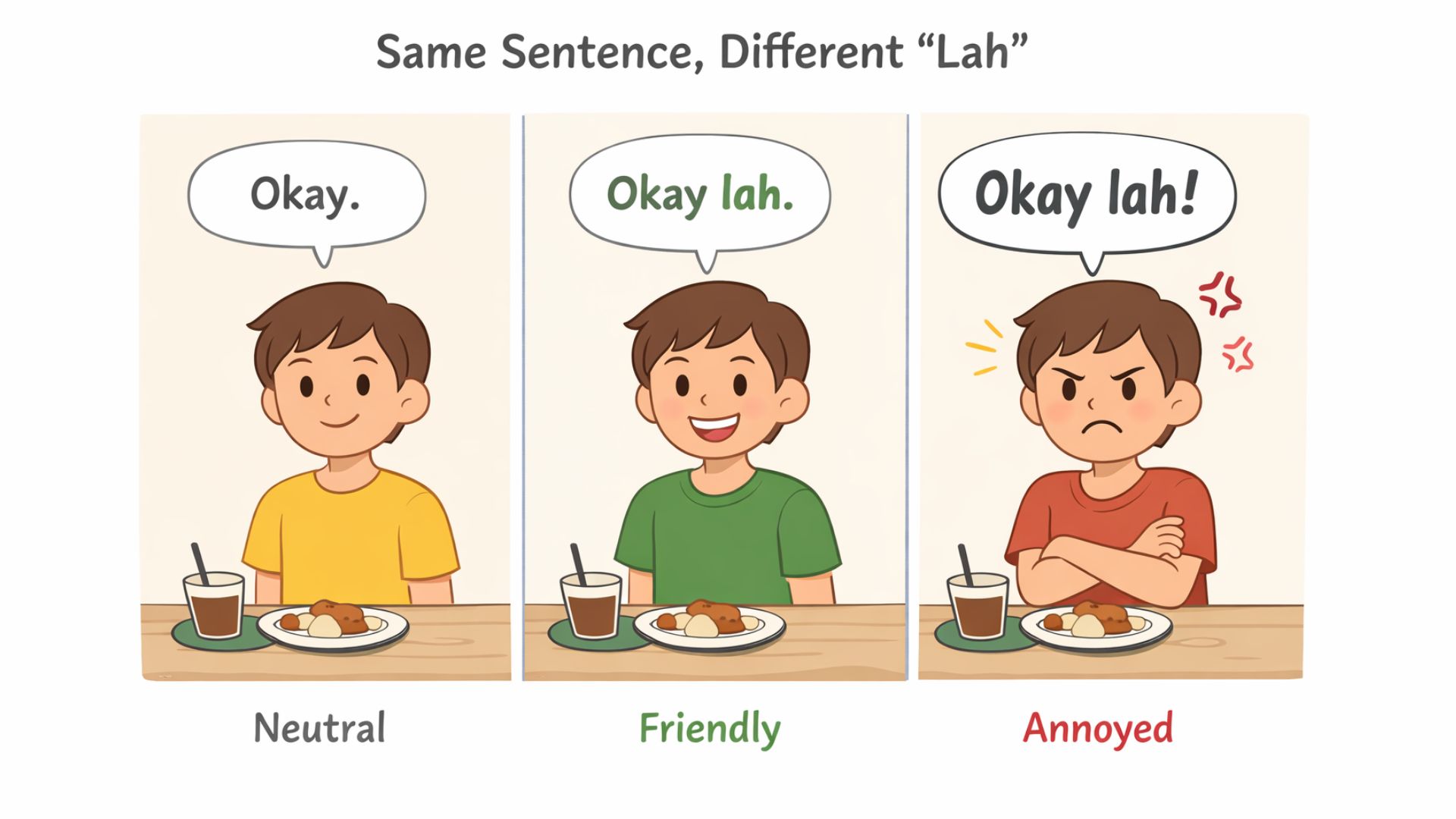
This is why “lah” is difficult for learners to master. You cannot memorise it from a list. You have to hear it used naturally and understand the emotional context behind it.
In Manglish, tone often carries more meaning than grammar.
Is “Lah” Polite or Rude?
“Lah” itself is neutral; context decides whether it sounds polite or inappropriate.
Among friends and family, “lah” usually sounds warm and casual. In professional or formal settings, especially with non-Malaysians, it may sound too informal.
For example:
- Casual setting: “No problem lah.”
- Professional setting: “No problem.” (without “lah”) is safer.
This is why many speakers switch between Manglish and standard English depending on who they are talking to. It is not about correctness, but appropriateness.
Can “Lah” Be Used in Writing?
“Lah” belongs to speech, not formal writing.
You may see “lah” used in:
- WhatsApp messages
- Social media posts
- Casual online conversations
It should generally be avoided in:
- Academic writing
- Professional emails
- Exams or formal assessments
When “lah” appears in writing, it is usually a stylistic choice to reflect spoken voice, not standard English usage.
“Lah” vs Other Manglish Particles
“Lah” is not the only tone marker in Manglish.
Manglish uses several particles, each with a different function:
- lah: reassurance or emphasis
- meh: doubt or scepticism
- lor: resignation or obviousness
For example:
- “Can meh?” expresses doubt.
- “Like that lor.” suggests resignation.
Understanding “lah” often opens the door to understanding how Manglish handles tone more broadly.
Why Understanding “Lah” Helps You Understand Manglish Better
Learning “lah” trains you to listen for intention, not literal translation.
Manglish relies heavily on context, shared understanding, and tone. Once you stop trying to translate every word directly, conversations start to make more sense.
Understanding how “lah” works helps you recognise when a speaker is:
- Reassuring
- Emphasising a point
- Trying to reduce tension
This makes it easier to follow everyday conversations and understand Manglish meaning in daily speech, rather than seeing it as broken English.
Conclusion: “Lah” Is About How You Speak, Not What You Say
“Lah” is not filler and it is not incorrect English. It is a cultural tool that helps speakers manage tone and social connection in conversation.
You do not need to use “lah” yourself to communicate well. Understanding what it does is enough to help you interpret Manglish more accurately and confidently.
For readers who want a deeper understanding of how Manglish works as a whole, including structure and usage beyond individual words, exploring Manglish explained provides helpful context.