
Corporate emails are rarely just about information. They are about tone, hierarchy, responsibility, and pressure, often hidden behind polite words.
Most people do not struggle with English in business emails because of grammar. They struggle because the literal meaning of a sentence is rarely the actual meaning.
This guide breaks down common corporate email phrases, explains what they usually mean in simple terms, and shows how tone shifts depending on hierarchy. Once you understand the patterns, these emails become far less confusing and far less stressful.
Why Corporate Emails Sound Polite but Feel Stressful
Corporate email language developed to reduce direct conflict. Instead of saying “this is urgent” or “this is now your problem,” people use softer phrasing.
The result is a style of communication that:
- Sounds polite
- Feels heavy
- Carries pressure without saying it directly
Understanding this gap between words and intent helps you read emails calmly, respond appropriately, and avoid overreacting to every “quick note.
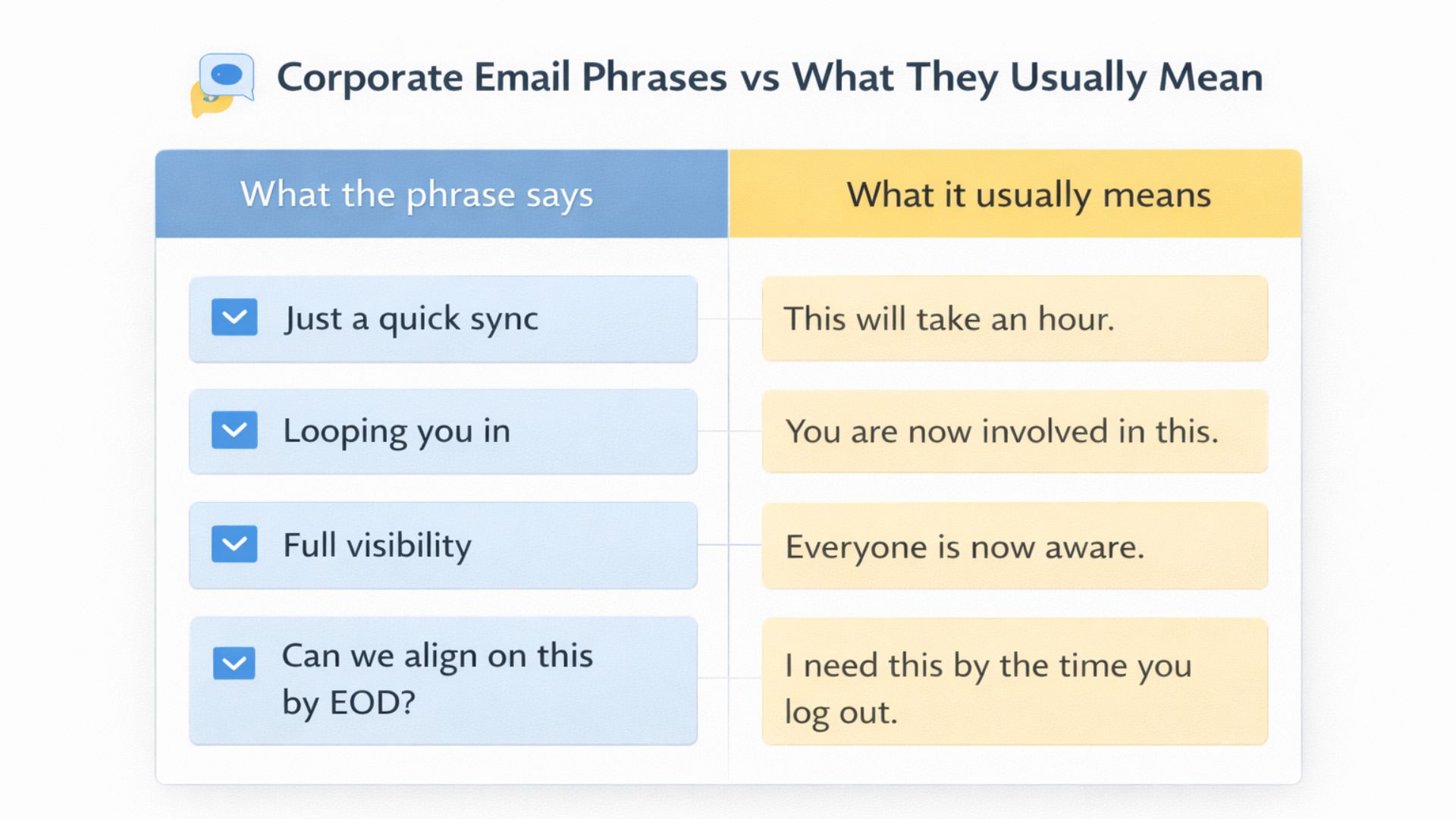
“Just a Quick Sync”
What it sounds like:
A short, casual discussion.
What it usually means:
A one-hour meeting that could have been a document.
In corporate settings, “quick” refers to intention, not duration. A “quick sync” often expands because:
- There is no clear agenda
- Multiple stakeholders are involved
- Decisions are unclear
When you see this phrase, expect a proper meeting, not a five-minute chat.
“Looping You In”
What it sounds like:
Adding you for awareness.
What it often means:
Bringing you into an ongoing issue, discussion, or problem.
“Looping you in” is rarely neutral. It usually signals one of the following:
- You are now expected to contribute
- You may be accountable later
- The issue is escalating
In simpler terms, you are being brought into the water, not just copied for fun.
“Full Visibility”
What it sounds like:
Transparency and openness.
What it often means:
Everyone is now aware, and responsibility is shared.
When someone says “for full visibility,” they are often:
- Protecting themselves
- Making the issue public
- Ensuring no one can say they were unaware
This phrase increases pressure because once visibility is established, inaction becomes visible too.
“Just Flagging This Thread So You’re Aware”
What it sounds like:
A helpful update.
What it often means:
You are now aware, and therefore accountable.
This phrase is common in escalation moments. It creates a record that:
- You were informed
- You saw the issue
- You had the opportunity to act
Congratulations. Awareness often comes with ownership, even if it is not stated clearly.
“Can We Align on This by EOD?”
What it sounds like:
A reasonable timeline.
What it usually means:
End of your day, not end of the calendar day.
In global or cross-team environments, “EOD” is flexible in theory but personal in practice. It often means:
- Before you log off
- Before the sender logs off
- Before this becomes tomorrow’s problem
When you see EOD, check the sender’s time zone and working style. It is rarely neutral.
“Just Checking In”
What it sounds like:
A friendly follow-up.
What it often means:
Pressure without escalation.
“Just checking in” is commonly used when:
- A deadline has passed
- The sender does not want to sound demanding
- The task is now overdue
It is polite language carrying urgency. The longer the delay, the heavier this phrase feels.
“Hope That Helps”
What it sounds like:
A friendly closing.
What it sometimes means:
I have explained this already, and I am done repeating myself.
This phrase is not always passive aggressive, but in context, it can signal:
- Frustration
- Closure
- Reduced willingness to continue the discussion
Tone depends heavily on the rest of the email. Short, factual emails ending with “hope that helps” often carry more weight than they appear to.
“As Discussed”
What it sounds like:
A neutral reference.
What it often means:
This was already agreed, and we are moving forward.
“As discussed” is commonly used to:
- Lock in decisions
- Prevent reopening debates
- Create a paper trail
It signals finality. If you disagree, that conversation should have happened earlier.
“Please Advise”
What it sounds like:
A request for guidance.
What it often means:
I need a decision from you.
This phrase shifts responsibility upward. It is frequently used when:
- The sender does not want to own the decision
- Approval is required
- Risk needs to be shared
The politeness hides the urgency of needing direction.
Tone in Corporate Emails Reflects Hierarchy
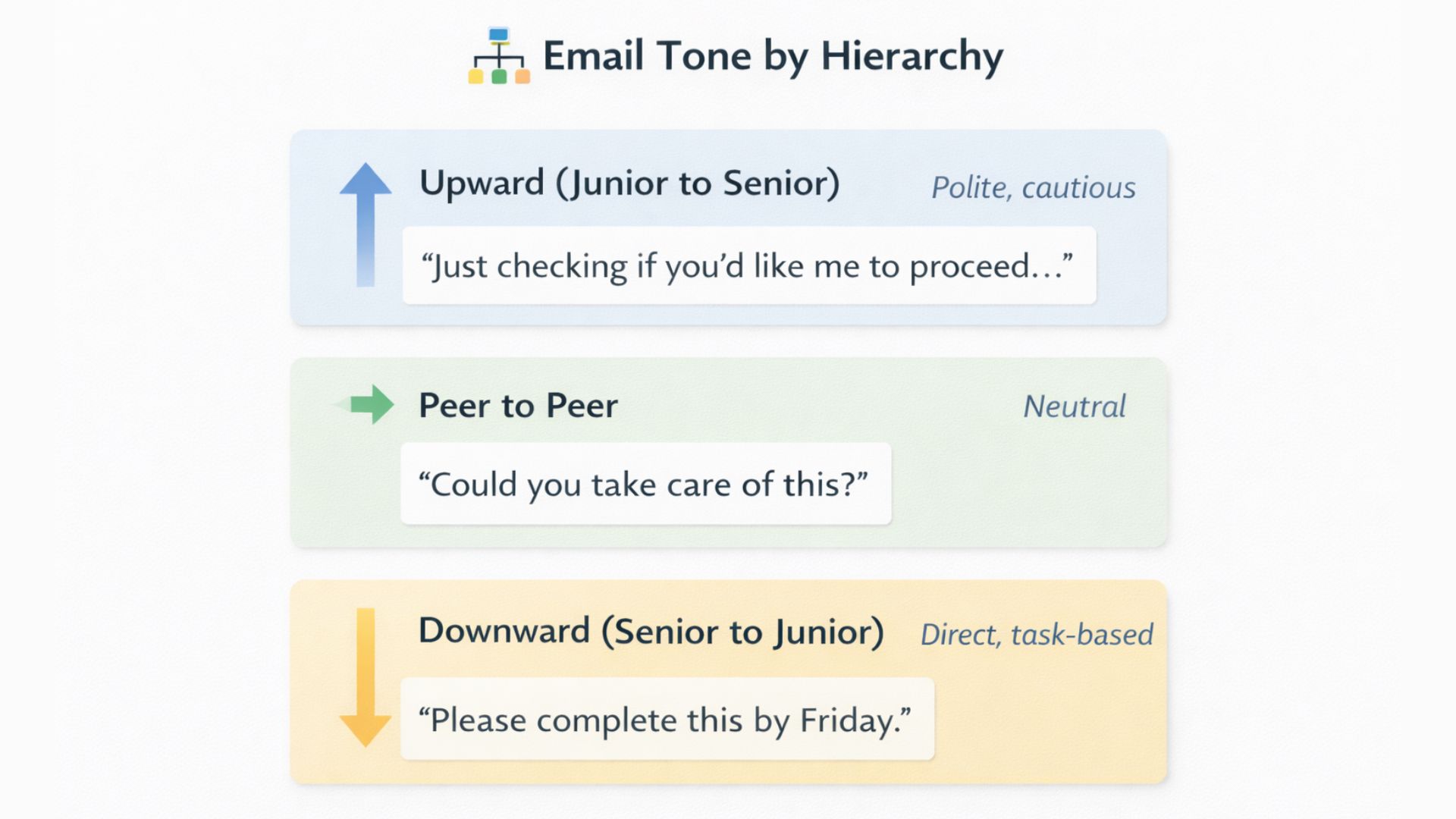
Tone in corporate emails is not random. It usually follows a hierarchy.
Upward Communication (Junior to Senior)
Tone is often:
- Polite
- Softer
- More indirect
Example: “Just checking if you’d like me to proceed with this.”
The sender is:
- Seeking permission
- Avoiding assumptions
- Showing respect for authority
Downward Communication (Senior to Junior)
Tone is often:
- Short
- Direct
- Task-focused
Example: “Please complete this by Friday.”
This is not rude. It is efficient. Authority allows for brevity.
Peer-to-Peer Communication
Tone sits in the middle:
- Collaborative
- Neutral
- Occasionally tense during deadlines
Understanding this hierarchy helps you read intent correctly instead of taking everything personally.
Passive Aggressive Emails: Polite Words, Unhappy Meaning
Passive aggressive emails are not openly rude. They sound reasonable but carry dissatisfaction or urgency.
Common signs include:
- Excessive politeness
- Repeated follow-ups
- Phrases like “just,” “kind reminder,” or “hope that helps”
The goal is often to apply pressure without confrontation.
Recognising this allows you to respond calmly instead of emotionally.
Why Everything Is “Quick” but Nothing Is Small
Almost every corporate email contains words like:
- Quick
- Short
- Simple
- Just one thing
In isolation, they seem harmless.
In reality:
- One quick task becomes five
- Five quick follow-ups become an evening
- Fifty quick things later, it is midnight
The language minimises effort, not workload.
How to Read Corporate Emails Without Burning Out
A few practical habits help.
- Focus on what is being asked, not how politely it is written
- Identify whether the email creates awareness, ownership, or urgency
- Look for deadlines hidden in words like “EOD” or “just checking in”
- Remember that tone often reflects hierarchy, not emotion
Most corporate emails are not personal. They are procedural.
Final Thoughts
Corporate emails rarely say exactly what they mean. They are shaped by hierarchy, risk management, and the need to sound polite while moving work forward.
Once you understand the hidden meanings behind common phrases, emails feel less overwhelming and far easier to manage.
Every email says it is “just one quick thing.” But as many professionals know, fifty quick things later, it is already midnight.
Understanding the language does not reduce the workload, but it helps you carry it with clarity instead of confusion.
This guide is part of a broader effort by Read, a language learning hub that explores how English is actually used in real work settings.