
English grammar does not need to feel complicated. Once you understand the structure behind sentences and the logic behind common rules, writing and speaking become much easier.
This guide gives you a clear, friendly introduction to grammar for Malaysian learners, with explanations that work for students, working adults and casual learners. Each section comes with examples and simple takeaways so you can build confidence step by step.
Why Grammar Matters for Malaysians
Grammar helps you create sentences that are clear and professional. It builds accuracy in exams, confidence in workplace emails and fluency in everyday conversations. Studying grammar also reduces mistakes caused by Manglish habits, literal translations and rushed writing.
Strong grammar supports your goals in these areas:
- Better English grades
- Clearer workplace communication
- More confidence in public speaking
- Writing emails that sound polite and professional
- Understanding books, news and international content
This comprehensive guide covers all the foundation you need.
What is Grammar
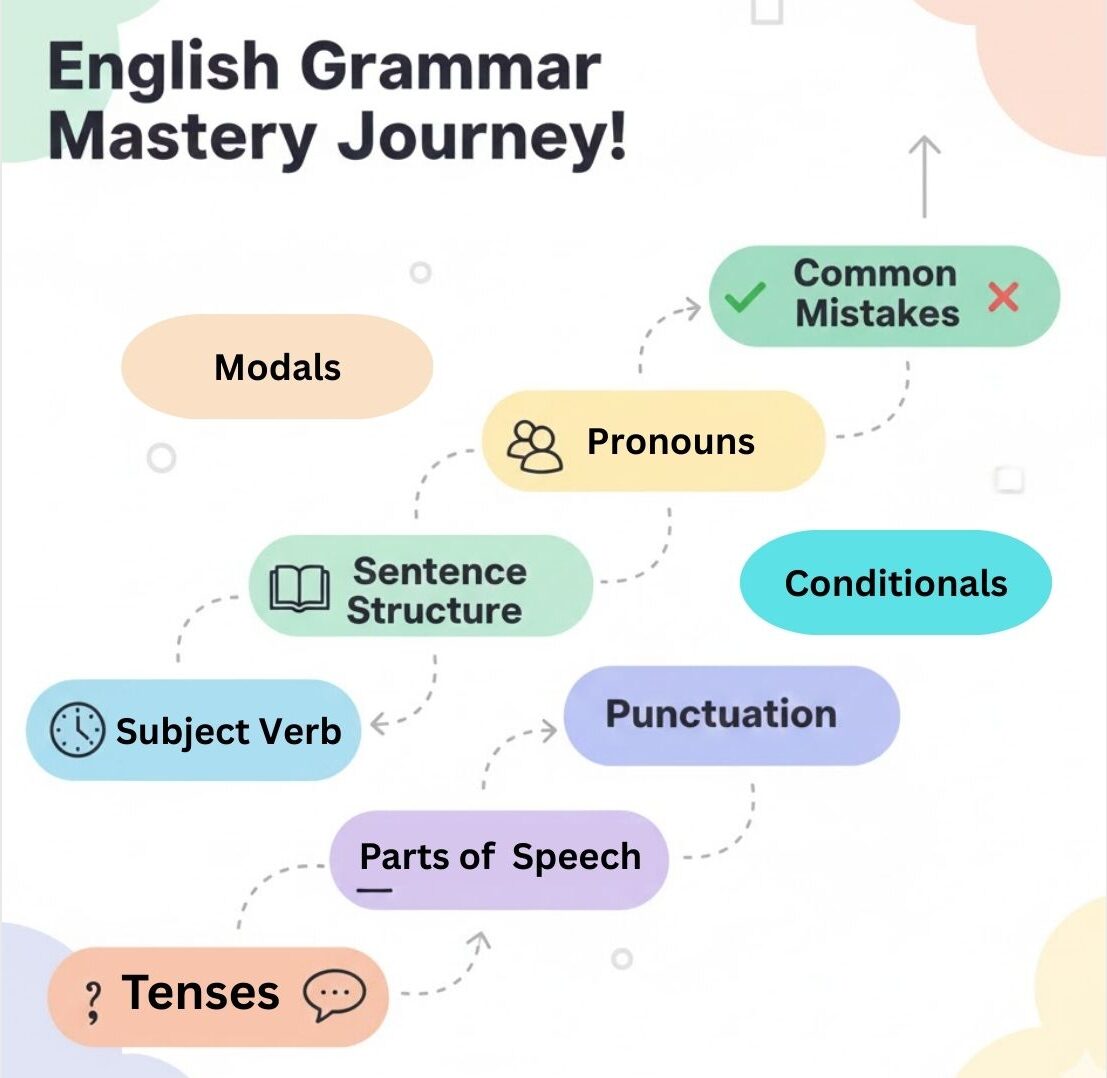
Grammar is the set of rules that decides how words fit together to form sentences. It includes tenses, sentence structure, punctuation, pronouns and many other parts that help readers understand your meaning easily.
You do not need to memorise everything at once. Learning grammar is easier when broken into simple parts, which you will see below.
Tenses: How English Shows Time
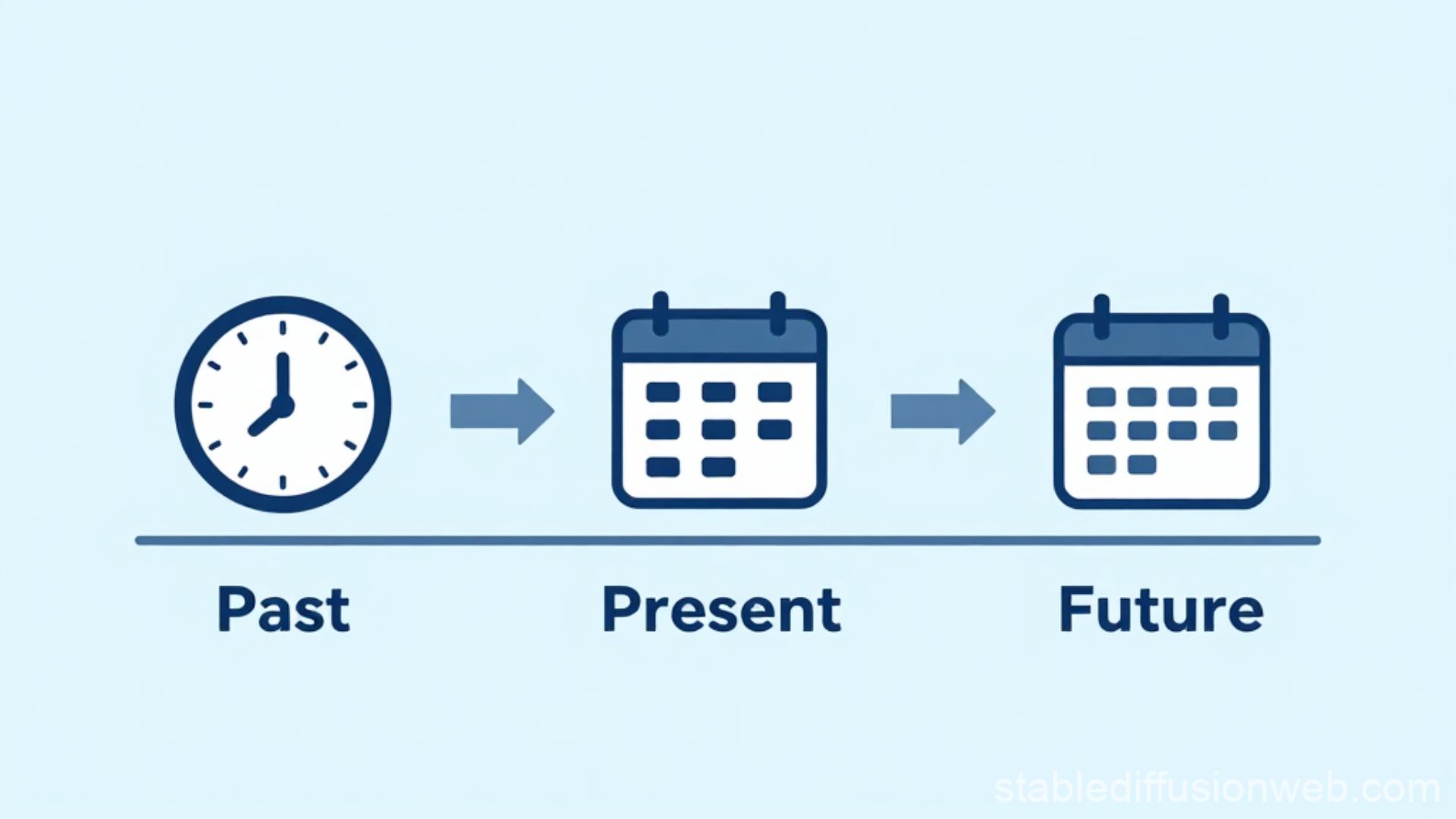
Tenses are one of the most important parts of English grammar because they show when an action happens. Every sentence you create, whether spoken or written, depends on choosing the correct tense to avoid confusion. For Malaysian learners, tenses can feel challenging because Manglish often drops time markers or mixes forms without changing meaning. In proper English, however, tense accuracy is essential for clarity and professionalism.
English divides time into three main categories: present, past and future. Each category expresses actions in slightly different ways through simple, continuous and perfect forms. Understanding these patterns helps you tell stories more clearly, write better essays and communicate professionally at work.
Basic Tense Forms
Here is a simple breakdown of the most commonly used tense structures.
| Tense Type | Example Sentence | Meaning |
| Present Simple | study English. | A regular or general action. |
| Present Continuous | I am studying English. | An action happening right now. |
| Past Simple | I studied English yesterday. | A completed action in the past. |
| Future Simple | I will study English later. | An action that will happen. |
These forms seem simple, but many learners struggle because each tense changes the tone and meaning of the message.
Why Tenses Matter
Correct tense use helps your reader understand time clearly. For example, when writing a school essay or sending a work email, the difference between “I submit the report yesterday’’ and “I submitted the report yesterday’’ changes whether your sentence is correct or confusing. Tenses also affect storytelling flow, making descriptions either smooth or awkward depending on the form you choose.
Common Malaysian Tense Mistakes
Many Malaysians face similar challenges. Here are the most frequent patterns:
1. Mixing Present and Past in the Same Sentence
Incorrect: Yesterday I go to KLCC.
Correct: Yesterday I went to KLCC.
2. Overusing Present Continuous
Incorrect: I am knowing the answer.
Correct: I know the answer.
3. Using “will” for Planned Actions That Should Use “going to’’
Incorrect: I will meet him later (when the plan is already confirmed).
Correct: I am going to meet him later.
4. Forgetting Time Markers
Incorrect: I finish the work.
Correct: I finished the work or I have finished the work, depending on timing.
These mistakes usually come from Manglish habits or from trying to translate directly from Malay or Chinese structures.
How to Choose the Correct Tense
A simple formula makes tense selection easier:
- Decide the time: now, before, or later.
- Decide if the action is complete, ongoing or repeated.
- Choose a tense that matches both time and action.
Tenses in Malaysian Context
Here are practical examples using situations Malaysians often talk about.
- Present simple: I work in Penang.
- Present continuous: I am working from home today.
- Past simple: We ate banana leaf rice last weekend.
- Present perfect: I have visited Melaka many times.
- Future simple: I will travel to Sabah next month.
These examples make tense selection easier to understand in real conversations.
Mini Exercise
Try choosing the correct tense for each sentence:
- She ______ (study) English right now.
- I ______ (meet) my friend yesterday.
- They ______ (visit) Johor next week.
- I ______ (live) here for five years.
- He ______ (not finish) the report yet.
Sentence Structure: How to Build Clear and Effective Sentences
Sentence structure is the backbone of clear communication. A well structured sentence helps readers understand your message easily, whether you are writing a school essay, crafting an email at work or posting on social media. Many Malaysian learners struggle with incomplete sentences, overly long sentences or Manglish influenced structures. Understanding how sentences work can instantly improve clarity and professionalism.
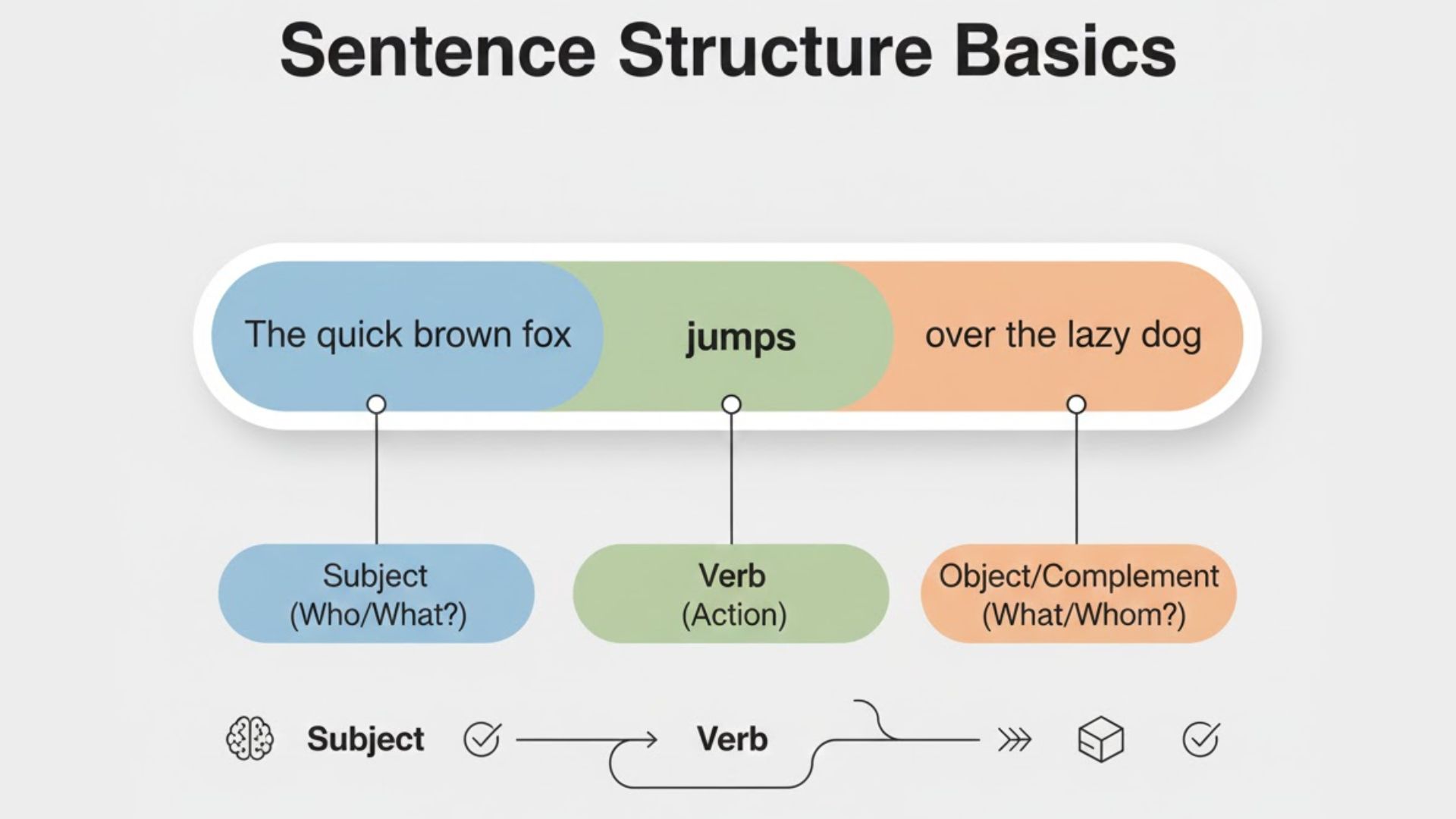
A complete sentence must have a subject (the person or thing doing the action) and a verb (the action itself). Without these two parts, your sentence will sound broken or unfinished. English relies heavily on sentence structure to show relationships between ideas, so learning the basic patterns helps you write more confidently.
The Three Main Sentence Types
English sentences usually fall into one of these categories. Knowing them helps you build variety in your writing.
| Sentence Type | Structure | Example | Use Case |
| Simple | One subject, one verb | She reads. | Clear and direct writing. |
| Compound | Two simple sentences joined by a connector | She reads and she writes. | Joining equal ideas. |
| Complex | One main clause plus a dependent clause | She reads because she wants to improve. | Showing cause, reason or contrast. |
These three types appear everywhere, from emails to novels. Using a mix of them creates smoother, more polished writing.
Why Sentence Structure Matters
Good sentence structure helps you:
- sound professional in emails and reports
- write essays that flow logically
- avoid confusion in instructions or explanations
- express complex ideas more smoothly
Bad structure, on the other hand, causes misunderstandings. For example:
Incorrect: Going to the shop. (This is not a sentence. No subject is included.)
Correct: I am going to the shop. (Subject and verb are present.)
Incorrect: Because he was tired. (This is a dependent clause left alone.)
Correct: He went to bed early because he was tired.
These small differences decide whether your writing feels polished or incomplete.
Common Malaysian Sentence Structure Problems
Because Malaysians often mix languages in daily conversation, certain habits appear in writing as well.
1. Sentence Fragments
A fragment is a sentence that is missing a subject or a verb.
Incorrect: When I reach home.
Correct: When I reach home, I will call you.
2. Overly Long Manglish Influenced Sentences
Incorrect: I go there already but he say cannot then I wait for him but he never come so I just go back.
Correct: I went there, but he said it was not possible. I waited for him, but he did not come, so I went home.
3. Missing Connectors
Incorrect: She studied hard she passed.
Correct: She studied hard, so she passed.
4. Using “and” or “then” Too Often
Malaysian learners may link everything with “and then,” which makes writing childish or unclear.
Better replacement options include:
- therefore
- however
- meanwhile
- afterward
- as a result
These connectors create more natural transitions.
How to Build a Strong Sentence
A simple formula helps you structure sentences correctly:
- Start with a clear subject.
- Add a verb that expresses the action.
- Add extra information such as time, reason or place.
- Use connectors when joining ideas.
- Check that each clause has its own meaning.
Example Progression
Basic: She studies.
Better: She studies English every evening.
Best: She studies English every evening because she wants to improve her exam results.
Each step adds clarity, detail and purpose.
Sentence Structure in Malaysian Context
Here are examples based on common local situations:
- Simple: The train arrived late.
- Compound: The train arrived late, and everyone became frustrated.
- Complex: The train arrived late because of heavy rain.
Even everyday descriptions become clearer when structured well.
Mini Exercise: Fix the Structure
Rewrite the sentences below into correct or clearer forms:
- Because I am tired.
- He likes football he plays every weekend.
- Walking to school every day.
- I finish the work then I send you then you check first then reply me.
- She happy because got bonus.
Parts of Speech: The Building Blocks of Grammar
Parts of speech are the foundation of grammar. Every English sentence is made from a combination of these categories, and understanding them helps you choose the right words with confidence. Many Malaysian learners struggle with sentence flow or clarity because they mix up word types or use the wrong form of a word. Once you understand how each part of speech works, your writing becomes smoother and more accurate.
English has eight common parts of speech: nouns, verbs, adjectives, adverbs, pronouns, prepositions, conjunctions and articles. Learning how each part functions allows you to express ideas precisely instead of guessing or translating directly from Malay or Chinese sentence structures.
1. Nouns: People, Places, Things and Ideas
Nouns name everything around you. They answer questions like “who” and “what.”
Examples
- person: teacher, Ali
- place: Kuala Lumpur, school
- thing: phone, car
- idea: freedom, happiness
Common Malaysian Mistake
Using plural nouns incorrectly.
Incorrect: She has many homework.
Correct: She has a lot of homework.
2. Verbs: Action or State of Being
Verbs express what the subject is doing or how it is feeling.
Examples
- Action: run, study, eat
- State: am, is, feel, seem
Verbs carry tense, so choosing the right verb form is essential for accuracy.
3. Adjectives: Words That Describe Nouns
Adjectives add detail by describing qualities such as size, colour, emotion or quantity.
Examples
- tall building
- delicious food
- three students
- excited crowd
Common Malaysian Mistake
Using “very” too often as a filler.
Instead of “very nice,” try stronger adjectives like “excellent” or “amazing.”
4. Adverbs: Words That Describe Verbs, Adjectives or Other Adverbs
Adverbs explain how, when, where or to what extent something happens.
Examples
- She runs quickly.
- He spoke softly.
- They arrived early.
Be careful not to overuse adverbs in writing. Too many can make sentences sound unnatural.
5. Pronouns: Replacements for Nouns
Pronouns prevent repetition and improve flow.
Examples
- I, you, he, she, they
- mine, yours, theirs
- this, that, which
Example sentence: Sarah lost her keys, so she borrowed his spare set.
6. Prepositions: Words That Show Relationships
Prepositions connect nouns, pronouns or phrases to other words. They describe time, place or direction.
Examples
- at home
- in the morning
- to the station
- from Malaysia
Common Malaysian Mistake
Incorrect preposition choice due to direct translation.
Incorrect: I am waiting you.
Correct: I am waiting for you.
7. Conjunctions: Words That Join Ideas
Conjunctions help you link sentences and maintain flow.
Types
- Coordinating conjunctions: and, but, or
- Subordinating conjunctions: because, although, since
- Correlative conjunctions: either or, neither nor
Example: She stayed inside because it was raining.
8. Articles: a, an, the
Articles help specify whether a noun is general or specific.
Examples
- a book (any book)
- the book (a specific book)
- an apple (general item, vowel sound)
Common Malaysian Mistake
Dropping articles completely.
Incorrect: I have meeting today.
Correct: I have a meeting today.
Why Parts of Speech Matter
Understanding parts of speech helps you:
- form correct sentence structure
- choose better vocabulary
- avoid common grammatical errors
- improve clarity in both speech and writing
It also strengthens your ability to edit your own work because you can spot incorrect word types quickly.
Malaysian Style Example
Here is how parts of speech work together in a sentence many learners can relate to:
The friendly coach (adjective plus noun) explained (verb) the new strategy (noun) clearly (adverb) to the players (noun) during (preposition) practice.
Once you understand how each part functions, sentence construction becomes far easier.
Mini Exercise: Identify the Parts of Speech
Identify the bold words:
- She quickly finished her homework.
- The weather today is unpredictable.
- They walked towards the beach.
- He bought an expensive watch.
- Although it rained, the match continued.
Subject Verb Agreement: Making Subjects and Verbs Match Correctly
Subject verb agreement is one of the most common grammar challenges for Malaysian learners. It refers to the rule that the verb must match the subject in number. A singular subject needs a singular verb, and a plural subject needs a plural verb. When this agreement is incorrect, sentences sound awkward or confusing. This is especially noticeable in emails, reports and school essays.
Many errors come from Manglish habits, where people may say “she go” or “they goes,” which do not follow standard English rules. Mastering subject verb agreement helps you write clearly and professionally while avoiding mistakes that reduce credibility.
Basic Rule: Singular Subject, Singular Verb
A simple rule to remember:
| Subject | Verb |
| singular | takes an -s verb (she likes) |
| plural | uses the base verb (they like) |
Examples
- He likes coffee.
- They like coffee.
It looks simple, but English has special cases that create confusion.
1. Subjects Joined by “And” Become Plural
When two subjects are connected with “and,” the verb becomes plural.
Example
Ali and Sarah are coming.
This is one of the most reliable rules.
2. Words like “Everyone,” “Someone,” “Each” Are Singular
These words look plural but are actually treated as singular.
Examples
- Everyone is ready.
- Someone has taken the keys.
- Each student receives a form.
Many Malaysians mistakenly use plural verbs here.
Incorrect: Everyone are going.
Correct: Everyone is going.
3. Collective Nouns Can Be Singular or Plural
Words like team, group, committee or family can take singular or plural verbs depending on context.
Examples
- The team is winning. (acting as one unit)
- The team are arguing among themselves. (acting as individuals)
In Malaysian English, most people default to singular, which is usually safe.
4. Long Phrases Do Not Change the Subject
A common mistake is matching the verb to the nearest noun, not the actual subject.
Incorrect: The box of oranges are heavy.
Correct: The box of oranges is heavy.
(Subject is “box,” not “oranges.”)
5. “There is” and “There are” Must Match the Real Subject
Examples
There is a problem.
There are many problems.
Many Malaysians mix these forms because “there” feels like the subject, but it is not.
6. Verbs After Amounts or Measurements Are Usually Singular
Examples
Ten dollars is enough.
Five kilometres is far to walk.
Even though numbers look plural, the whole amount is treated as one unit.
7. Be Careful with “None”
“None” can be singular or plural depending on meaning.
Examples
None of the cake is left.
None of the students are absent.
Why Malaysians Struggle With This Rule
Subject verb agreement mistakes often come from:
- Manglish influence
- direct translations from Malay or Chinese
- speaking habits that drop verb endings
- fast writing without proofreading
Awareness is the first step to improving accuracy.
Workplace Examples
Incorrect: The data are unclear.
Correct: The data is unclear.
(Modern English treats “data” as singular in business use.)
Incorrect: The documents inside the folder needs approval.
Correct: The documents inside the folder need approval.
Incorrect: Marketing team have submitted the report.
Correct: The marketing team has submitted the report.
Correct agreement makes your writing sound more professional instantly.
Mini Table: Common Tricky Subjects
| Subject Type | Correct Form | Example |
| Indefinite pronouns | singular | Everybody loves music. |
| Collective nouns | mostly singular | The committee has decided. |
| Phrases with “of” | depends on first noun | A pack of wolves is running. |
| Titles or names | singular | Stranger Things is popular. |
Quick Strategy to Check Agreement
When unsure:
- Identify the real subject.
- Ignore extra phrases like “of the students” or “near the door.”
- Match the verb to the subject only.
This prevents most agreement mistakes.
Mini Exercise: Correct the Sentences
Fix the subject verb agreement in these sentences:
- Everyone on the team have submitted their forms.
- The quality of the products are improving.
- My family are planning a trip.
- There is many reasons to join.
- A series of events were surprising.
Pronouns: Replacing Nouns to Avoid Repetition and Improve Sentence Flow
Pronouns are words that replace nouns, helping sentences sound smoother and less repetitive. Without pronouns, writing becomes awkward and overly long because you would repeat names and objects in every sentence. For Malaysian learners, pronouns can feel confusing because Malay and Chinese languages use simpler systems, while English requires careful matching of gender, number and reference.
Mastering pronouns improves sentence clarity, prevents repetition and helps you sound more natural in both speaking and writing.
Types of Pronouns You Should Know
Here are the most common categories of pronouns, with examples and simple explanations.
1. Personal Pronouns
These refer directly to people or things.
| Type | Pronouns | Example |
| First person | I, me, we, us | I went to the mall. |
| Second person | you | You should try this. |
| Third person | he, she, it, they, them | They arrived early. |
Malaysian issue: Many learners forget that “they” cannot refer to a singular person unless gender is unknown.
Incorrect: My teacher said they wants my homework.
Correct: My teacher said she wants my homework.
2. Possessive Pronouns
These show ownership.
| Type | Pronouns |
| Independent | mine, yours, his, hers, theirs |
| Adjectival | my, your, his, her, their |
Example: This is my book. That one is yours.
Common mistake: Confusing “its” and “it’s.”
- its = possession
- it’s = it is
Incorrect: The dog ate it’s food.
Correct: The dog ate its food.
3. Reflexive Pronouns
Used when the subject and object are the same person.
Pronouns: myself, yourself, himself, herself, itself, ourselves, themselves
Example: She taught herself to bake.
Incorrect reflexive forms appear often in Malaysia.
Incorrect: Please contact myself if needed.
Correct: Please contact me if needed.
4. Demonstrative Pronouns
Used to point to specific things.
| Pronouns | Use |
| this, these | near |
| that, those | far |
Example:
This is my phone.
Those are her shoes.
5. Relative Pronouns
Used to connect clauses.
Pronouns: who, whom, whose, which, that
Example: The student who arrived early helped set up.
Relative pronouns improve description and sentence flow in longer writing.
Why Pronouns Matter
Correct pronoun usage helps you:
- avoid repeating names or objects
- create smoother, more natural sentences
- prevent confusion about which noun you mean
- write more professionally in emails or essays
Misused pronouns can confuse the reader and make writing feel messy.
Common Pronoun Mistakes in Malaysia
These mistakes come from direct translation or from everyday Manglish habits.
1. Using “they” for Singular People
Incorrect: My sister said they will come.
Correct: My sister said she will come.
2. Confusing “his”, “her” and “their”
Incorrect: Every student must bring their pencil.
Correct (formal): Every student must bring his or her pencil.
Correct (modern English): Every student must bring their pencil.
(This modern usage is accepted today.)
3. Using “it” for People
Incorrect: I saw my teacher, it was angry.
Correct: I saw my teacher, she was angry.
4. Dropping Pronouns Completely
Incorrect: Went to shop already.
Correct: I went to the shop already.
Dropping subjects is common in Manglish but incorrect in standard English.
5. Using Reflexive Pronouns Incorrectly
Incorrect: He asked myself to check.
Correct: He asked me to check.
Pronoun Reference: Making Sure the Reader Knows Who You Mean
A pronoun must refer clearly to a noun. If two nouns can match, the reader becomes confused.
Ambiguous sentence:
Sarah phoned Maria after she reached home.
(Who reached home, Sarah or Maria?)
Clear sentence:
Sarah phoned Maria after Sarah reached home.
or
Sarah phoned Maria after Maria reached home.
Clear reference improves understanding.
Pronouns in Malaysian Context
Here are natural examples:
- Personal: She told me the news.
- Possessive: Is this your laptop or theirs?
- Reflexive: We prepared the food ourselves.
- Demonstrative: I prefer this brand over that one.
- Relative: The food that he cooked was delicious.
These examples reflect common daily situations for local learners.
Mini Exercise: Choose the Correct Pronoun
- Every child must bring ______ own water bottle. (his or her, their)
- This phone is mine, not ______. (your, yours)
- The teacher who called was ______. (he, him)
- She hurt ______ while cooking. (herself, her)
- Do you know the student ______ scored highest? (who, which)
Active and Passive Voice: Choosing the Right Focus in a Sentence
Active and passive voice are two different ways to express the same idea. The choice affects clarity, tone and emphasis. Many Malaysian learners use passive structures without realising it, especially in workplace emails and reports. Understanding when to use each voice helps you communicate more confidently and professionally.
In active voice, the subject performs the action.
In passive voice, the action is done to the subject.
Neither form is “wrong,” but active voice is usually clearer and more direct.
Active Voice: Clear and Direct
Active voice is preferred in most forms of writing because it shows who is doing the action.
Structure: Subject + verb + object
Examples:
- The student completed the assignment.
- The manager approved the budget.
- The team fixed the problem.
Active sentences sound confident and easy to understand.
Passive Voice: Used to Emphasise the Action or When the Doer Is Unknown
Passive voice is useful in specific situations, especially when:
• the doer is unknown
• the doer is not important
• the focus should be on the action, not the person
• writing needs a formal or neutral tone
Structure: Object + verb (be + past participle) + by subject (optional)
Examples:
- The assignment was completed.
- The budget was approved by the manager.
- The problem was fixed yesterday.
Passive voice can sound weaker if overused, but it is appropriate in scientific writing or formal announcements.
Active vs Passive Comparison
| Type | Example | Tone |
| Active | The teacher explained the lesson. | Clear and strong |
| Passive | The lesson was explained by the teacher. | Polite, formal, slightly distant |
Both are correct, but the message changes depending on structure.
Common Malaysian Issues With Voice
1. Overusing Passive Voice in Emails
Many Malaysians write: The report was submitted by me.
Better: I submitted the report.
2. Using Passive Voice to Avoid Responsibility
The mistake was made instead of I made a mistake.
3. Mixing Both Voices Within the Same Sentence
Incorrect: The team is completing the task and the result will be reviewed by us.
Better: The team is completing the task, and we will review the result.
When to Use Active Voice
Use active voice when you want to:
- be direct
- sound confident
- show responsibility
- create simple and natural sentences
- make instructions easy to follow
Example:
Active: Please submit the form by Friday.
Passive: The form should be submitted by Friday.
(Active is clearer and more direct.)
When Passive Voice is Useful?
Passive voice is helpful when:
- the doer is unknown
- you want to soften a message
- you want to highlight the result, not the doer
Examples:
Unknown doer: My laptop was stolen.
Soften tone: Your request has been declined.
Result focus: The bridge was completed in 2024.
In formal writing, passive voice can create a neutral tone.
Rewrite Examples for Better Clarity
Here are real-life Malaysian style sentences rewritten into active voice:
Email writing:
Passive: The meeting will be handled by the HR department.
Active: The HR department will handle the meeting.
School assignment:
Passive: The experiment was carried out by the students.
Active: The students carried out the experiment.
Workplace reports:
Passive: A mistake was found in the calculation.
Active: We found a mistake in the calculation.
Active voice strengthens clarity and accountability.
How to Change Passive Voice to Active Voice
- Identify the object receiving the action.
- Find the doer of the action (if mentioned or implied).
- Rewrite with the doer as the subject.
- Use the base verb instead of the past participle.
Example:
Passive: The food was cooked by the chef.
Active: The chef cooked the food.
Mini Exercise: Rewrite in Active Voice
Convert these sentences into active voice:
- The letter was written by Angela.
- The photos were taken by the students.
- The decision was made by the manager.
- The room was cleaned yesterday.
- The warnings were ignored by them.
Modals: Words That Express Possibility and Politeness
Modals are special helping verbs used to express ability, permission, possibility, advice or politeness. They include words like can, could, may, might, must, should, will and would. Modals are essential for daily conversations and workplace communication because they change the tone of your sentence. A request can sound polite, direct or rude depending on which modal you choose.
Many Malaysians rely on only a few modals, especially “can,” which results in sentences that sound too blunt in formal English. Learning how to use modals properly helps you communicate more respectfully and clearly in emails, meetings and everyday conversations.
Common Modals and Their Uses
Here is a clear breakdown of the most common modals with examples.
1. Ability
| Modal | Meaning | Example |
| can | able to | She can swim. |
| could | past ability or polite form | He could solve the puzzle when he was younger. |
2. Permission
| Modal | Meaning | Example |
| can | informal permission | You can borrow my book. |
| may | polite permission | You may leave early today. |
“Can I” is acceptable in casual speech, but “May I” is preferred in formal situations.
3. Possibility
| Modal | Strength | Example |
| might | low possibility | It might rain later. |
| may | medium possibility | It may rain later. |
| could | uncertain possibility | It could rain later. |
4. Advice
| Modal | Meaning | Example |
| should | recommended | You should sleep earlier. |
| ought to | similar meaning | You ought to revise for the test. |
5. Necessity and Obligation
| Modal | Meaning | Example |
| must | strong requirement | You must wear a helmet. |
| have to | rules or external necessity | I have to submit the form today. |
6. Requests and Politeness
Modals control politeness levels, especially in workplace English.
| Sentence | Tone |
| Can you send the report? | casual |
| Could you send the report? | polite |
| Would you mind sending the report? | very polite |
Malaysian problem: Using only “can” in emails makes the tone too direct.
Incorrect: Can send me the file?
Correct: Could you send me the file?
Using Modals in Workplace English
Modals help create polite and professional communication.
Examples:
- We should review the budget before approval.
- I must attend a training session today.
- Could you join the meeting at 3 pm?
- The results may change after updates.
Using modals helps you sound more respectful and confident.
Malaysian English Challenges With Modals
1. Overusing “can”
“Can” becomes a universal modal in Manglish.
- Can ah?
- Cannot lah.
- Can do?
This is fine for casual conversation but not for professional contexts.
2. Using Modals With “to” Incorrectly
Incorrect: He can to swim.
Correct: He can swim.
3. Mixing Modals and Verbs
Incorrect: I must to go now.
Correct: I must go now.
4. Using “should” for Obligation Instead of Advice
Incorrect: All employees should follow the rules.
Better: All employees must follow the rules.
(“Should” is too weak for rules.)
Modal Strength Scale
A simple way to understand modals is to rank them according to strength or certainty.
Possibility Scale: might < may < could < should < will < must
Example:
- It might rain. (small chance)
- It will rain. (strong certainty)
How Modals Change Tone in Sentences
Here is one sentence rewritten with different modal tones.
- Can you help me? (casual)
- Could you help me? (polite)
- Would you be able to help me? (very polite and formal)
- You must help me. (strong, urgent)
Understanding tone choices helps you sound appropriate in different situations.
Modal Verbs in Malaysian Context
Here are relatable examples:
- Ability: I can speak Malay and English.
- Permission: May I know your full name?
- Advice: You should try the new LRT route.
- Necessity: You must renew your license.
- Politeness: Could you pass me the receipt?
These examples help learners apply modals in real daily communication.
Mini Exercise: Choose the Correct Modal
- You ______ submit this by tonight. (must or should)
- ______ you help me carry this? (Could or Must)
- It ______ rain later, so bring an umbrella. (might or must)
- She ______ speak three languages. (can or may)
- You ______ leave early if you finish your work. (may or must)
Punctuation: Small Marks That Change Meaning Completely
Punctuation controls rhythm, clarity and meaning in English. A single comma or apostrophe can change the entire message of a sentence. Many Malaysian learners rely on speech patterns instead of punctuation rules, which results in long, confusing sentences or unintended meanings. Mastering punctuation helps your writing feel professional and easy to understand, especially in emails, essays and reports.
English punctuation marks show pauses, connections, ownership, quotations and emphasis. When used correctly, they guide readers smoothly through your ideas.
1. Full Stop (.): Ending a Statement
A full stop signals the end of a complete sentence.
Correct use:
- I will call you later.
- The meeting starts at ten.
Common Malaysian issue: Writing very long sentences with no full stops.
Incorrect: I went to the bank they told me to come back later so I went home and waited and then I forgot.
Correct: I went to the bank. They told me to come back later. I went home and waited, but then I forgot.
Shorter sentences improve clarity.
2. Comma (,): Separating Ideas and Avoiding Confusion
Commas are used to show pauses, separate items or clarify meaning.
Common uses:
- Before connectors: and, but, so
- After introductory phrases
- In lists
- To avoid misreading
Example:
Let’s eat, father.
Let’s eat father.
One comma completely changes the meaning.
3. Apostrophe (’): Showing Ownership or Contractions
Apostrophes often confuse Malaysian learners.
Possession:
- Ali’s phone
- The teacher’s advice
- The students’ classroom (plural owners)
Contractions:
- don’t (do not)
- it’s (it is)
- she’s (she is)
Common mistake: Confusing “its” and “it’s.”
Incorrect: The company updated it’s logo.
Correct: The company updated its logo.
4. Colon (:) and Semicolon (;)
Colon: Used to introduce lists, examples or explanations.
Example: We bought three items: bread, milk and eggs.
Semicolon: Used to join two related sentences without using a connector.
Example: The rain was heavy; the match continued anyway.
Semicolons help create smoother transitions in formal writing.
5. Quotation Marks (“ ”): Showing Exact Words
Quotation marks indicate direct speech or quoted text.
Examples:
She said, “I will be there soon.”
The sign read “No Parking.”
Malaysian issue: Forgetting punctuation inside quotes.
Incorrect: She said, “I will be there soon”.
Correct: She said, “I will be there soon.”
6. Question Mark (?)
Used after a direct question.
Examples:
• What time is the meeting?
• Are you coming today?
Avoid using a question mark for statements.
Incorrect: I am not sure?
Correct: I am not sure.
7. Exclamation Mark (!)
Shows strong emotion, surprise or urgency.
Examples:
• Stop!
• That was amazing!
Avoid using too many exclamation marks in professional writing.
8. Comma Splice: A Silent Enemy of Good Writing
A comma splice happens when two sentences are joined using only a comma.
Incorrect: I studied, I passed the test.
Correct:
• I studied, so I passed the test.
• I studied. I passed the test.
• I studied; I passed the test.
This is one of the most common errors in Malaysian essays.
9. Overuse of Punctuation Marks
Too many commas, question marks or exclamation marks can make writing look unprofessional.
Incorrect: Can you send the report???
Incorrect: I am really excited!!!!
Correct: Can you send the report?
Correct: I am really excited.
A Table of Common Punctuation Uses
| Mark | Purpose | Example |
| , | separates ideas | She cooked, and he cleaned. |
| . | ends a statement | The class ended. |
| ? | shows a question | Are we ready? |
| ! | shows emotion | Watch out! |
| ‘ | shows possession or contraction | teacher’s, it’s |
| : | introduces items | Bring these: pens, paper, files. |
| ; | joins related sentences | I tried; it worked. |
Why Malaysians Struggle With Punctuation
Common reasons include:
- influenced by oral speaking patterns
- writing long sentences without pauses
- confusion over contractions and ownership
- mixing English rules with Malay or Chinese punctuation habits
This makes punctuation one of the most important areas for improvement.
Mini Exercise: Add the Correct Punctuation
- Please bring your books pens and calculator
- When will the parcel arrive
- The dog chased its tail it was very funny
- She said I can help you
- The company updated it’s website yesterday
Conditionals: Sentences That Describe Possibilities
Conditionals are sentences that describe possibilities, imaginary situations or the results of actions. They usually follow an “if” structure and are extremely common in daily conversations, workplace communication and exams. Many Malaysian learners struggle with conditionals because Malay and Chinese express “ifs” differently, often without tense changes.
Understanding conditionals helps you explain consequences, give advice, make predictions and discuss hypotheticals more accurately.
All conditionals follow a similar logic:
If X happens, Y will happen
but the tense changes depending on how real or unreal the situation is.
The Four Main Types of Conditionals
Here are the most commonly used conditionals in English.
1. Zero Conditional: Facts and General Truths
Used for statements that are always true.
Structure: If + present tense, present tense
Examples:
- If you heat water, it boils.
- If it rains, the grass gets wet.
Malaysian example: If you drive during peak hours, you get stuck in traffic.
Zero conditional is simple and does not change tense.
2. First Conditional: Real Future Possibility
Used for things that might actually happen in the future.
Structure: If + present tense, will + base verb
Examples:
- If it rains later, we will cancel the picnic.
- If she studies, she will pass the exam.
- If you leave now, you will arrive before lunch.
Malaysian example:
If the jam gets worse, I will take the MRT instead.
3. Second Conditional: Unreal or Imaginary Present/Future
Used for things that are unlikely, impossible or imaginary.
Structure: If + past tense, would + base verb
Examples:
- If I had wings, I would fly.
- If he were taller, he would join the team.
- If I lived nearer, I would visit more often.
It does not mean the past; the past tense expresses unreality.
4. Third Conditional: Imaginary Past
Used for situations that did not happen and imagining how things could have been different.
Structure: If + past perfect, would have + past participle
Examples:
- If she had woken up earlier, she would have caught the bus.
- If they had studied, they would have passed.
- If I had known, I would have helped.
- If he had checked Waze, he would have avoided the traffic jam.
Third conditional is important for expressing regret or analysis.
Conditional Comparison Table
| Type | Time | Structure | Example | Meaning |
| Zero | always true | If + present, present | If you freeze water, it becomes ice. | Fact or general truth |
| First | real future | If + present, will | If I finish work early, I will call you. | Possible future |
| Second | unreal now | If + past, would | If I had time, I would join you. | Imaginary situation |
| Third | unreal past | If + past perfect, would have | If I had known, I would have come. | Imagined past outcome |
Why Malaysians Get Conditionals Wrong
Common reasons include:
- translating directly from Malay or Chinese
- mixing up “will” and “would”
- forgetting tense changes
- using present tense in imaginary sentences
- using “if” incorrectly in formal writing
Example of a common mistake:
Incorrect: If I know earlier, I will come.
Correct: If I had known earlier, I would have come.
(Third conditional, because the event happened in the past.)
Conditionals in Malaysian Daily Conversation
Natural examples include:
- If the weather is nice, we will go hiking.
- If I were rich, I would buy a house in Penang.
- If you had told me, I would have joined you.
- If the LRT breaks down again, I will be late.
Seeing conditionals in familiar situations makes them easier to understand.
Mini Exercise: Identify and Correct the Conditional
- If you will study, you will pass.
- If I am you, I will not worry.
- If she had money, she will buy a car.
- If we left earlier, we would have arrive on time.
- If you told me, I will come.
Common Grammar Mistakes Malaysians Should Avoid
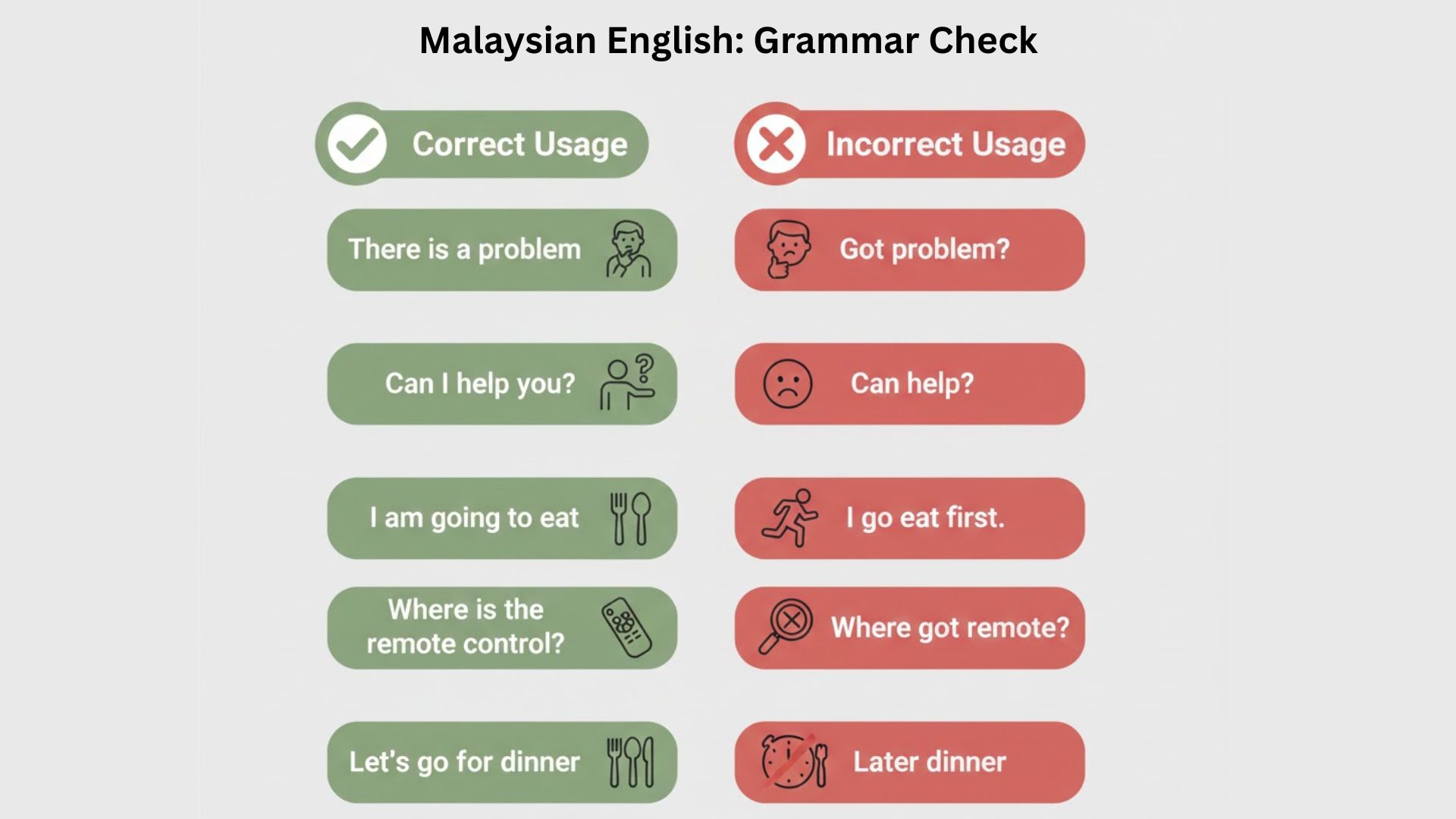
Every English learner makes mistakes, but certain patterns appear more frequently among Malaysians due to the influence of Malay, Chinese dialects and Manglish speaking habits. These patterns often affect clarity in professional writing, school essays and public communication. Understanding these mistakes helps you correct them quickly and write with more confidence.
Below are the 15 most common grammar issues Malaysians face, along with simple explanations and easy corrections.
1. Dropping the Subject in Sentences
In Malay and Chinese, the subject can be omitted because it is understood in context. English requires a visible subject in every sentence.
Incorrect: Can go already. Eat first then talk.
Correct: I can go already. Let us eat first, then we can talk.
Leaving out the subject makes your writing sound incomplete or overly casual.
2. Mixing Tenses in the Same Sentence
Switching between present and past tense is a common issue caused by fast thinking and direct translation.
Incorrect: Yesterday I go to the mall and buy shoes.
Correct: Yesterday I went to the mall and bought shoes.
Consistent tense keeps your writing smooth and logical.
3. Overusing “Got”
The Malay word “ada” is often translated incorrectly as “got.”
Incorrect: Here got problem. She got car?
Correct: There is a problem here. Does she have a car?
“Got” is informal and should not replace “have,” “has,” or “there is.”
4. Incorrect Subject Verb Agreement
This happens when the verb does not match the subject in number.
Incorrect: The students in the class is noisy.
Correct: The students in the class are noisy.
This is one of the most common issues in Malaysian school essays.
5. Using “Can” in Every Situation
“Can” is often used for requests, ability, permission and even agreement in Manglish.
Incorrect: Can send me the file?
Correct: Could you send me the file? or Can you send me the file? (casual only)
Using the right modal changes politeness levels.
6. Wrong Preposition Choice
Malay and Chinese do not use prepositions in the same way, leading to confusion.
Incorrect: I am waiting you. She is good in singing. Let me explain about the plan.
Correct: I am waiting for you. She is good at singing. Let me explain the plan.
Prepositions are small but impactful.
7. Using “Very” Too Often
Malaysians tend to rely on “very” as an all purpose intensifier.
Examples: very nice, very big, very cold, very tired
While correct, they can be weak in writing.
Better options: excellent, huge, freezing, exhausted
Stronger adjectives improve style and clarity.
8. Confusing “Since” and “For”
Since is used for a starting point; For is used for a duration.
Incorrect: I have worked here since two years.
Correct: I have worked here for two years.
Incorrect: I have known her for 2019.
Correct: I have known her since 2019.
9. Overusing Passive Voice in Emails
Many workplace emails sound too indirect because of unnecessary passive structures.
Incorrect: The report was completed by me yesterday. The payment will be processed by finance.
Correct: I completed the report yesterday. The finance team will process the payment.
Active voice improves clarity and responsibility.
10. Incorrect Word Order in Questions
In Manglish, question word order often stays the same as statements.
Incorrect: You are going where? She is from where?
Correct: Where are you going? Where is she from?
English questions require inversion.
11. Confusing “Much” and “Many”
Both mean a large quantity, but they are used differently.
- much for uncountable nouns
- many for countable nouns
Incorrect: How many money do you have?
Correct: How much money do you have?
Incorrect: I did not receive much messages.
Correct: I did not receive many messages.
12. Confusing “Less” and “Fewer”
- less for uncountable nouns
- fewer for countable nouns
Incorrect: Fewer time is needed.
Correct: Less time is needed.
Incorrect: Less mistakes were made this year.
Correct: Fewer mistakes were made this year.
13. Using Double Negatives
Malay allows double negatives. English does not.
Incorrect: I do not know nothing. She never said nothing.
Correct: I do not know anything. She never said anything.
Double negatives reverse the meaning.
14. Using “Is it?” as a Tag Question for Everything
“Is it?” is a popular Manglish tag, but incorrect in most cases.
Incorrect: She is coming tomorrow, is it? You finished the work, is it?
Correct: She is coming tomorrow, is she not? You finished the work, did you not?
Native speakers use different tag forms depending on the verb.
15. Missing Articles (a, an, the)
Malay and Chinese do not use articles, so learners often forget them.
Incorrect: I bought new phone. She is teacher.
Correct: I bought a new phone. She is a teacher.
Articles help specify nouns clearly.
Mini Exercise: Correct These Sentences
- Yesterday I buy new shoes at Mid Valley.
- Can borrow me your charger?
- She is good in cooking.
- Got many people at the event.
- I work here since five years.
Grammar for Business English
Business English requires clarity, precision and a professional tone. Many Malaysians write emails or reports using casual structures influenced by everyday speech, which can sound unclear or unprofessional. Good grammar helps you communicate confidently with colleagues, clients, managers and international partners. It also reflects your professionalism and builds trust.
Business English is not about sounding “complicated.” It is about sounding clear.
1. Use the Correct Tone and Form
Workplace writing should be polite, respectful and direct. Grammar plays a major role in setting the tone.
Polite and Professional Examples
- Could you send me the updated file?
- Please let me know if you need clarification.
- We will follow up once the documents are ready.
Avoid overly casual expressions.
Too Casual
- Can send me the file ah?
- I explain already what.
- You see first then reply me.
These may be common in daily speech but not in business communication.
2. Keep Sentences Clear and Concise
Long, confusing sentences make emails difficult to read.
Overly Long Sentence
Regarding the project timeline which we discussed last week, I think maybe we need to update it again because the client changed their requirements and now must submit earlier, so we need to adjust together.
Clear Version
We need to update the project timeline because the client has moved the submission date earlier. Let us discuss the adjustments.
Shorter sentences improve clarity and reduce misunderstanding.
3. Use Active Voice to Show Responsibility
Active voice is preferred in business writing because it is clearer and more accountable.
Passive: The task was completed by the team.
Active: The team completed the task.
Incorporating active voice helps managers and readers understand who is responsible.
4. Avoid Ambiguous Pronouns
In business communication, unclear references can cause serious confusion.
Ambiguous: Please send it to him by today. (Who is “him”?)
Clear: Please send the report to Mr. David by today.
Always ensure pronouns clearly match the intended person or item.
5. Correct Prepositions Improve Professional Tone
Malaysian speakers often pick the wrong preposition due to translation habits.
| Incorrect | Correct |
| I will discuss about this. | I will discuss this. |
| She is good in Excel. | She is good at Excel. |
| I am waiting you. | I am waiting for you. |
Small improvements lead to a big difference in clarity.
6. Professional Requests Use Proper Modal Verbs
Modals change politeness levels.
| Tone | Example |
| Casual | Can you sign this? |
| Polite | Could you sign this? |
| Very polite | Would you be able to sign this? |
Emails with “can” may sound too blunt in formal environments.
7. Use Standard Grammar, Not Manglish
Manglish is fine socially but unsuitable in corporate writing.
Examples of Manglish structures to avoid:
- I send you later.
- You see first.
- Got problem?
- I copy you the email.
Correct versions:
- I will send it to you later.
- Please review it first.
- Is there a problem?
- I will copy you in the email.
These changes make your English more internationally understood.
8. Avoid Sentence Fragments
A sentence must have a subject and a verb.
Incorrect: Regarding the payment. Because the system is down.
These are incomplete.
Correct: Regarding the payment, we will issue it tomorrow. We could not submit the form because the system is down.
Fragments cause confusion and look unprofessional.
9. Structure Emails with Clear Paragraphs
A professional email usually follows this format:
- Greeting
- Purpose of email
- Details or explanation
- Required action
- Closing line
Example:
Good afternoon Ms. Liyana,
I would like to confirm the meeting time for tomorrow.
The client has requested to start at 10 am instead of 9 am.
Please let me know if this works for you.
Thank you.
Well structured writing shows professionalism.
10. Avoid Overusing Exclamation Marks
Too many exclamation marks reduce professionalism. Write “Thank you.” or “Thank you very much” instead of “Thank you!!!”
One exclamation is fine for enthusiasm, but avoid using it in formal communication.
11. Use Standard Formats for Dates and Numbers
In business English, clarity is essential.
Dates: 12 March 2025
Avoid: 12/3/25 (confusing internationally)
Numbers: Use commas correctly as 1,200 employees
Avoid: 1.200 employees (European style)
12. Rewrite Examples: From Casual to Corporate
Here are real Malaysian style sentences rewritten professionally.
Casual: Can send me the invoice?
Professional: Could you please send me the invoice?
Casual: I finish already, you check first.
Professional: I have completed the document. Please review it when you are free.
13. Grammar Mistakes That Affect Professional Image
These errors are taken seriously by employers and clients:
- mixing tenses
- vague pronoun references
- incorrect subject verb agreement
- missing articles
- informal contractions in formal writing
- excessive exclamation marks
- Manglish fillers like “lah,” “meh,” “leh”
Improving these areas strengthens credibility.
Mini Exercise: Fix the Business Grammar
Rewrite these sentences to sound professional:
- I explain to you already.
- Can help me check this?
- Got any problem with the proposal?
- You see first, then let me know.
- I waiting you at lobby.
Grammar for Students
Students need strong grammar skills to score in essays, summaries and comprehension papers. Good grammar also helps with speaking tests and tertiary level assignments. This section highlights the core rules students must master and the mistakes to avoid.
Students preparing for English exams should focus on:
1. Master Basic Sentence Structure
A complete sentence needs:
- a subject
- a verb
- a complete idea
2. Keep Tenses Consistent
Examiners look for steady tense use. Do not mix past and present.
3. Use Strong, Precise Vocabulary
Avoid basic or repetitive words. Better vocabulary earns higher marks in descriptive writing.
4. Avoid Common Mistakes in Essays
Watch out for:
- sentence fragments
- run on sentences
- wrong prepositions
- missing articles
- informal expressions (lah, meh, got)
Example:
Incorrect: Got many people at the event.
Correct: There were many people at the event.
Formal English is required in exam essays.
5. Use Connectors to Improve Flow
Good writing links ideas smoothly. Better connectors help students structure paragraphs clearly.
Useful connectors
- however
- therefore
- meanwhile
- for example
- as a result
Example: I was late. However, the teacher allowed me to enter.
Connectors raise coherence marks.
6. Use Pronouns Correctly
Avoid repeating nouns.
Weak: Sarah went to class. Sarah sat down. Sarah opened her book.
Better: Sarah went to class. She sat down and opened her book.
Good pronoun use improves flow and reduces repetition.
7. Plan Paragraph Structure
A strong paragraph contains:
- a topic sentence
- supporting details
- examples
- a concluding idea
Clear structure improves narrative, argumentative and descriptive essays.
8. Write in Formal English for Exams
Avoid slang or social media language.
Incorrect: I was like so shocked.
Correct: I was very surprised.
Incorrect: The place was very vibe.
Correct: The place had a nice atmosphere.
Formal language earns more marks.
9. Check Your Work Before Submitting
A quick checklist helps catch mistakes:
- Did I use one consistent tense?
- Are my sentences complete?
- Did I repeat words too often?
- Are my connectors used correctly?
- Did I avoid Manglish and slang?
Simple proofreading improves scores immediately.
Mini Exercise: Improve These Student Sentences
- The boy run very fast because he late.
- I go school, then meet friends, then we play.
- That place got many food.
- She cry because very sad.
- I am not agree with this.
How to Practise Grammar Effectively
- Read English daily
- Watch shows with subtitles
- Write short sentences and check them
- Use grammar apps for quick quizzes
- Learn patterns, not only rules
Consistency is more important than memorising every rule at once.
Conclusion
Grammar is the foundation of clear communication. Once you understand tenses, sentence structure and the basic rules that guide English, speaking and writing become easier and more natural.
Whether you are a student aiming for better grades, a working adult sending emails or a casual learner who wants stronger English, improving grammar gives you long term confidence. You can explore more English learning resources on our homepage to continue your progress. Visit our homepage for more ways to improve your English.